
Reflections
-
It is weird to read my correspondences from the late August/early September
period, being the time of transition between my old function in life to my
new ...
14 years ago
Memento (USA, 2000)
Directed by Christopher Nolan
Starring Guy Pearce, Carrie-Anne Moss, Joe Pantoliano, Stephen Tobolowsky
Long before his reinvention of the superhero genre with Batman Begins; long before he conjured The Prestige onto our screens; long before Inception even existed in a dream, Christopher Nolan was proving his worth as a director. Having garnered critical attention for his debut feature Following, Nolan sets its sights on his brother Jonathan's short story, Memento Mori. Eleven years on, it remains one of the most audacious thrillers in recent memory. Nolan's films have often been criticised for being cold or clinical, being too focussed on ideas or concepts to be interested in the characters. While this has been emphatically disproven with regard to his subsequent films, the opening 20 minutes of Memento are a little too mechanical. Some critics complained about the film's reverse chronology being little more than a gimmick, and certainly if all the colour sections had played literally in reverse, the film would have quickly become annoying. While such accusations are misplaced, this section of the film does seem more concerned with establishing a structure than with introducing a story.
But once we are in the zone and understand how the film is going to work, Memento is never short of fascinating. Like many films associated with time travel or disparate memories, the big reveal happens in the middle (or so we think). But the film's deceptive chronology keeps pulling us in, forcing us to think if we want to keep up and rewarding our detective work. As in The Prestige, Nolan allows us to revisit scenes and places which we thought had run their course, and shows us that little bit more that makes all the difference. Telling the story of Memento in reverse is not simply a gimmick, designed to cover a deceptively simple story of revenge. Instead it challenges one of the deepest foundations of the thriller, namely the linear progression of suspense. In one sequence, when his wife is in bed re-reading a book, Leonard says: "I thought the real pleasure was in wanting to know what happens next." Memento completely inverts this idea, making us want to find out what happened before and allowing us to share in Leonard's disorientated state.
 On top of this emotional inversion, Memento twists the age-old principle of Chekhov's Gun. Chekhov's Gun states that no prop or device shall be introduced unless it is going to be used at some point: if there is a gun on stage in a play, it must be fired at some point, otherwise there is no point in it being there. In Memento, however, the question is not so much what each prop is for as to how it got on stage in the first place. If there is a Polaroid of someone or a name scribbled out, we want to find out how, when and why it got there. We (mostly) know what these props are for, but how they came about could make all the difference.
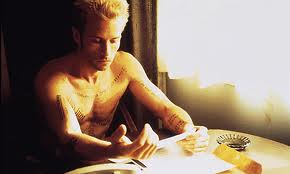 Memento is often cited by film theorists as a demonstration of the difference between plot and story. The distinction, put simply, is that the plot is a logical progression of events from A to B, while the story is what these events are ultimately about. In this case, the plot involves Leonard waking up in a motel, meeting various characters, and shooting Teddy. But it is the story of Memento, namely its exploration of memory and revenge, which is the thing which keeps us glued to the screen.
In approaching the subject of memory, Memento begins by making a distinction between factual and emotional memory. Leonard talks about learning by routine, relying on facts to determine his actions and tattooing them onto his body. Emotional memory, the memory of how an event or moment felt, takes a back seat to cold rationality. But as the film moves on it becomes clear that this distinction is at best ill-defined and at worst completely redundant. Leonard talks about memory being essentially impressionistic - the memory we have of an object or event is not an actual picture of it, but something we have created, changing anything from the colour of a car to the whole time and place when it happened. Even the photos on which Leonard relies are subject to manipulation and can be burned should his desires lead him to believe they are unessential. This, combined with the climactic twist and his recurring mention of 'instinct', raises the question of whether we really know or experience anything real.
 In terms of its character content, Memento could be called the acorn from which the mighty oak of Inception grew. Apart from their aesthetic similarities (both being expertly shot by Wally Pfister), both films have a central character whose actions are driven or dominated by the memories of his dead wife. Although Leonard's wife is a much gentler creature than Mal and has much less screen time, there is the same idea of creating new worlds from memories as a way of dealing with or attempting to escape reality (whatever that is). While Inception is more successful and adventurous in conveying this concept, all the groundwork for Cobb's dreamscapes is to be found in Leonard's decision-making.
 Memento is also further proof of the hardiness of film noir, showing just well how its techniques and archetypes have persisted and retained their relevance. Where previous neo-noir efforts like Blade Runner borrowed most from the genre's visual poetry, Nolan takes the convention of the unreliable narrator to its most extreme conclusion. Just as Deckard is increasingly unsure who may or may not be a replicant (or indeed, whether that really matters), so we find ourselves unravelling with the story until, in Teddy's words, "you can only remember the things you want to be true".
 This brings us on to the final scene in which the timelines merge and we are left utterly baffled by what we have seen. Teddy's line is the pivotal phrase in the film, capturing as it does both the film's message about memory and the motivations of the various characters. In Teddy's case, it is an indication of corruption, a desire to solve cases and create something certain even if the outcome isn't true: as he says, "there's plenty of 'John G's for us to find."
For Leonard, however, the line reveals something darker. Having believed all along that Leonard was in the right, we are faced with the possibility that our tragic hero may in fact be a monster. Either his version of events is true, in which case his wife was murdered and Teddy gets what he deserves - or Leonard killed her, and is now wandering the earth killing people to fit with his twisted version of events. Most chillingly, Nolan leaves it to us to choose, handling his material with more subtly than American Psycho and leaving us genuinely unnerved. Memento is a truly great film with a twist and subtle touch which makes The Usual Suspects look like total child's play. Its intense examination of memory, morality and revenge is counterpointed by slick visuals and great performances, including a career-best turn from the eternally underrated Guy Pearce. It isn't quite a masterpiece, being neither as multi-stranded as Inception nor as mesmerising as Mulholland Drive. But whichever version of events you choose to believe, its greatness cannot be disputed.
Rating: 
Verdict: Memorably marvellous
In over a century of cinema, we have seen a wide variety of artistic and technical innovations which have changed the shape (and size) of the silver screen, from the invention of Technicolour and recorded sound to the advent of widescreen and the steadicam. But in terms of the narrative and thematic conventions of the films themselves, several aspects have persisted long after technology has brought them into question. And one of the most persistent of these conventions is the ninety-minute running time.
Ninety minutes is a figure which crops up over and over again in the history of cinema. As silent cinema became a mass medium through the 1910s and 1920s, American distributors selected 90 minutes at the cut-off point for any film being shown in cinemas. If a film were any longer, they reasoned, people would either lose interest and leave, or be put off and not bother to pay in the first place. They stuck so rigidly to this idea that when Metropolis arrived States-side (having already been butchered by the German studios), it was run through projectors at one-and-a-half times the intended speed in certain cities. By the 1950s, trash maestro Roger Corman and his exploitation partners-in-crime were manufacturing 90-minute films for the drive-in and grindhouse circuits, films that were shown in cinemas of endless double bills, designed to do the rounds and then disappear forever.
Nowadays the average film on screen in a multiplex will last the best part of two hours, not including the mind-numbing 20 minutes of adverts and the patronising warnings about piracy. Many films still fall below this running time, and a great many, both arthouse and blockbuster, will beat it. But why does the figure of ninety minutes still hang like a rusty sword of Damacles over the world of filmaking? And what have we lost (or gained) by the now typical disregard for thisconvention?
I count four possible explanations. The first lies in the three-act structure of filmaking, which holds that all films play out (or at least should play out) in three acts: setup, conflict, and resolution. Take Back to the Future as an example - Marty McFly is a teenager living in 1985 (setup); he is transported back to 1955 and cannot return (conflict); he puts things right in the past and finds a way home (resolution). The French writer Yves Lavandier reasoned that in most dramatic works, half the content is taken up with conflict and both setup and resolution take a remaining quarter. We unconsciously expect a certain amount of time to be taken up with each act, and 90 minutes seems a reasonable average to aim for, giving enough scope for storytelling while retaining some form of restrictive discipline.
Regardless of whether Lavandier's maths were right, the three act structure has been called into dispute by a succession of writers and directors. In the last twenty years we have seen films which play with narrative and character identity to such an extent that a simple linear progression of setup-conflict-resolution simply doesn't cut the mustard. Take David Lynch's Mulholland Drive, one of the very best films of the last decade. There is an internal element of the three-act structure - Naomi Watts is an actress in Hollywood (setup); she has a fateful encounter with Rita who has lost her memory (conflict); they sort-of discover who she is (or do they?) (resolution). But this is not an adequate means of summing up an ingeniously complicated plot in which identities change rapidly and time jumps around. Later efforts like Eternal Sunshine of the Spotless Mind and The Prestige raise similar problems.
The second explanation lies in an argument about discipline. Corman famously quipped that no film should be longer than 90 minutes without special Papal dispensation - something which his errant pupil James Cameron swiftly ignored. We can all cite examples of films which are too long - Titanic, Out of Africa and of course Heaven's Gate - but it is extremely rare, if not unheard of, to criticise a film for being too short. If a film is long, it is often seen as indulgent, pretentious or desperately worthy - Mark Kermode once referred to The Deer Hunter (182 mins) as "a cinematic dick-measuring contest". Short films have an in-built modesty to them, a modesty which plays into the film's hands if its story or ideas are remarkably well-told.
This sounds convincing, but one should not simply assume that "short is good, long is bad", to paraphrase the sheep in Animal Farm. While many films are too long, some of the best ever made are well in excess of 90 minutes and most of them justify that length. Imagine trying to cut down Stanley Kubrick's Barry Lyndon to half its length; all the painterly quality which is essential to its success and its unique status would be lost. Both The Shawshank Redemption and The Green Mile thrive on being slow-burners, giving the necessary time for the drama and spiritual insight to emerge naturally, rather than being forced upon an audience. On the other hand, there are a great many short films that are terrible - look at the Troma stable, or its modern equivalent, Asylum Films. Or if you want something a bit more mainstream, I give you Disaster Movie and its associates.
A third explanation as to the value of 90 minutes comes down, rather cynically, to money. Making short films is quick and cheap - it takes less time to write the script, the production costs are lower, and you don't have to spend months locked in an editing suite trying to piece together different scenes from miles of exposed film (or gigabytes of digital footage). In the days of grindhouse and drive-ins, keeping the films short was the only way in which the individual outlets could make money; the double bills had to run to 3 hours, and had to be changed over rapidly in time for the next lot of paying punters to get their few bucks' worth. Working off a low budget focusses screenwriters and filmakers, getting them to say the most they can in the most concise possible way.
That all seems fine, and there are many examples of great low-budget filmaking still going on in Europe, America and elsewhere, from the latest Ryan Reynolds thriller Buried to horror efforts like [REC] and Paranormal Activity. But most of the films which gain wide release are multi-million dollar blockbusters, with budgets of typically more than $100m and a running time of well over 90 minutes. If the 90 minute rule was so reliable, why has it become the trend to make movies by throwing huge amounts of money at them and to hell with the length? The role of producers has changed as well - instead of standing over directors with a big stick asking them to cut it down, the likes of Joel Silver and Jerry Bruckheimer are more concerned nowadays with demographic targeting, demanding that directors deliver a product that will sell regardless of its eventual length.
The fourth and final explanation is probably the most unfair to us punters - limited attention span. Forget all the articles about ADHD or people talking on phones in the cinema - people, or at least certain kinds of people, are very impatient and can very quickly get bored. Although this may seem like a modern phenomenon, it's one thing that hasn't changed from the silent era. We will still fall asleep in films or walk out of them if they go on too long to sustain our attention, and if a film is deliberately billed as a certain length, we probably won't go. Ninety minutes in this context is a happy medium between being bored out of your skull and not getting your money's worth.
But again, here's a problem. If most people won't pay to sit through films which are more than 90 minutes long, how does one explain the huge box office takings for Avatar (162 mins) or the Star Wars prequels (136 mins, 142 mins and 140 mins respectively)? The answer is not a matter of length, and certainly not one of depth. It is a matter of hype; these are event movies, films which exist to be seen at a certain time to separate the in-crowd from the out-crowd. They are films to be watched as an experience, as an "I was there" moment - e.g. "I was there when everyone realised that The Phantom Menace was one of the worst films ever made!" As for keeping their attention, most mega-length, mega-budget movies are packed with action spectacle and technically outstanding set-pieces, designed to keep 14-year-old boys happy and oblivious to their very thin (or non-existent) plot.
In short, there is no one reason why 90 minutes is (or at least was) a touchstone in filmaking. Each explanation has its flaws, and they don't form a coherent thesis when meshed together. But looking around at the erratic quality of filmaking we see today, from Hollywood and elsewhere, maybe certain elements of this rule could be reintroduced and lead to artistic and commercial reinvention further down the line.


