
Reflections
-
It is weird to read my correspondences from the late August/early September
period, being the time of transition between my old function in life to my
new ...
14 years ago
Kind Hearts and Coronets (UK, 1949)
Directed by Robert Hamer
Starring Dennis Price, Alec Guinness, Valerie Hobson, Joan Greenwood
Since the brand was revived several years ago, Ealing Studios have developed a reputation for quaintness. With the exception of John Landis' underrated Burke and Hare, the majority of the new Ealing's output has been frothy, often retrograde films designed solely for the export market. How easily we forget that the self-same studio once produced some of the darkest, edgiest and blackest comedies the world had ever seen. And there is no better example of this than Kind Hearts and Coronets, which takes pride of place with The Red Shoes as one of the finest British films of the 1940s. Describing any old film as 'edgy' comes with problems. Changes in social attitudes since the 1940s means that, on one level, filmmakers are now able to show a wider range of subjects to a greater extent than ever before. Under this line of argument, what was once considered edgy, radical or insightful now looks timid and tame. But even if we accept this as a general rule, Kind Hearts and Coronets still stands as a proud and intriguing exception. Like Peeping Tom eleven years later, it has retained its emotional impact even after its aesthetic achievements have been surpassed.
 Kind Hearts and Coronets is a comedy about a serial killer, at a time when the vast majority of films involving murder sought to completely demonise the assailant in question. More than that, it is about a serial killer who vengefully targets the aristocracy, who while waning in power still held a great deal of influence in government and high society. The film is a vitriolic attack on the British class system, thinly disguised as an erudite comedy of manners. To paraphrase Macbeth, it may look like the innocent flower, but it is most definitely the serpent under it, and its venom is ruthless and bitter.
 In a further comparison to Peeping Tom, the film had a rocky ride with the censors when first released. Sir Michael Balcon, then-head of Ealing, sought to distance himself from the film, believing that the public could not handle its ironic treatment of the subject matter. In line with the restrictive Hays Code, the American distributors requested that Robert Hamer added a ten-second epilogue, to show Louis Mazzini getting his comeuppance in a way while the original ending only implied. While Alec Guinness went on to win an Oscar for The Bridge on the River Kwai, neither Dennis Price nor Robert Hamer would ever reach this level of success again. Film critic David Thompson described the latter's fortunes as "the most serious miscarriage of talent in post-war British cinema".
 Many of the classic Ealing comedies used present events to satirise the past and vice versa. Passport to Pimlico satirised both the Berlin airlift and the exile of the Dutch monarchy to Canada, while some commentators have argued that The Ladykillers is a send-up of the post-war Labour government. Kind Hearts and Coronets was made in the year of the Second Parliament Act, which further curbed the power of the House of Lords and with it the aristocracy. The real-life political attack on landed wealth is contrasted with the lethal attacks of Louis Mazzini, with the aristocracy being 'killed off' in both cases.
 Kind Hearts and Coronets has a very poisonous view of the British class system, and in particular of the aristocracy's attempts to justify its position. While marrying out of love may have brought Mazzini's mother poverty, marrying for wealth and "good breeding stock" brings nothing but misery. Whatever diversions the D'Ascoynes may pursue (the navy, photography, the church, hunting) there are a universally inward-looking bunch, with little time for anyone whose interests or backgrounds are not identical to their own.
 Although Mazzini is of noble blood, his training as a draper, shop assistant and bank clerk gives him a middle-class status, something which simultaneously repulses and pleases him because it serves as the perfect cover for his crimes. The closer he comes to his goal of becoming Duke of Chalfont, the more he takes on the characteristics of a D'Ascoyne, shunning his childhood sweetheart Sibella (Joan Greenwood) and refusing to help Lionel in his hour of need. The film brutally depicts the entrenched arrogance of the British elites, something which has persisted longer after the D'Ascoynes of this world have withered away.
 Dennis Price, who had previously found fame in Powell and Pressburger's A Canterbury Tale, is absolutely extraordinary in the lead role. Having been aptly described as "sourly handsome", he presents Louis Mazzini as a man of immense class and sophistication, but who is also capable of being cold, dismissive, callous and sociopathic. Price was always self-deprecating about his acting abilities, describing himself as "second-rate" and "lacking the essential spark." But whatever else happened in his career, this performance is enough to dismiss all such deprecation.
 What makes his performance so interesting is that, for a lot of the time, Price doesn't speak. The prolific use of voiceover gives his performance a silent movie quality - not because his movements are exaggerated, but because his facial expressions and posture play a bigger part in his characterisation. Normally this amount of voiceover could quickly become tedious, but here it works brilliantly, taking us behind Mazzini's mask of dignity. It makes his deadpan expression all the more funny, as the most unspeakable things are uttered without the merest twitch of his lips. It is as though we were inside the mind of a killer, hearing his darkest deeds completely uncensored and without any license on the part of the screenwriter.
 Kind Hearts and Coronets' themes of love and class are also expressed in Mazzini's relationships with women. For most of the film he is taken with Sibella, who marries Lionel but confides in Louis due to their friendship as children, and increasingly out of desperation as just how boring her husband is. Louis strings Sibella along, playing with her heart strings and being glad to kiss her while knowing he can never bring himself to be with her. This is a further example of Louis' corruption as he grows closer to his goal, becoming as cold and as haughty as the people who caused him to swear revenge.
 If Sibella is the proud plaything who is ultimately beneath his stature, Edith (Valerie Hobson) provides the security of wealth and the moral backbone Louis needs. Their initial meeting, while her husband is still alive, indicates that such a marriage would not be any fun: her strong religious conviction forbids drinking, leading her husband to keep gin and whisky in his dark room. Much of the film plays out like a bedroom farce as Louis tries to keep the two women from ever meeting. In the final scene, he has to choose between dull security and loving disgrace, quoting from The Beggar's Opera as he struggles to make up his mind.
 The humour in Kind Hearts and Coronets is as black as can be, with multiple jokes about hanging and all the murders having a comedic quality. These range from the general being blown up as he opens the caviar, to the admiral mistaking port for starboard and sinking his ship, and finally Mazzini's employer dying of shock after inheriting the title. There are dozens of laugh-out-loud moments, such as Mazzini's comments after shooting down Lady Agatha D'Ascoyne: "I shot an arrow through the air; she fell to earth in Berkeley Square." But a lot of the time the film is so edgy and so forthright that you're almost afraid to laugh: the barb is so strong that to laugh is almost too easy a response.
 The film is most popularly remembered for Alec Guinness, who plays all eight members of the D'Ascoyne family. He was originally only offered four roles, but pressed Hamer to cast him in all eight after reading the script. Suffice to say, he's magnificent, with each family member having clearly developed character traits and quirks, and each looking hilariously pompous in all that make-up. The split-screen shooting used to put all eight characters on screen is utterly seamless, and Hamer's direction is totally first-rate.
 Kind Hearts and Coronets is a perfect black comedy, which is as funny as Monty Python and the Holy Grail and as artistically accomplished as the best work of Powell and Pressburger. The performances are all superb, particularly from Guinness and Price, and Robert Hamer's direction gives the film a note-perfect pace so that all the jokes hit the spot. Over 60 years since it took the world by storm, it remains the darkest, edgiest and funniest of the classic Ealing comedies, and will be reducing generations to fits of laughter for years to come.
Rating:
Verdict: A perfect black comedy
Apocalypse Now (USA, 1979)
Directed by Francis Ford Coppola
Starring Martin Sheen, Marlon Brando, Robert Duvall, Dennis Hopper
When it comes to reviewing films, there are two kinds of masterpieces. One is the film in which every single scene is immaculately perfect, and your emotional involvement supports and compliments this perfection. The other, more contentious kind is a film which on paper is riddled with faults, but the experience of watching it is so intoxicating that all such faults can be forgiven or forgotten. With war films, the first camp is defined by Full Metal Jacket and the second by Apocalypse Now. Where Stanley Kubrick's film is meticulously constructed and judged to clinical precision, Francis Ford Coppola's is simultaneously a bloated, meandering mess and one of the greatest films of all time. Full Metal Jacket is the more accessible and perhaps more rewarding, but on the big screen Apocalypse Now is nothing short of knockout, as all the elements of Coppola's epic collide in a full-on and frightening story of darkness, madness and war.
 As with so many great films, the production history of Apocalypse Now leads us to believe that things should have turned out very differently. John Milius, who had written much of Clint Eastwood's dialogue in Dirty Harry, drafted a loose adaptation of Joseph Conrad's Heart of Darkness by the middle of 1969. Originally titled The Psychedelic Soldier, George Lucas was set to direct before being hired to helm American Graffiti. In 1974 the project came to Coppola, who had just seen both The Conversation and The Godfather Part II nominated for the Best Picture Oscar.
Shooting for the re-titled Apocalypse Now began in March 1976 and was scheduled to last for five months. Soon after shooting began, Harvey Keitel was replaced by Martin Sheen and in May the entire set was destroyed by Typhoon Olga. When filming resumed a month later, Marlon Brando turned up heavily overweight and completely bald; Coppola compensated by dressing him in black, shooting him in shadow and using a body double in the wide shots. While shooting the ending in 1977, Sheen suffered a heart attack and had to walk a quarter of mile to get medical attention. By the time Coppola finished editing the film for release in August 1979, Apocalypse Now was two years late and three times over budget. If you attempted to write down all the things that are wrong with Apocalypse Now, it wouldn't take you long to get quite a big list. For a start, the film is too long - or at least, it feels too long. The story of Captain Willard travelling up the Nung River unfolds at a very leisurely pace, with every section of the river having some major significance in terms of plot or mood. There is no montage or time-lapse footage of the boat rapidly reaching the Cambodian border, and the longer it goes on the less sure you feel that Coppola actually knew where the story was going.
 There is a very fine line in screenwriting between poetic and ponderous, and Apocalypse Now crawls along this line like the snail on the edge of a straight razor. The actual scenes of Brando reading poetry in the temple are dull; the fact that we can't always make out what he's saying annoys us at first, but after a few lines we couldn't care less. By the time you have reached the temple, you are more or less certain that there will be some kind of brutal final confrontation between Willard and Kurtz, so that even as you sit there soaking up T. S. Eliot, you wish that things would get a move on.
 Then there is the problem of characters. Martin Sheen is absolutely terrific as Captain Willard, and in spite of his incoherence Marlon Brando manages to match him in the last truly good performance of his career. But as is the way with epics, a lot of the supporting cast don't get even half the screen time they deserve. When you've got a film featuring Harrison Ford, Robert Duvall and Dennis Hopper, you expect them to be on screen a lot. But only Duvall gets the screen time and the character depth he needs, with the other two becoming largely superfluous.
 Finally, there are aspects of Apocalypse Now which reek of the indulgence present in New Hollywood and 1970s filmmaking in general. This is typified by Coppola's self-referential cameo as the director of a war documentary; Sheen walks into his shot at the river mouth, and he shouts: "Don't look at the camera! Keep on fighting!". If Coppola was making a point about the psychological role of a director, it's handled a lot more clumsily and self-importantly than Peeping Tom. Add in the sequence of a live cow actually being butchered and you have more than enough reason to dismiss this film.
 So far, Apocalypse Now would seem like the Vietnam equivalent of Gone With the Wind: commendable for its scale and ambition, but over-long with too many characters and several questionable scenes. And yet, for all the truth in what I have said, none of it really matters. For Apocalypse Now is not a film to be dissected but to be experienced; it will burn its way into your synapses in a mixture of horror and wonder. Watching it is less like making a Swiss watch than walking into a cloud of hallucinogenic vapours. If you refuse to go with it, you won't get it, but if you do, it'll be one hell of a trip.
 Instead of recreating the experience of Vietnam with a deliberate and calculated sense of hindsight, Apocalypse Now seeks to put the audience in the same place as the soldiers so they can decide how war felt and why men behaved the way they did. Because the script was written during the war, there is no attempt made by Coppola to lecture the audience one way or the other. There are no easy answers to the questions of right and wrong, and the film's slow, meandering tone is vital for us to soak up as much information as we can. Whatever our conclusions, we feel like we've been through hell with these characters, and been changed irrevocably by the horrors of war.
 So much of Apocalypse Now is about the chaos of war, and so it's appropriate (at least to some extent) that the film should feel out of control. The relaxed discussions at the beginning, in which Willard's mission is laid out, give us some kind of grounding so that we know where he will end up. But the film is populated by profound and moving insights into the inherent anarchy and absurdity of war. These range from Robert Duvall's insistence on surfing at the beach to the post near the Cambodian border where the troops are fighting without a commanding officer. These scenes produce reactions ranging from laughter to sadness to genuine fright, and often all three at once.
 Apocalypse Now keeps adding more and more literary aspects to its central story, like someone throwing books into a library that had just been set on fire. The final showdown between Willard and Kurtz is an inventive restaging of The Golden Bough, in which the murderer kills the mad king and becomes king himself. Much of Martin Sheen's dialogue is culled from Michael Herr's Dispatches, which would later be used by Kubrick on Full Metal Jacket. And Kurtz takes on aspects of both Eliot's 'The Hollow Men' and Genghis Khan, whom Coppola studied while the sets were rebuilt.
At the heart of Apocalypse Now is the darkness at the heart of all mankind, and the ability of such darkness to consume all that is good and just and sane if fully unleashed. Kurtz has tipped over into this darkness by his experiences in Vietnam. The war has caused him to see the futility and the nonsense in his orders, and he now lives out his days as a hollow man who has understood evil at the cost of losing his soul. Willard kills Kurtz to fulfil his mission, but the very act of obedience threatens to tip him over into the same darkness. Although he manages to resist, he leaves Kurtz's kingdom as a shell of a man, his life shattered by knowledge of that same evil. Apocalypse Now is a truly extraordinary piece of work which is fully deserving of its masterpiece status. In spite of its myriad flaws, it retains an indescribable aura which leaves us shrinking into our seats, mesmerised and paralysed with fear and wonder. It's a film which damaged both Coppola as a filmmaker and the New Hollywood movement, whose reputation for indulgence had finally caught up with them. But at the dawn of the blockbuster age, it is a fantastic last hurrah and remains one of the most extraordinary experiences in American cinema.
Rating:
Verdict: New Hollywood's last hurrah
Peeping Tom (UK, 1960)
Directed by Michael Powell
Starring Carl Boehm, Moira Shearer, Anna Massey, Maxine Audley
When looking back on his long career in an interview with The Onion, Robert Altman said that "you tend to love your least successful children the most", saying that he felt more affection for Popeye than for anything critics and audiences embraced, such as Short Cuts or Nashville. One wonders whether Michael Powell would have taken the same view of Peeping Tom, the film which all but destroyed him as a filmmaker. But unlike Popeye, which produces reactions ranging from 'utter rubbish' to 'guilty pleasure', there can be no doubt that Peeping Tom is a blistering masterpiece. You will struggle to find a more audacious, bold, striking and shocking piece of British cinema, at least until the rulebook was re-written by A Clockwork Orange. Coming at the beginning of a decade which would be defined by rebellion against any and every convention, Peeping Tom blazed the trail, stepping into the darkness with a red-hot torch at the cost of setting its own coat-tails on fire.
 Considering that Peeping Tom and Psycho were released within months of each other, you would expect audiences to have flocked to both releases, and for both to become regarded by critics as among the best works of 1960. Aside from their similarities in terms of story and characters, there was very little to separate the prestige of Alfred Hitchcock from that of Michael Powell. While the former was more recognisable in public and was in his commercial prime, the latter had captured audience imaginations during the war years through his work with Emeric Pressburger.
 Sadly for Powell, who was a close friend of Hitchcock's, joint adulation was not to be. While Psycho enjoyed huge box-office success and garnered four Oscar nominations, Peeping Tom was greeted with outright hatred in the British press and quickly disappeared from screens. For the next twenty years the film was seen as an untouchable bête noire, a half-whispered rumour of a once-great man gone mad. It was not until 1979, when Martin Scorsese was asked to remake it, that Peeping Tom began its long rise from the critical sewers to take its place among the all-time greats.
 It would be tempting to blame Peeping Tom's demise on the perceived small-mindedness of 1960s audiences, something seemingly reinforced by the ridiculous reviews which branded it as "evil", "vulgar" and "repellent". But watching the film even 50 years later, you can understand why even the most open-minded people in any age would be shocked by it. On this occasion it is not so much a case of finger-pointing at audiences, as applauding the dangerous (and self-deprecating) vision of a director.
Peeping Tom was made at a time when cinema was still very much focussed around the life and trials of the rich and famous: a time when films were star vehicles with often shamefully predictable plots, consisting of little more than talking, smoking, dancing and kissing (though not always in that order). When Hollywood attempted to tackle difficult subjects, or to interpose itself among the less fortunate, it did so in a way which was often deeply patronising (in the case of My Fair Lady) or which smoothed over any rough edges in a way which made the finished product seem dishonest. The problem wasn't simply that the subject of Peeping Tom was a million miles from the ballet of The Red Shoes or the pilots of A Matter of Life and Death. It was more the way in which prostitutes, sleazy models and above all a serial killer were presented in a way which was not only realistic, but empathetic. The film eschews melodramatic convention, contrasting the showy, frothy acting of the film star (played by Shirley Anne Field) with the considered, naturalistic and more believable performance of Carl Boehm. Proof of this is to be found in the murder of Moira Shearer's character; Powell allows her to perform a flamboyant dance routine, as happens in The Red Shoes, before her dancing days are cut short with a tripod leg and a piercing scream.
 As Scorsese observed, Peeping Tom is like the darker, shiftier cousin of 8 1/2. Both are self-reflexive films about filmmaking and the role of the director, and both feature said director coming in front of the camera (Powell appears in the black-and-white sections as Mark's manipulative father). For Federico Fellini, cinema was inherently a force for good, a place of magic in which the director was a creative genius with noble intentions. But for Powell, in an act of brutal self-deprecation, cinema was a dangerous weapon in the hands of an insane voyeur, who would exploit, manipulate and even kill, just to get the perfect shot.
 In complete contrast to the fairy tale quality of his earlier work, there is very little in Peeping Tom in the way of childlike magic. Film is presented as a medium characterised by darkness and strange noises; Mark's dark room is like a haunted house or Frankenstein's lab, only instead of slamming doors and creaking floorboards, we have the flicking of metal switches and the drip-drip-drip of silver nitrate. Camera and projector hum and whirr like some sinister insect, waiting for the right moment to pounce and claim its victim.
 Having likened filmmaking to murder, Powell then turns the camera on us to show that we are as much a part of this as the director. The film is a breath-taking examination of voyeurism, arguing that the very act of watching a film is voyeuristic. When we pay good money to sit in the dark for two hours, we are devoting our time to watching others who are oblivious to our presence and have no means of defence. We see their lives play out in such detail that we become unwittingly obsessed by them; our psychological relationship is of the same morbid fascination which prompts Mark to make his documentary.
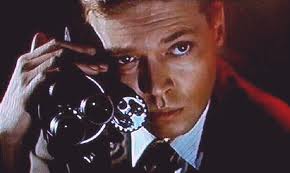 As with Blue Velvet more than twenty years later, this revelation of our role in Peeping Tom produces a reaction combining repulsion and mesmerism; we are shocked, or offended, we cannot look away. But rather than shock us cheaply by showing the murders in graphic detail, Powell leaves the real terror of what is occurring entirely in our minds. Towards the end of the film, Anna Massey discovers the footage of Mark's victims; she watches, being frightened and repulsed - but she keeps watching. The camera tracks her reactions in a long panning shot, which tell us all we need to know about what is happening.
 But even taken outside of all its commentary, Peeping Tom is still terrifying as a pure, full-on horror movie. Carl Boehm's performance is extraordinary, helping to create an immensely compelling character who feels more three-dimensional than Norman Bates. The psychological trauma which Mark suffers could be lazy shorthand, but instead he comes across as a lonely, fractured young man who struggles with himself, something reinforced by the distant, broken quality of his slight Austrian accent.
 The film explores the relationship between love and fear, with Mark wavering between the two as he is caught between the need to complete his documentary and the affections bestowed on him by Helen. We feel so close to Mark that when his doom approaches, we are willing to ignore or forgive his gruesome actions if it would save or redeem him. This is the final savage trick of Peeping Tom which reinforces our position as voyeurs; not only are we drawn to gaze, we impose emotion on people's actions so that even the truly terrifying can seem tragic.
 Peeping Tom is a barnstorming masterpiece which ranks alongside The Red Shoes as Powell's finest achievement. Its psychological complexity and cerebral treatment of its themes are perfectly complimented by Powell's direction, and the whole project is enhanced by Otto Heller's luridly beautiful visuals. It is still as fresh, shocking and truly terrifying as it was over 50 years ago, and in its level of emotional engagement - say it quietly - it's a better film than Psycho. In short, it is compelling, chilling and nothing less than essential viewing.
Rating:
Verdict: A dark, creepy, chilling masterpiece


