
Reflections
-
It is weird to read my correspondences from the late August/early September
period, being the time of transition between my old function in life to my
new ...
14 years ago
This is a reprint of my review which was first published on Rotten Tomatoes about 2 years ago. It appears here to mirror a series of reviews I had done for RT entitled 'From Burton to Nolan'.
The Dark Knight (USA, 2008)
Directed by Christopher Nolan
Starring Christian Bale, Heath Ledger, Gary Oldman, Aaron Eckhart
The word 'masterpiece' is batted around far too often these days, and with The Dark Knight it's sadly inappropriate. Most of what makes Christopher Nolan a great modern filmmaker is up there on screen, and you cannot fault it for being a blockbuster which is attempting to address such relevant and complicated ideas. But while it is a general success, it is not as disciplined or focussed as Batman Begins and does not reward repeat viewing like The Prestige. It deserves to be celebrated and admired for its intelligence, but one must inevitably acknowledge that it isn't flawless. Having barely put a foot wrong in his previous films, The Dark Knight is the first glimpse of Christopher Nolan ever so slightly losing control. Like Batman Begins the film is a little too long, but it also feels slightly bloated, with much of the dialogue being rushed or mumbled in order to cram in all the ideas. It's almost as though there was enough plot and themes in here for two films, but rather than shoot back-to-back sequels, like The Matrix, Nolan decided to compress them down into one. Considering how mediocre The Matrix sequels were, this was not in itself a bad idea, but we still have to live with the fact that there are too many stories going on.
 Moreover, the film is edited and structured in a peculiar way. Where Batman Begins progressed in a defined direction, The Dark Knight feels more like a series of philosophical vignettes rather than something more progressive and incremental. The set-pieces are undeniably brilliant, but with the exception of the final sequence with the ships, you could put these set-pieces in almost any order and the film would feel the same. It's not terrible because of it, but it does mean that there is less cumulative tension than there could have been.
 This feeling of disorder is bolstered by the increased spectacle. Of course, being a blockbuster we don't expect things to be quiet, but there is a feeling watching all the explosions of Nolan pandering to the popcorn crowd just a little too much. In Batman Begins there were two hours of substance and character development, followed by 20 minutes of explosions to make up the trailer. In The Dark Knight, with its themes of escalation and chaos, it seems right that there should be more carnage, up to a point. But the carnage Nolan puts on screen eventually becomes repetitive, and his decision to film some of it in IMAX adds to the impression that he is overcompensating.
 These criticisms make it seem that Nolan's film is a failure, and when compared to the rest of his output, it is disappointing. But it remains head and shoulders above your average superhero blockbuster. The discipline of the first film has been compromised, but the film retains a desire to explore characters rather than just blow everything up. If nothing else, you have to admire Nolan for being able to take such an ideas-heavy film and sell it to such a wide audience.
 Thematically, this picks up the reins of the first film, dealing with the idea of understanding one's enemy as the means to defeating them. The difference is that the Joker is not a Nietzschean figure like Ra's al Ghul, someone who becomes evil by believing so strongly that he is doing good. In fighting him Batman still risks becoming like his enemies, but this lack of morality means that the cost to him will be greater. Killing the Joker seems necessary, but it would destroy Batman's moral code and undermine the belief that good can overcome evil in a non-Nietzschean way.
 The film is quite nihilistic in suggesting that even at its weakest, evil can triumph over good. The Joker's fate at the end remains uncertain, but the revelations surrounding Harvey Dent give a sense of him winning even though his direct influence is curtailed. The Joker's evil is allegorical to terrorism, in that his influence is fragmented and disparate. He does not take power by marching in with an army; he infiltrates, twisting, turning and double-crossing. Dent and Batman are the dove and the hawk trying to uphold rules in the face of chaos, and both are essentially destroyed in the process.
 The thing which marks out The Dark Knight from Nolan's previous work is that it is relatively conventional in its storytelling. It's ridiculous to call it 'dumbing down', but there is none of the jumping back and forth in time which made The Prestige so gripping. The themes are presented in a much more upfront way, both in the dialogue and the precise mechanics of the moral dilemmas. You could almost accuse Nolan of ramming ideas down the audience's throats, but thankfully the script and the characters are good enough to prevent this.
 The film has similar character development to Batman Returns, which was criticised for sidelining Batman in favour of the svillains. But that's always been the point. Since Batman is a superhero who uses cunning rather than powers, there has to be a section of the film in which he is the underdog; if nothing else it makes his eventual triumph more powerful and palatable. What makes The Dark Knight clever is that it does all this while withholding the Joker for a long time. Apart from the opening bank raid, the first act largely concerns itself with Lau and the Mob.
 As with all Nolan films, the performances are really great. Heath Ledger was generally a lightweight, but as the Joker he manages to channel Malcolm McDowell and make him truly terrifying. It's easily his best performance, although like the film it has become a victim of its own hype. Like the Scream killer, it has been so widely parodied that it isn't quite as scary anymore. Christian Bale remains convincing, and as before it is right that he should be a little sidelined so that the great evil is acknowledged.
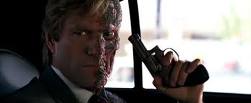 Michael Caine and Morgan Freeman are both warm and affable, and the script does allow for more humour this time round - for instance, when Rachel Dawes and Batman land on the car, she turns to him and says, "Let's not do that again". Interestingly enough, the film glosses over the most interesting character development: the individuals closest to Bruce Wayne finding out his identity. This was explored in Batman Returns in some detail, but here there are several conversations between Bruce and Rachel in which she knows he is Batman, which somewhat undercuts the drama.
 The Dark Knight contains many promising performances, along with stunning visuals from Wally Pfister who gives Gotham a grungy and decaying edge. In the end it struggles to completely control all the rogue elements, but at least Nolan doesn't fall into the same trap as Sam Raimi on Spiderman 3, namely throwing everything at the screen in the hope that some of it will work. If Batman Begins was Nolan's equivalent of Alien, then this is his Aliens: more action-packed and slightly less compelling, but still weighty, intelligent and interesting. One only hopes that Inception will not be his Alien 3.
Rating: 
Verdict: Bloated but containing brilliance
Eraserhead (USA, 1977)
Directed by David Lynch
Starring Jack Nance, Charlotte Stewart, Judith Anne Roberts, Laurel Near
Just it's hard to imagine cinema without Steven Spielberg or Stanley Kubrick, so a world without David Lynch seems as absurd and as nightmarish as one of his films. The man who is arguably America's greatest living filmmaker has so completely re-written the rulebook for surrealist filmmaking, that even non-fans like Roger Ebert would admit that the world would be a duller place without him. If you want proof of this sea-change which Lynch has caused in cinema, you need look no further than his debut feature Eraserhead, a dark and fascinating fable about marriage, heaven and industry which set the midnight movie circuit alight in the late-1970s. Marrying Alan Splet's masterful sound design to a series of horrifically beautiful and strange images, Lynch creates a viewing experience which is nothing short of mesmerising.
 Part of the mystique of Eraserhead lies in the fact that relatively little is known about it even after 34 years. Lynch is famous for refusing to reveal what his films mean, but the production history is as mysterious as the finished product. There are no making-of documentaries, and even Lynch's own interviews focus on the pre-production rather than the actual filming.
Eraserhead was filmed intermittently over six years beginning in 1970, when Lynch received a grant from the American Film Institute to film a 21-page script about adultery. What began as a long short morphed over these six years into a four-hour rough cut which Lynch subsequently pared down to 90 minutes. During this time Lynch experienced a spiritual epiphany, beginning his involvement in transcendental meditation which he continues to this day. Lynch's photography, both past and present, has often revolved around disused factories or industrial landscapes which have fallen into disrepair. Eraserhead mirrors this fascination, depicting a vision of post-industrial society which makes the workers' city in Metropolis look like the Costa del Sol. Every building seems to be either a relic of a bygone age or coming apart at the seams; where there are plants or trees, they are black and completely bare. Alan Splet's amazing soundtrack howls and wails, as if the Earth itself were groaning under the weight of Man's work, from all His once-great achievements now rendered obsolete by age and progress.
 By creating such a dark and desolate landscape, Lynch makes us feel isolated and alien to our surroundings: we are the living and the breathing in a world comprised entirely of death and decay. This feeling of alienation and malaise spills over into the characters, with Henry's father-in-law remarking that the whole world has become a "hell-hole". Their conversations are filled with the awkward silences that would become characteristic of Lynch's work, while the black-and-white visuals give the impression that this world is slipping into the next, like the characters in Samuel Beckett's Endgame who are patiently waiting for death.
 Like Alien two year later, Eraserhead's central story revolves around the male fear of pregnancy and the Freudian connotations of offspring. Some commentators have speculated that the entire film is an allegory for Lynch's anxiety about the birth of his daughter Jennifer - none moreso, incidentally, than Jennifer Lynch herself. Regardless of whether that is true or to what extent, this theme is writ large throughout Eraserhead, and manifests itself in a number of sinister ways.
 When Henry first discovers that he is a father, he reacts not with delight but with fear - fear not of the parents' reaction, or for his girlfriend, but of what monster he may have created. The film begins with the spectral apparition of a child emanating from Jack Nance's mouth, as if this creature was spawned from the darkest depths of his unconscious. The baby is the id to Henry's ego, its bizarre and impossible constructions being at odds with his straightforward demeanour and limited range of expression. Along these lines, Henry's attack on the child is the ego (or super-ego) defeating the animalistic id, albeit with serious and unforeseen consequences.
 Over the course of the film both Henry and his girlfriend are tormented by their child. It lies screaming incessantly at night, to the point where the girlfriend packs her things and goes home, leaving the baby entirely in his care. From then on the baby becomes more menacing and vindictive towards Henry: first it screams to prevent him leaving the flat, and then it laughs at him when it seems the girl who lives across the hall no longer cares for him.
 With this development Eraserhead becomes a film not just about fear but about responsibility, in which the child is the physicalisation of Henry's conscience. Although Henry is hardly the philandering type, he does entertain fantasies of other women, where the brunette across the hall or the strange blonde who lives in the radiator. There are almost hints of Pinocchio in the father-son relationship, with the almost unreal baby keeping the real-life father on the straight and narrow. But unlike Pinocchio, there is no friendship between them, and ultimately the puppet permanently rebels against his conscience.
 In his 2006 book Catching the Big Fish, Lynch called Eraserhead his "most spiritual movie", and claimed that the whole project came together after he read a certain (unnamed) part of The Bible. There are huge Biblical overtones in Eraserhead, and most of them are from the more unpleasant parts of the Old Testament. Not only does the baby represent the sins of the father being visited on the sons (Exodus 34:7), but the man in the moon moving all the levers could be God setting all of this in motion.
 Alternatively, the man in the moon and the woman in the radiator may have nothing to do with God at all. They might be projections of Henry's subconscious, being respectively a scapegoat and a possible source of redemption. The man resembles the baby in all his rashes and peculiar spots, hinting at the concept of Man creating a jealous, negative God as a projection of his own cold heart.
 When the lady is dancing, she tramples on copies of the apparitions from the beginning, suggesting to Henry that he must overcome this evil to gain both her love and his salvation. The final scene, where she embraces Henry and the screen fades to white, could indicate that he has gone to heaven - where, as the song says, everything is fine. There are clear through-lines to Mulholland Drive in her resemblance to Marilyn Monroe (whom Betty/ Diane also resembles) and in the use of a theatrical performance within the world of a film.
 All of these interpretations are valid, and there is nothing in the content of Eraserhead which can be explained for certain. What is for certain is the terrifying nature of the special effects used to bring this baby to life. Various rumours surround this unique special effect, the most common being that it is a pickled calf foetus, animated from within. Whatever it is, its twisted shape and harrowing cries burn deep into our subconscious and genuinely freak us out. We jump when we see it break out in spots, and its death throes are nothing short of nerve-shredding.
 Eraserhead is a dark and twisted masterpiece which remains one of the most extraordinary debut features in all of cinema. Lynch's direction is immaculate, creating a unique cinematic vision which is not only frightening but deeply visceral and dripping with substances. It is a high point of surrealist cinema that would have made Salvador Dali proud, and may even be the best such work since Un Chien Andalou. In any case, it is essential viewing for everyone with even an iota of interest in film.
Rating: 
Verdict: Lynch's first of many masterpieces
Ghosts of Mars (USA, 2001)
Directed by John Carpenter
Starring Natasha Henstridge, Ice Cube, Jason Statham, Pam Grier
The 1990s were a bad time for John Carpenter. Having returned to form with They Live, the man who was once the king of low-budget horror served up a series of disappointments, from the Near Dark rip-off Vampires to the witless Escape from L.A.. But none of these misfires incite such fury and frustration as Ghosts of Mars, one of the lousiest, stupidest and worst thought-out movies outside Michael Bay's back catalogue. For starters, Ghosts of Mars looks really, really cheap. At a budget of $28m, it was among Carpenter's more expensive efforts, and yet it looks for all the world like it was made for less than a tenth of that. The film was shot in a gypsum mine in New Mexico, with all the rocks being painted red to make it vaguely resemble a Martian settlement. Every scene bar one is shot at night, in a move designed to disguise this low-tech approach but which only serves to emphasise it. The film's aesthetic is worryingly similar to Vampirella, a little-known 1990s turkey starring Roger Daltrey as a renegade vampire who lays low on Earth by posing as a rock star.
 The story of Ghosts of Mars finds Carpenter shamelessly ripping off his back catalogue. The idea of prisoners and cops constantly changing sides and teaming up to fight a greater foe is taken from Assault from Precinct 13, but with all the intelligence and social commentary taken out. The idea of ancient ghosts being bent on revenge is from The Fog, and the manner in which people become possessed by these ghosts is like a cross between The Thing and Prince of Darkness.
Ghosts of Mars also rips off at least a dozen other films, borrowing their respective styles at the expense of their collected substance. Being an action movie set on Mars with horror overtones and lots of violence, there is a natural comparison with Total Recall. But whereas Paul Verhoeven was able to use flesh-ripping violence to draw an audience into the story, Carpenter borrows the full-on gore and doesn't use it for anything other than shock value. The designs of the Martian base are not original either. With the angular sandy buildings and metal doors with circles in the middle, they look exactly like Tatooine at night. It's almost as though George Lucas met Carpenter for lunch, agreed to lend him the sets and had them shipped to New Mexico. There are other Star Wars knock-offs too: the sequence of the soldiers breaking into the power station is unforgivably close to Return of the Jedi, where the rebels break into the shield generator on Endor. Add in some grimy interiors from the Alien series and possessed miners who are somewhere between Braveheart and Mad Max, and you have one desperately derivative movie.
 The problem is not simply that Ghosts of Mars is made of seriously well-worn parts. There are dozens of films made each year which use familiar genre tropes and make for passable if forgettable viewing. The problem with Ghosts of Mars is that it is completely stone-faced about its place in the genre. It doesn't show contempt for science fiction or action-adventure, but it takes itself deadly seriously when what it should be doing is having fun. It is to Total Recall what Xanadu was to Flash Gordon: po-faced, naff, and completely misjudged.
 The story of Ghosts of Mars is almost non-existent. There is the thinnest of plots involving the transport of a dangerous convict from A to B, which is complicated by the fact that evil ghosts which used to live on Mars have been released from a mine. But the film ignores or dismisses every possible chance to spice things up, trotting through the backstory of how the ghosts got there and throwing away a potentially interesting idea about Mars being run by a matriarchal society. Such nuggets are treated like the dust on the planet's surface: characters ignore it as best they can and see it as a nuisance when it gets in the way.
 In the absence of any real story, the plot plays out like a video game. Every five minutes there has to be a big action sequence where faceless miners get killed, beaten or blown. And because killing the miners will just unleash the ghosts to possess someone new, there is an endless supply of cannon fodder on which the protagonists can empty their magazines in ever-more pointless shootouts. We keep going round and round in circles until the train arrives, and as soon as our heroes are on the train, one of them insists on going back to try and blow them up!
 The stupidity of Ghosts of Mars can be seen in its numerous plot holes. If the ghosts are indeed ghosts, how come they cannot pass through walls and doors: what is it about them which make them need to possess humans? And if they need human hosts to survive, what was keeping them 'alive' before the seal on the mine was broken? Were there other creatures on Mars before humans arrived that the ghosts preyed on? What caused them to be ghosts in the first place? Why are they here?!
 Then there are various technical questions about Mars itself. Martian gravity appears to be the same as it is on Earth, but there is no attempt to explain this via some kind of 'gravity field generator' or other such device. The planet has only been partially terra-formed, and yet the film expects us to believe that characters can tolerate this by wearing the kind of safety specs worn by A-Level chemists. None of the weapons seem to have been customised or built specifically for Mars, and despite there being less oxygen in the air, the fireballs are every bit as big as they would be on Earth.
 When Carpenter made Assault on Precinct 13, he was very careful to focus on the ethics of law enforcers trusting criminals with their guns. He kept the number of times that guns changed hands to a minimum, so that the claustrophobic tension would not be compromised. Ghosts of Mars is almost a parody of film shootouts in its complete disregard for common sense. There's barely a scene involving Ice Cube where the tables aren't turned or people pull out guns they never had before. This idiocy culminates in a scene where the criminals have their weapons confiscated, only to be armed with new ones seconds later.
 The acting in Ghosts of Mars is universally bad. Ice Cube plays a caricature of himself, attempting to exude attitude via scenery chewing but ending up as little more than obnoxious. Natasha Henstridge, who was cast at the last minute, seems to have only one facial expression and has no chemistry with her co-stars. Because the whole film is narrated by her in flashback, we already know that she will survive: there is no tension or reason to care, and because she is the only one found on the train, all the other characters are expendable.
 The supporting cast fare no better. Jason Statham tries his best but is nowhere near as enjoyable as The Transporter series, or even his brief appearance in Mean Machine. Pam Grier turns up to give the film some kind of genre credibility, but before long the script deems her unnecessary and she literally loses her head. Worst of all is Joanna Cassidy, most famous for playing Zhora in Blade Runner. She spends half her time bouncing off the walls pretending to be mad and half the time staring blankly into space, wondering what happened to her career.
 To say Ghosts of Mars is an abject failure would be doing a disservice to abject failures. It is easily the worst film of Carpenter's career, containing none of the wit, substance, polish or ambition of his heyday. The characters are paper-thin and dull, the acting is terrible, the script is weaker than dishwater and the direction is almost non-existent. It ranks alongside Captivity as an example of a once-great director hitting rock bottom, and is nothing short of dull, dumb and deeply depressing.
Rating: 
Verdict: Mind-numbingly terrible
The Haunting (USA, 1963)
Directed by Robert Wise
Starring Julie Harris, Claire Bloom, Richard Johnson, Russ Tamblyn
One of the longest arguments in horror fiction and filmmaking is over a very simple question: to show, or not to show? The novelist and director Clive Barker one said of monster movies: "I hate that school of filmmaking where for the first hour you see a foot, for the second hour you see a hand, and then you finally see the monster for five seconds before it gets blown up by an atom bomb."
For those too squeamish to throw in their lot with Barker, or his partners-in-slime David Cronenberg and John Carpenter, The Haunting is Exhibit One in the case of withholding the monster to produce terror. Along with close counterpart The Innocents, it has become the Bible of the modern cinematic ghost story, whose influence can be seen in everything from Alien to The Others. Though not a masterpiece by any standards, it remains essential viewing for any horror fan. In both its story and its production, The Haunting comes from very deep-rooted stock. The haunted house movie had been around in some form for over 40 years, and in the 1940s the genre produced such classics as The Uninvited and The Canterville Ghost, one of the big influences on Tim Burton's Beetlejuice. Robert Wise, the film's director, came from a background in low-budget horror, having helmed such titles as The Body-Snatcher and The Curse of the Cat-People.
 But the first success of The Haunting is its departure from both the increasingly comedic tone of the haunted house movie and the ultra-low budget look pioneered by Wise's benefactor Val Lewton. Whereas the spooks in The Canterville Ghost were included primarily for comedy, the ghostly forces present in The Haunting are inherently malevolent towards the inhabitants of Hill House. The impressive exterior shots (of Ettington Hall in Stratford-upon-Avon) situate the story in the serious end of gothic fiction, being reminiscent of the wide shots in Alfred Hitchcock's Rebecca.
 The visuals of The Haunting are very restrained, and are well-complimented by the score by classical composer Humphrey Searle. Wise shot the exterior scenes of Hill House on infra-red film to create a grainy, amorphous look for the stones and give the impression of an ancient monster lurking within. His composition is very good, choosing his angles and edits very carefully to wring the most tension you could out of a door slamming or heavy footsteps on a wooden landing.
 Like most great ghost stories, the central dilemma of The Haunting surrounds whether what we are seeing is reality or a particular kind of insanity: in other words, are there ghosts, or is it all in the mind of Nell? The lengthy voiceover in the early section of the film makes the character naturally unsettling, not simply because she is sensitive but because the tone of our thoughts gives the impression of her being at least partially mentally unhinged.
 Though it seems obvious to point out, The Haunting was a huge influence on The Shining. But beyond Stanley Kubrick's general intention to put his own stamp on the classic ghost story, there are whole scenes in The Shining which either pastiche The Haunting or lift directly from it. Compare the sequence of Jack Nicholson driving his family to the Overlook Hotel with Nell's long drive to Hill House. Both Nell and Jack Torrance have a frenzied quality behind the wheel, as if both know that they are leading themselves, their loved ones and the audience to certain doom - and though Torrance shows it more, both are somehow excited by it.
 On a thematic level, The Haunting is about humans' attempts to rationalise the supernatural - to paraphrase Dr. Markway, to give a name to what we don't understand, even if the name is meaningless. The desire to prove the existence of the supernatural through science is found throughout mediaeval and early modern philosophy, with thinkers as varied as Thomas Aquinas and Rene Descartes believing that the scientific method could reveal the essence or nature of God. The Haunting is the latest chapter in this long line of inquiry, and as with Aquinas and Descartes, its findings are decidedly ambiguous and inconclusive.
 Subsequent ghost stories like The Orphanage have explored the link between science and the supernatural from a technical point of view - for instance, by showing the movements of a medium on infra-red cameras. But despite the scientific intentions of Dr. Markway, there is precious little cold science in The Haunting. Markway enters the house with purely rational intentions, seeking to objectively study, record and observe rather than pass judgement or live in fear. But as the nights wear on, the house rebels against his attempts to impose order, until he concludes that the only sensible thing to do is to burn Hill House to the ground.
Much of the success of The Haunting lies in its ability to make us see things which aren't necessarily there. There is a comparison with Repulsion in the way that the architecture of Hill House seems to embody some sinister force, ever-present and ever-threatening. Wise is no Roman Polanski, but he does manage a couple of good tricks, making us see faces in the wallpaper, eyes in the window of the tower, and something deeply sinister in the blank expression of the marble statues. As with The Shining, the terror of The Haunting comes from the fact that so little is explained. There's nothing on the level of the man in the bear suit or Jack Torrance's appearance in the photograph, but we are still left with uncertainty as to whether or not Hill House was haunted, or whether we have just spent two hours in the midst of a deranged mind. Julie Harris gives a really great performance which is convincing and engaging even in the moments where she is bouncing off the walls.
 The flaws with The Haunting lie in aspects of it which are too close to the riper end of studio horror. In the midst of several really good scares, there are numerous shots of characters running into mirrors or being scared by their reflections, things which feel silly or cheesy within the context of the story. Some of the special effects are creaky even for the day; we can see the wires pulling down the mirror on the mantelpiece, and when one character falls down the stairs in the prologue, it looks stunted and over-choreographed.
 Elsewhere the film resorts in certain small ways to cliché, deriving a couple of jumps or scared from devices which just don't cut the mustard. The introduction of Markway's wife, played by Lois 'Moneypenny' Maxwell, is largely unnecessary - especially when she randomly appears in the attic like the mad first wife of Lord Rochester in Jane Eyre (which in turn inspired Rebecca). The opening prologue, whilst being deliberately hackneyed, almost overcooks things from the off, and it's only through a speedy introduction to Markway's plan that we choose to overlook it.
 The Haunting remains a scary and significant horror movie which still holds up to some degree even after nearly 50 years. Its inventive take on the haunted house motif is complemented by Wise's solid direction and a series of good performances (including an unrecognisable Valentine Dyall as Mr. Dudley). It's dated and cheesy in places, and has long been surpassed by The Shining and its successors. But as a yardstick against which ghostly movies should be measured, it still has the power to spook.
Rating: 
Verdict: A creepy classic


