
Reflections
-
It is weird to read my correspondences from the late August/early September
period, being the time of transition between my old function in life to my
new ...
14 years ago
Gone With The Wind (USA, 1939)
Directed by George Cukor, Victor Fleming & Sam Wood
Starring Vivien Leigh, Clark Gable, Leslie Howard, Olivia de Havilland
There's no getting away from Gone with the Wind, either as a darling of the Academy or as one of the most commercially successful films of all time. Nor is there any escaping its influence on filmmaking, from its direct impact on the golden age of Hollywood, through to less desirable legacies in the shape of Out of Africa and Heaven's Gate. With a reputation exceeding that of almost any other film, it is something that everyone should see once - but probably only once. Apart from anything else, you have to admire the sheer ambition of Gone with the Wind from a production point of view. The scale of filming is immense, taking in huge barren plains, long warm sunsets, sprawling towns and every kind of weather other than snow. At a budget of $3.9m in 1939, it was already the third most expensive film ever made, behind only Hell's Angels and the 1925 version of Ben-Hur. There is nothing about the production which feels cheap or half-hearted, with impeccable craftsmanship in every set and shot.
 This is more remarkable when you consider the film's complex and convoluted production history. David O. Selznick purchased the rights to Margaret Mitchell's Pulitzer Prize-winning novel for a record $50,000 in 1936. What followed was two years of bartering and in-fighting where Selznick and the executives at MGM and Warner Bros. grappled over matters of budgeting and distribution rights.
Gone with the Wind took nearly two years to cast, with Vivian Leigh only being installed as Scarlett a week before shooting started. Filming began in January 1939 and last for five months, during which time Selznick fired both the cinematographer Lee Garmes and original director George Cukor. His replacement, The Wizard of Oz director Victor Fleming, expressed dissatisfaction with the script, so Selznick and screenwriter Ben Hecht re-wrote the entire film in five days. In May, Fleming briefly left the production due to exhaustion, with Sam Wood being drafted in to cover. This version of events would seem to paint the production as one of ego gone mad - Selznick's, namely - and would set the film up to be a total catastrophe. But it's worth remembering just how radical aspects of Gone with the Wind were when it was first released, and how it courted controversy with the censors. This was the age of the MPAA's Production Code, in which there were clear lines between what could and could not be said or shown in a film. Clarke Gable's famous final line, "Frankly, my dear, I don't give a damn" sent shockwaves through the Code's administrators, and Selznick only avoided a hefty fine by an amendment passed by the MPAA board, which permitted the use of "damn" or "hell" within an appropriate historical context.
 For a film that went through three directors, two cinematographers and one of the most hands-on producers in the history of Hollywood, it is remarkable that Gone with the Wind still looks and feels like a single film. The visuals in places are exceptionally beautiful, particularly the bright pink sunsets and the composition of the battle scenes. One of the best sequences comes during the Civil War part of the story, which finds Vivien Leigh wandering through acres of injured men, lying and dying all around her.
 In terms of its themes, Gone with the Wind explores the concepts of chivalry and honour. It is nostalgic about the age of chivalry, in which masters and their companions went through life side by side, doing what is honourable and helpful to others even at the cost of one's own life or happiness. Scarlett's multiple unhappy marriages reflect this theme, as she repeatedly makes herself unhappy out of silent respect for the marriage between Ashley and Melanie. In turn Melanie thanks Scarlett for her loyalty, delivering the film's central lines as she lies dying: "Look after Ashley, Scarlett... but... don't ever let him know."
 Much of this review so far has focussed on the reputation of Gone with the Wind. The positive comments made therein would seem to confirm its status as the greatest American movie of all time. Sadly, this is not the case. For when stripped of its acclaim and its trophy cabinet full of Oscars, Gone with the Wind is riddled with myriad flaws which, while not totally scuppering it, severely tarnish its image.
 The first, and most obvious flaw, is that the film is way, way, WAY too long. Even if we take out the intermission and the title cards, it still overstays its welcome by at least an hour, insofar as the story could have been handled in a shorter time through a simple act of compression. There is an argument that today's audience are more impatient, and would not watch a four-hour film no matter how good it was - an argument supported by the initial screenings, in which the punters begged MGM not to cut a single frame. But there are whole sections of Gone with the Wind which are so baggy and repetitive that even devotes of The Deer Hunter would struggle to resist looking at their watches.
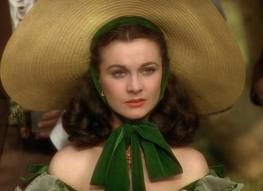 The first hour in particular is very difficult to get into, being populated by a huge number of characters who are all in some way unlikeable. The barbecue at Twelve Oaks consists essentially of spoilt rich people bitching about each other, with Vivien Leigh coming across as a childish brat who moans and screams and cries whenever she doesn't get her way. Leigh is a good actress who is undeniably beautiful, and very good at demonstrating the ambivalence of the character in her attitude to others. But we end up as ambivalent to her as she does to Ashley, and it take a lot of patience to stay with her character.
 Because the film is attempting to be so big in every single department, it ends up as the dictionary definition of sprawling. Although it just about manages to keep us focussed on the central characters (anchored by the great performance of Clarke Gable), the supporting cast is way too big, with potentially enthralling individuals endlessly drifting in and out. When characters do come back, they re-appear in the most contrived way imaginable; Sam, for instance, just happened to be sitting around the campfire when Scarlett was being attacked on the bridge.
 This brings us on the racial aspect of the film. The arguments here are the same as those surrounding The Birth of a Nation: do we accept the racial attitudes as a product of an historical period, or do we criticise such a revered film for being so deeply questionable? If we take the latter view, then the film is totally reprehensible, with almost every black character being reduced to pantomime; they never question their duty and seem incapable of functioning without being ordered around by impeccably dressed white nobles. If we accept the former, then the film is slightly more enjoyable, but the characterisation of Prissy as a screaming, incapable slave girl is still nothing short of toe-curling.
 In the last half hour, the film's poor storytelling is exposed and things get completely silly. In further testimony to it rambling, aimless style, most of the main characters are quickly killed off so that we arrive, very clumsily, at the union of Scarlett and Rhett. Every plot point in this section is prompted by an unfortunate death - Bonny falls from her horse like Scarlett's father, and Melanie falls mysteriously ill again, just so Scarlett can realise that Ashley never loved her. The plot drags laughably as we yearn to get to the staircase and Rhett's final line (which, of course, is not the end of the film).
 Gone with the Wind remains that most difficult of films: something which is so heavily flawed and hugely overrated, but also essential viewing for anyone who loves cinema. It is better than subsequent epic romances like Out of Africa because even at its weakest, baggiest moments it still feels like it is going somewhere. But its greatness is ultimately tarnished by its dated attitudes, poor storytelling and ramshackle structure. In short, it contains both the best and the worst that Hollywood has ever offered; it's massively, massively flawed, but also strangely irresistible.
Rating:
Verdict: Overrated but still essential
The Deer Hunter (USA, 1978)
Directed by Michael Cimino
Starring Robert De Niro, Christopher Walken, John Savage, Meryl Streep
Which is worse? A heartless, soulless blockbuster with no wit, intelligence or shelf life, designed solely to milk money from moviegoers in the quickest and most cynical way possible? Or a film which presents itself to be a poignant, intelligent, moving work of art, only to emerge as a bloated, pretentious, self-indulgent piece of crap? For most of us, the obvious answer is the former. But that all changes once you've seen The Deer Hunter.
At the risk of slowly making myself unpopular, let me be perfectly clear from the outset. The Deer Hunter is a truly hateful film, a badly-written, badly-directed, poorly-acted piece of garbage, at turns boring, racist, mawkish, churlish, pretentious and manipulative. It is in a very select group of films which are almost unendurable, because of its length, its structure, its tone and its content. It is an utterly hollow experience which leaves its audience somewhere between slipping into a coma and erupting into blind fury. There are many three-hour films which justify their length - think of The Green Mile, Barry Lyndon or The Lord of the Rings trilogy. There are also a great many films which use long unedited shots very effectively, like Alfred Hitchcock's Rope or The Passenger. The problem is not length in itself, it's whether or not the film is disciplined in a way that you don't notice or aren't bothered by the length. In The Deer Hunter, the editing is so bad that you feel every agonising minute of those three hours. Shots that should be short and sweet are allowed to run on for minutes, so that hours come to feel like days until the whole film has run itself into the ground.
Film critics often heap praise on directors, but it's worth remembering that most great directors have been kept in check by their writers or producers. There's no doubt that Michael Cimino was talented; he co-wrote Silent Running and his first film, Thunderbolt and Lightfoot, is a solid, light-hearted thriller. But do a little digging and you discover that all his best work happened before he was given a free rein. Thunderbolt and Lightfoot was produced by Clint Eastwood, who forbade the young director from doing more than four takes on any given scene. Barry Spikings and Michael Deeley simply didn't put pressure on Cimino like they should have done; left to his own devices he couldn't separate the wheat from the chaff, and thus the whole thing is dust. Then we come to the politics of The Deer Hunter, which are at best churlish and at worst completely reprehensible. For starters, the film is every bit as racist in its depiction of the Vietnamese as The Green Berets ten years earlier (ironically, since John Wayne presented Cimino with the Best Picture Oscar). The Vietnamese are depicted as bloodthirsty gamblers who enjoy sadistically tormenting innocent soldiers and winning money in the process. There is no attempt made to explore the conflict from their point of view, or to offer examples of the intelligent political activity that brought Ho Chi Minh to power in the first place. It's the kind of blatantly racist propaganda that makes even The Birth of a Nation seem even-handed and subtle.
 It's easy to see in hindsight why The Deer Hunter won over American audiences. America was still licking its wounds after the fall of Saigon and so a film which portrayed their enemies as essentially mad, bloodthirsty killers with no brains or mercy was bound to strike some kind of chord. Looking at it now, the film is overtly manipulative in getting us to sympathise with the people invading and terrorising a foreign country. In the last scene before the characters play Russian roulette - which incidentally, probably didn't happen - we see Robert De Niro turning a flame-thrower on a 'gook' soldier, and the camera lingers in graphic detail as the flames slowly engulf him. And then there is the ending, where Meryl Streep begins to sing 'God Bless America' in a pathetic rip-off of Paths of Glory. The film swallows the very lies it set out to dismiss, being little more than sour grapes and flag-waving.
As if that wasn't enough, the film is completely up its own fundament. It's the classic kind of epic or awards contender which constantly thinks it is saying something profoundly meaningful, when in actual fact it has no depth at all. The dialogue is just a bunch of platitudes and tittle-tattle delivered by characters that are paper-thin and uninteresting. All the issues which the film claims to address - the ethics of warfare, its impact on communities, etc. - aren't addressed beyond the odd scene of random hysterical crying. More than anything else, the film has no sense of humour. That might seem an obtuse comment to make about a war film, but the best war films are those which see the humour and humanity in the darkest situations, whether in the outlook of the characters or in the total absurdity of the war in question. Full Metal Jacket may be a harrowing, chilling exploration of the duality of man, but it's also clearly a black comedy. Apocalypse Now has the scenes of the soldiers joking on the boat, not to mention all Dennis Hopper's ramblings. The Deer Hunter takes every aspect of these characters so seriously that they become less and less human. Everything is delivered with a face so straight it's made of stone, and the more we try to connect the less it works.
 Then there is the tone of the film, which lurches between the ponderous and the melodramatic, the snore-inducing and the outright hysterical. For most of its running time, the film is like sleepwalking through treacle; most of the dialogue is either mind-numbingly repetitive or incomprehensibly mumbled, and the slow pace makes everything feel like a bad dream. But then, there is a massive amount of odd, stupid scenes which any editor worth their salt would have taken out in a heartbeat.
 It makes no sense to have Robert De Niro running through the streets taking all his clothes off, only to sit down and have a quiet chat with Christopher Walken in the very next scene. We don't need the scenes of the veterans playing bingo, or the boys winding up Chuck Aspegren with the car, or the erotic dancers in Saigon: we get the message just fine without these distractions. Most of the opening hour is pointless: when we're not being bored out of our skulls watching people dance, we have to put up with the cast being drunk and disorderly.
Then there is the plot itself. As before, you don't need three hours to tell what is a relatively simple story - three men go to Vietnam, one gets left behind, one of the other two goes back to find him. But as The Deer Hunter draws to a close, various contrivances begin to emerge which cause it to tip even further into melodrama. How can Michael get back into Vietnam (and out again) just as Saigon is about to fall? How has Nick been able to earn so much money without getting shot? And why, if the army haven't found him beforehand, are they so willing to let Michael try? The performances in The Deer Hunter are not much cop either. Robert De Niro is largely phoning it in, hiding behind that thick beard, mumbling most of his lines and not showing anything approaching emotion until the final reel. Christopher Walken, like most of his roles, essentially plays himself, right down to a scene of him dancing awkwardly in the bar. Meryl Streep is showy and grating as Nick's bride-to-be, and John Savage's performance flits between dull and hysterical without good cause.
 The Deer Hunter is one of the worst films of the 1970s and a failure on every conceivable level. It is a total, unadulterated mess, exacerbated not just by its racism but its gleeful depiction of cruelty, whether towards humans or animals. If it had simply been boring it might be easier to forgive, or at least for the memory of its poor quality to quickly fade. But its attempts to be meaningful or profound, all of which fail miserably, leave you with a headache that will last for days and days.
Rating: 0.5/5
Verdict: Almost unendurable
In over a century of cinema, we have seen a wide variety of artistic and technical innovations which have changed the shape (and size) of the silver screen, from the invention of Technicolour and recorded sound to the advent of widescreen and the steadicam. But in terms of the narrative and thematic conventions of the films themselves, several aspects have persisted long after technology has brought them into question. And one of the most persistent of these conventions is the ninety-minute running time.
Ninety minutes is a figure which crops up over and over again in the history of cinema. As silent cinema became a mass medium through the 1910s and 1920s, American distributors selected 90 minutes at the cut-off point for any film being shown in cinemas. If a film were any longer, they reasoned, people would either lose interest and leave, or be put off and not bother to pay in the first place. They stuck so rigidly to this idea that when Metropolis arrived States-side (having already been butchered by the German studios), it was run through projectors at one-and-a-half times the intended speed in certain cities. By the 1950s, trash maestro Roger Corman and his exploitation partners-in-crime were manufacturing 90-minute films for the drive-in and grindhouse circuits, films that were shown in cinemas of endless double bills, designed to do the rounds and then disappear forever.
Nowadays the average film on screen in a multiplex will last the best part of two hours, not including the mind-numbing 20 minutes of adverts and the patronising warnings about piracy. Many films still fall below this running time, and a great many, both arthouse and blockbuster, will beat it. But why does the figure of ninety minutes still hang like a rusty sword of Damacles over the world of filmaking? And what have we lost (or gained) by the now typical disregard for thisconvention?
I count four possible explanations. The first lies in the three-act structure of filmaking, which holds that all films play out (or at least should play out) in three acts: setup, conflict, and resolution. Take Back to the Future as an example - Marty McFly is a teenager living in 1985 (setup); he is transported back to 1955 and cannot return (conflict); he puts things right in the past and finds a way home (resolution). The French writer Yves Lavandier reasoned that in most dramatic works, half the content is taken up with conflict and both setup and resolution take a remaining quarter. We unconsciously expect a certain amount of time to be taken up with each act, and 90 minutes seems a reasonable average to aim for, giving enough scope for storytelling while retaining some form of restrictive discipline.
Regardless of whether Lavandier's maths were right, the three act structure has been called into dispute by a succession of writers and directors. In the last twenty years we have seen films which play with narrative and character identity to such an extent that a simple linear progression of setup-conflict-resolution simply doesn't cut the mustard. Take David Lynch's Mulholland Drive, one of the very best films of the last decade. There is an internal element of the three-act structure - Naomi Watts is an actress in Hollywood (setup); she has a fateful encounter with Rita who has lost her memory (conflict); they sort-of discover who she is (or do they?) (resolution). But this is not an adequate means of summing up an ingeniously complicated plot in which identities change rapidly and time jumps around. Later efforts like Eternal Sunshine of the Spotless Mind and The Prestige raise similar problems.
The second explanation lies in an argument about discipline. Corman famously quipped that no film should be longer than 90 minutes without special Papal dispensation - something which his errant pupil James Cameron swiftly ignored. We can all cite examples of films which are too long - Titanic, Out of Africa and of course Heaven's Gate - but it is extremely rare, if not unheard of, to criticise a film for being too short. If a film is long, it is often seen as indulgent, pretentious or desperately worthy - Mark Kermode once referred to The Deer Hunter (182 mins) as "a cinematic dick-measuring contest". Short films have an in-built modesty to them, a modesty which plays into the film's hands if its story or ideas are remarkably well-told.
This sounds convincing, but one should not simply assume that "short is good, long is bad", to paraphrase the sheep in Animal Farm. While many films are too long, some of the best ever made are well in excess of 90 minutes and most of them justify that length. Imagine trying to cut down Stanley Kubrick's Barry Lyndon to half its length; all the painterly quality which is essential to its success and its unique status would be lost. Both The Shawshank Redemption and The Green Mile thrive on being slow-burners, giving the necessary time for the drama and spiritual insight to emerge naturally, rather than being forced upon an audience. On the other hand, there are a great many short films that are terrible - look at the Troma stable, or its modern equivalent, Asylum Films. Or if you want something a bit more mainstream, I give you Disaster Movie and its associates.
A third explanation as to the value of 90 minutes comes down, rather cynically, to money. Making short films is quick and cheap - it takes less time to write the script, the production costs are lower, and you don't have to spend months locked in an editing suite trying to piece together different scenes from miles of exposed film (or gigabytes of digital footage). In the days of grindhouse and drive-ins, keeping the films short was the only way in which the individual outlets could make money; the double bills had to run to 3 hours, and had to be changed over rapidly in time for the next lot of paying punters to get their few bucks' worth. Working off a low budget focusses screenwriters and filmakers, getting them to say the most they can in the most concise possible way.
That all seems fine, and there are many examples of great low-budget filmaking still going on in Europe, America and elsewhere, from the latest Ryan Reynolds thriller Buried to horror efforts like [REC] and Paranormal Activity. But most of the films which gain wide release are multi-million dollar blockbusters, with budgets of typically more than $100m and a running time of well over 90 minutes. If the 90 minute rule was so reliable, why has it become the trend to make movies by throwing huge amounts of money at them and to hell with the length? The role of producers has changed as well - instead of standing over directors with a big stick asking them to cut it down, the likes of Joel Silver and Jerry Bruckheimer are more concerned nowadays with demographic targeting, demanding that directors deliver a product that will sell regardless of its eventual length.
The fourth and final explanation is probably the most unfair to us punters - limited attention span. Forget all the articles about ADHD or people talking on phones in the cinema - people, or at least certain kinds of people, are very impatient and can very quickly get bored. Although this may seem like a modern phenomenon, it's one thing that hasn't changed from the silent era. We will still fall asleep in films or walk out of them if they go on too long to sustain our attention, and if a film is deliberately billed as a certain length, we probably won't go. Ninety minutes in this context is a happy medium between being bored out of your skull and not getting your money's worth.
But again, here's a problem. If most people won't pay to sit through films which are more than 90 minutes long, how does one explain the huge box office takings for Avatar (162 mins) or the Star Wars prequels (136 mins, 142 mins and 140 mins respectively)? The answer is not a matter of length, and certainly not one of depth. It is a matter of hype; these are event movies, films which exist to be seen at a certain time to separate the in-crowd from the out-crowd. They are films to be watched as an experience, as an "I was there" moment - e.g. "I was there when everyone realised that The Phantom Menace was one of the worst films ever made!" As for keeping their attention, most mega-length, mega-budget movies are packed with action spectacle and technically outstanding set-pieces, designed to keep 14-year-old boys happy and oblivious to their very thin (or non-existent) plot.
In short, there is no one reason why 90 minutes is (or at least was) a touchstone in filmaking. Each explanation has its flaws, and they don't form a coherent thesis when meshed together. But looking around at the erratic quality of filmaking we see today, from Hollywood and elsewhere, maybe certain elements of this rule could be reintroduced and lead to artistic and commercial reinvention further down the line.


