
Reflections
-
It is weird to read my correspondences from the late August/early September
period, being the time of transition between my old function in life to my
new ...
14 years ago
The Others (Spain/ France/ Italy/ USA, 2001)
Directed by Alejandro Amenabar
Starring Nicole Kidman, Alakina Mann, James Bentley, Fionnula Flanagan
In my review of The Secret Garden, I said that many films which are held up as British classics are the result of a collaboration between British and international talent - in this case, a Polish director adapting a British book from an American screenplay. It is fitting therefore that the tradition of old-fashioned English and American ghost stories should be most fittingly upheld by an international director, which brings us, (super)naturally, to The Others. At its most basic level, The Others is a stylish and evocative throwback to the classic Victorian ghost stories, which in turn formed the basis for 1960s horror classics like The Haunting and The Innocents. Like the latter of these films, The Others has its roots in Henry James' renowned novella The Turn of the Screw: both revolve around children whom, it is suggested, can interact with a world beyond our own. There are also hints of The Shining in the use of panning shots throughout the house, and in several of the music cues. Alejandro Amenabar borrows from Wendy Carlos in his use of deliberate anti-climaxes following by deep terror.
 The Others takes place on the Channel Island of Jersey just after the Second World War. The setting is interesting due to the cultural differences between the Islands and mainland Britain, and the fact that they were occupied by the Germans (although Nicole Kidman is keen to point out that none of them made it to the house). Amenabar exploits these differences to quickly create an unsettling, 'other-worldly' feel: we recognise all the hallmarks of 1940s fashion and architecture, but they are so precisely and readily positioned that something doesn't seem right.
 The film evokes the immediate post-war period very effectively. Although the majority of shooting was done in Spain, the house feels British in every detail. The ornate and elegance furniture, the empty, echoing halls, the pale but elaborate costumes - it is almost too perfect in its recreation of wartime Britain. The film has a very pale visual palette to underscore the age of the characters' environment and the sense of personal and national exhaustion. Javier Aguirresarobe, who later shot The Road, contrasts light and dark to such an extent that it almost feels like sepia, hinting at the chilling revelations lurking in the old photographs.
 Because of its affection for classic cinematic ghost stories, The Others does contain a fair number of familiar elements. The elderly housekeeper may be much nicer than Mrs. Danvers, but she still has ulterior motives and secrets to hide. In a further reference to Rebecca (which itself borrowed heavily from Jane Eyre), one of the key plot twists concerns the contents or inhabitants of an attic. The use of fog as a meeting point between this world and the next borrows not only from John Carpenter's The Fog but from gothic horror: Susan Hill's The Woman in Black is set in a house cut off by marshland, and the title character first appears after the fog comes in.
 With so many familiar elements in play, there comes a point where the film has to make its own mark on the genre. It takes a while for it to do so, but it eventually achieves this through both technical proficiency and the substance of its storyline. On a technical level, The Others is very creepy. Amenabar uses the pale cinematography and period dressing to play up all the creaks and shadows (and there are a lot of shadows), and he achieves two really big jumps: one with the door closing on Nicole Kidman's face, the other involving the old woman and the cupboard where the children are hiding.
 Like all great ghost stories, The Others makes you question whether or not you saw something, and what that something might have been. It shares with The Haunting and The Innocents the device of a central female protagonist who, in one interpretation, has gone completely round the twist. The film establishes Grace as the audience's guide, using her strict values and sense of conviction to unnerve us. During the opening act, her character is set up as someone completely orderly and in control, in contrast to Nell in The Haunting, who was always a little on edge. Hence when the strange noises start to occur, we experience either the act of someone going mad or Grace's genuine shock at seeing her values so deeply questioned.
 Whereas The Haunting explored possible scientific explanations for the strange goings-on in a dark house, The Others is primarily concerned with the role that religion plays in dealing with or understanding the world beyond this. Grace remarks early in the film that she "doesn't like fantasies": she is a staunch Catholic who takes literally both the teachings of the Bible and, even more so, the Church's views on purgatory. The film's view of religion is mixed - faith in the afterlife is rewarded, while the dogma to which Grace clings turns out not to be enough.
 When Grace's religious outlook interacts with those of her children, The Others drifts closer to the work of Guillermo del Toro, who directed his own ghost story in The Devil's Backbone and would later produce The Orphanage. An underlying theme of del Toro's work is that of children being able to connect with another world, with some underlying force which adults have chosen to ignore or dismiss outright. When Grace's children say that they don't believe all that they have been taught about God and the afterlife, it's not simply a reflection of a lack of faith. It is a sign that they see the truth, the horrifying magic which Grace denies or avoids; as Roald Dahl wrote in The Minpins, "those who don't believe in magic will never find it".
 The Others is very smart in tricking us over where the boundaries between the living and the dead lie. In light of its final twist, the reunion between Grace and her husband (Christopher Eccleston) gains an added layer of poignancy; the joy and subsequent strain of reunion becomes overladen with grief and despair. Like The Shining, the film suggests that portions of individuals' souls are imparted into a location or building which has significance in their life, and that after death their spirit returns, as if one's life were recurring in eternity with all by way of meaning plain to see.
 The Others is also boosted by its great performances. It finds Nicole Kidman in her prime, following up her excellent work in Moulin Rouge! the same year. She has often been criticised for being brittle, but here it is entirely appropriate that she be highly strung: her character is very close to Deborah Kerr's in The Innocents, and she delivers a performance which is almost on a par with that. There are also great performances by the two child actors: Alakina Mann is terrific as the impetuous Anne, and is matched beautifully by James Bentley, who later played Geoffrey Rush's son in The Life and Death of Peter Sellers.
 There are a couple of flaws with The Others. Although its ideas are interesting and thoroughly explored, it remains just a little too generic: it doesn't develop or advance the genre in the way that del Toro's efforts have done. It is a little too long, being very slow at the beginning and predictable towards the end. And in the scenes involving the medium, it treads a fine line between creepiness and Blithe Spirit, with the deadpan delivery of the medium's observers threatening to tip us over that line.
 The Others is a stylish and creepy retuning of a classic ghost story. In spite of its flaws it still delivers a satisfying amount of substance and shivers, which have not decreased in the decade since its twist was first revealed. Kidman and her child co-stars are on scintillating form, matched by solid support work from Eccleston and a 78-year-old Eric Sykes. Though it has since been eclipsed by The Orphanage, it still has the power to chill.
Rating: 
Verdict: Chilling if a tad generic
Dirty Pretty Things (UK, 2002)
Directed by Stephen Frears
Starring Chiwitel Ejiofor, Audrey Tautou, Sergi Lopez, Sophie Okonedo
Over a career spanning 40 years, Stephen Frears has demonstrated versatility in his filmmaking rivalled only by Alan Parker and Ridley Scott. His directorial stamp is so subtle that you would have difficulty convincing the casual viewer that Dangerous Liaisons and High Fidelity were directed by the same man. With Dirty Pretty Things he returns to the gritty territory of My Beautiful Laundrette, and delivers what is possibly his finest film. It's all too common for a film to boast about its 'gritty realism', with most such boasting being a hopeless cover for a preposterous storyline or sub-par shooting style. But even if Dirty Pretty Things felt the need to boast about such things, there would be no need for it. The world which Frears creates is so readily and shockingly believable that we don't need constant reminders that we are seeing might actually be based on fact.
 Like much of his 1980s work, Dirty Pretty Things has an unassuming visual style. Chris Menges, who has worked with Frears extensively since Gumshoe, lights London completely naturalistically, with no effort made to glamorise the characters' surroundings or gloss over the dingier aspects of London. This is not a film which takes on a pertinent and sensitive subject only to hand it with kid gloves: it is frequently painful to watch, but in a way which is ultimately vindicated.
 Dirty Pretty Things is about the British underclass of illegal immigrants, refugees and asylum seekers, who come over in their thousands ever year to do the jobs that no-one else will do. Though the film is nearly ten years old, the political issues it raises are still big hot potatoes; rarely a week goes by without the Daily Mail bursting blood vessels over immigration numbers or benefit cheats. But the film is layered and nuanced enough to make xenophobe reconsider, or at least to admit how lucky they are.
 The central point of the film is that a capitalist society cannot function without an underclass of cheap labour which can be readily exploited. Whether they're driving taxis or cleaning toilets, the people in this underclass live virtually hand-to-mouth with no proper rights and no chance of police protection. They exist in a limbo state where the only choice is survival, by any means and at any cost.
 Throughout the film several characters sell or attempt to sell one of their kidneys to Signor Juan (Sergi Lopez) in exchange for that most coveted of items, a British passport. This storyline allows the film to explore the workings of the black economy, again without either glamorising or outright condemning its participants. Signor Juan is presented as equally a monster and a twisted entrepreneur: as he says, "I'm an evil man, and yet I am saving a life." He is fulfilling the capitalist dream by making something of himself and earning money, but his success comes at the expense of innocent people who have no form of defence, legal or otherwise.
 If Steven Knight's screenplay wasn't so adept at constructing characters, Dirty Pretty Things would quickly descend into melodramatic hogwash. Instead, the film is a screenwriting triumph, with Knight thoroughly deserving his Oscar nod. On the one hand, there are attempts made to differentiate between the different aspects or layers of the underclass: Okwe is an illegal immigrant, Senay is seeking asylum, and Guo Yi is an employed refugee. By showing their different circumstances and levels of security, the film avoids the trap of caricaturing the underclass as something to be pitied, and hence it never risks us losing trust in the story.
 On the other hand, Knight's screenplay constantly resists becoming too generic. The storyline contains a number of mystery or thriller elements, with Chiwitel Ejiofor's sleepless protagonist bringing something of a film noir feel. But neither Frears nor Knight ever feel the need to crowbar the characters into an existing mould. Sophie Okonedo's prostitute may be pleasant, but she's not a hooker with a heart of gold.
 The story of Dirty Pretty Things unfolds very economically, with a perfect sense of pacing which allows the characters to develop of their own accord. By setting most of the action in and around a hotel, we get a microcosmic view of the issues, so that the ideas never get so broad that they drown out the characters. For all the time you spend soaking up the political implications of their actions, you are mainly and constantly interested in the protagonists and whether or not they will survive the increasing number of ordeals put before them.
 Because it treats its subject so honestly and truthfully (without being earnest or worthy), there are a number of scenes in Dirty Pretty Things which are uncomfortable to watch. One of the first scenes finds Okwe finding a human heart lodged in the u-bend of a toilet, a sight that will turn many a stomach. The surgical scenes are appropriately gruesome, producing the desired reaction of revulsion without feeling like they were just included for shock value.
 Alongside this, however, the film is very good at catching us off guard at certain moments. There are several scenes where the story threatens to slip into cliché, only for the camera to cut and reveal something which sheds new light on what is happening. When Okwe first goes into the back room of the cab office, he is asked to get down on his knees. We think he is about to provide the man with oral sex, but it later emerges that he was a doctor examining him for venereal disease.
 In a similar sequence, Senay is working in a sweatshop and asked to perform said act on the manager in return for keeping her on after the police have raided. Audrey Tautou sinks out of shot and the camera zooms in on the manager's face, which turns to a grimace after he is bitten. The recurring image of presumed oral sex could be seen as a metaphor for the position and status of illegal immigrants. On the surface we are the ones being pleasured and in control, when in fact they have at least as much influence, and we have no means of responding should the relationship break down.
 This latter scene also hints at the presence of humour in the film. Rather than going down the route of being admirably grim, Frears acknowledges that the characters would use humour to get through their experiences. It is not a comedy, but there are a few moments which provoke a light chuckle, which in turn provides much by way of context and pathos. One such moment finds Senay eating a stew Okwe has cooked, and he remarks, "you can do many things with pork". Senay stops eating, being a Muslim and therefore forbidden to eat pork, and Owke continues, "of course, I used lamb."
 The performances in Dirty Pretty Things are all first-rate. Sergi Lopez, best known for his role in Pan's Labyrinth, brings a sneering, snooty quality to the character while never slipping into pantomime. Audrey Tautou proves her range as an actress, giving a layered and subtle performance on a par with her work in Amelie. And Chiwitel Ejiofor is terrific, delivering every line with the right balance of conviction and nervous apprehension.
 Dirty Pretty Things is one of Frears' finest efforts as a filmmaker and remains of the best films of the decade. Its intelligent handling of a difficult subject matter is complimented by its versatile treatment of its characters, culminating in an ending which is both valedictory and heart-breaking. On the basis of his subsequent output (Mrs. Henderson Presents, Cheri, Tamara Drewe), it may turn out to be the last great film Frears ever makes. But that cannot tarnish a remarkable viewing experience which has stood the test of time and will continue to do so.
Rating: 
Verdict: Frears' finest film
The Orphanage (Spain/ Mexico, 2007)
Directed by Juan Antonio Bayona
Starring Belen Rueda, Fernando Cayo, Roger Princep, Geraldine Chaplin
Mainstream horror in the early-21st century has become defined by inept remakes, unnecessary reboots, and an uncreative obsession with physical mutilation embodied by so-called 'torture porn'. But even as the genre was taken to new lows with Roland Joffé's utterly vile Captivity, there were a couple of reasons to be cheerful about being a horror fan. The first was Pan's Labyrinth, and the second is The Orphanage. The Orphanage is the latest chapter in the reinvention of horror and fantasy cinema spearheaded by Guillermo Del Toro and his counterparts. Although ostensibly directed by Juan Antonio Bayona, Del Toro's fingerprints are all over this stylish and chilling ghost story which breathes new life into the haunted house sub-genre and the lost child motif. While not on a par with Pan's Labyrinth, it is a worthy companion to both Del Toro's own ghost story The Devil's Backbone and to the classic cinematic ghost stories of the early-1960s.
 Because of its ghost story heritage, The Orphanage is immediately comparable to The Innocents, The Haunting and most recently The Others, in its emphasis on the unknown and its use of suggestion and paranoia rather than shock and gore to bring out true terror in an audience. There are also connections with Don't Look Now and Dark Water in the central thread of a family attempting to cope with the loss of their child, and in the resulting encounters with the spirit world where the intentions of the spirits are decidedly ambiguous.
 Like these great ghost stories, The Orphanage is on one level about dealing with grief - or more specifically, the idea that being able to make contact with the world beyond this would be in some way cathartic. Just as Julie Christie feels at ease after the psychic sister tells her that her daughter is safe and happy, so Belen Rueda allows the medium into her home on the grounds that she might be able to make contact with Simon. And as with Don't Look Now, direct communication with the supernatural lifts the lid off Pandora's Box, compelling Rueda's character to pursue her son even at the cost of her own life.
 If you want proof of the strength of the production, both in its direction and its script, you need look no further than the sequence involving the medium, played in a good performance by Geraldine Chaplin. Utilising the same hand-held, infrared aesthetic of The Blair Witch Project or [Rec], this is the point where the film could fall apart and descend into nothing than scared faces intercut with loud bangs. But though the content of these scenes are naturally creepy, Bayona never allows the tone to get too hysterical. He keeps cutting back to the crew observing and recording the medium, keeping our focus on the reasons behind the set-piece rather than simply expecting us to be scared.
 The Orphanage utilises a number of different techniques which combine seamlessly to keep the shivers flowing down our spine. The most prominent technique is the use of suggestion, with the long shadowy corridors and creaky floorboards of the orphanage leading us to imagine we are seeing something we are not. The masks worn by the children at the welcome party also have a macabre, creepy quality, being reminiscent of the Venetian masks worn in the mansion scenes of Eyes Wide Shut. But there are also one or two scenes of physicalized horror to provide variety, including a shattered and disproportioned face worthy of Rob Bottin.
 But beyond scaring us purely as a technical exercise, The Orphanage uses its chilling atmosphere to explore other issues beyond that of grief and catharsis. On a broader level it explores the way in which life and death intertwine, merge and even co-exist within a given place. The orphanage is presented as both a physical entity rooted in the present and as a portal into the past - a vessel, if you like, for the souls of the children who lived there. The crime that was committed there all those years ago has caused their souls to remain there, like a dark mark on history, and they now seek company in the form of Laura to comfort them and explain their fate.
 There are big overtones of Peter Pan in The Orphanage which influence its view of the afterlife and the role of the central character. The children at the orphanage are like the Lost Boys, both in their status as orphans and the fact that they will never age. Simon's fondness for the book, games and his 'imaginary friends' stems from a desire to remain young forever; when teamed with the knowledge that he is dying, his insolent rejection of his parents becomes a yearning for something or somewhere where death is no longer feared.
 If the ghost children are the Lost Boys and Simon is one of the Darling children, Laura begins as the sceptical parent but ends up rediscovering her childhood self and taking on the role of Wendy. There is a through-line with Pan's Labyrinth here in the idea of a central female protagonist who has forgotten her true identity, and who must find her true self through a series of challenges. But The Orphanage puts its own spin on it, characterising Neverland as the afterlife and the physical act of death as the gateway to staying young forever.
 This emphasis on childhood and childlikeness slips over into the behaviour of the ghosts with regard to their human companions. In the earlier sections of the film, The Orphanage seems to side with The Haunting in portraying the supernatural as something inherently and inexplicably malevolent, as shown by Tomas slamming Laura's finger in the bathroom door and then locking her in. But as things move on the ghosts' nature becomes more clearly playful; like children, they do as they please because they do not know the consequences of their actions. Any perception of threat is less down to their intentions as our preconceptions about death and the afterlife.
 There is a further comparison with The Haunting in the question of whether the events which transpire at the orphanage have any form of rational explanation. In the final scene, where the source of the scraping sounds is revealed, we gain some kind of understanding as to where the boundary between the explicable and the inexplicable lies. But up until then The Orphanage is great at keeping us guessing, generating real suspense during the night sequences which build to a heart-breaking last ten minutes.
 The Orphanage is also visually beautiful. Oscar Faura, who most recently shot Julia's Eyes, captures the haunting quality of the orphanage through a careful selection of pale blues, faded browns and a meticulous choice of shadows. The film has a sumptuous quality to it which makes its harsher moments all the more frightening. The performances are also of a high quality, with Belen Rueda anchoring the film in a portrayal which combines panic, dignity, sorrow and despair while never seeming anything less than human.
 The Orphanage is a first-class ghost story which confirms horror's ability, in the right hands, to address profound and insightful issues in a manner which is not only immersive, but sensitive, touching and intensely memorable. Because of its strong resemblance to Del Toro's work, it's hard to say how much of its success lies with Bayona, or whether he will be able to achieve this level of results under his own steam. But in the meantime it should be celebrated for what it is, namely an intelligent, heart-breaking chiller which will stay with you for a very long time.
Rating: 
Verdict: A creepy and heart-breaking chiller
Cronos (Mexico, 1993)
Directed by Guillermo del Toro
Starring Federico Luppi, Ron Perlman, Claudio Brook, Tamara Shanath
Well before the 'abstinence porn' of Twilight began to hit our screens, a whole wave of vampire films in the 1990s returned to the deep well of sex which had become the lifeblood of vampire fiction. We had Anne Rice's AIDS allegory Interview with a Vampire, John Landis' uneven crime drama Innocent Blood, and of course Francis Ford Coppola's bonkers version of Dracula.
But in the midst of these hypersexual offerings, a small Mexican film from a first-time director was helping to radically reshape the genre. Cronos, the debut by Guillermo Del Toro, demonstrated that vampire fiction could explore themes far more varied than sex, such as the fear of death, the loneliness of old age and the relationship between Mexico and the USA. A hugely influential work of horror cinema, it is every bit as striking and significant as Let The Right One In. When I reviewed The Usual Suspects, I remarked that one test of a good filmmaker is being able to take a hackneyed series of conventions, and create something which is both memorable and mindful of its genre origins. On this level alone Cronos is a triumph, since it is able to fulfil all the requirements of being a bona fide vampire film which approaching all the key plot points and characters arcs from distinctively unusual angles.
 Cronos may have a backstory about the origins of the vampire, followed by the introduction of our protagonists to said bloodsucker which results in quite a lot of gore. But Del Toro manages to achieve this while removing from the story all connotations of sex or lust. In place of Hammer's heaving bosoms and phallic fangs, he gives us skin peeling like wallpaper and the intricate clockwork of the Cronos device. The closest the film comes to anything sexual is a scene of Federico Luppi licking a nosebleed off a bathroom floor, which is shot with such clinical precision that there can be no room for erotic thoughts.
By refocusing the story around ageing and the fear of death, Cronos hits on the central dilemma in vampire fiction: would you rather live forever but lose your soul, or stay pure and human but live in constant fear of death? Both the elderly characters in the film choose the former, albeit for different motives and by entirely different means. Dieter, the dying businessman, makes a conscious decision to pursue the device: he owns the manual needed to operate it and believes it is the only thing that can keep him and his empire alive (and out of his nephew's hands). Jesus, on the other hand, is 'bitten' accidentally, and only comes to use the device frequently through observing its physical benefits. His desire, in the form of addiction to blood, is every bit as strong as Dieter's desire to possess the device himself, but it is not motivated by selfishness or a desire for power. Like Dracula, Jesus becomes weary of eternal life: he is worn down not by an army of brides, but by the constant torment of those who are jealous of his powers. In the end his remaining sense of self triumphs over the vampire he has become, and he sacrifices himself to protect his beloved granddaughter.
The theme of ageing is also conveyed in the visuals of Cronos. Guillermo Navarro's cinematography is very washed-out, with dark woods and fading reds to indicate how everything around the characters is very slowly dying or decaying. Even the brightest scenes in the film, like the New Year's party, are filled with pale colours and make use of shadows wherever possible.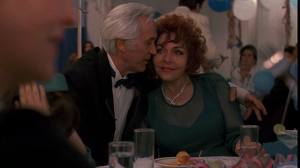 Beyond its direct connections with the vampire genre, Cronos is connected to other key figures in horror. The design of the Cronos device itself, with its peculiar blend of biology and mechanics, resembles the work of Clive Barker: its design as is intricate as the puzzle box in Hellraiser and there is the same suggestion of great evil being contained in or brought forth from something of great beauty.
 There are also connections with John Carpenter in the film's elaborate and highly convincing make-up. Del Toro's training under make-up artist Dick Smith shines through in his pursuit of organic, physical terror, and the work of his make-up artist M. Carrajal rivals anything which Rob Bottin achieved on The Thing. There is a further connection with Carpenter contained in a line where the device is dismissed as "just a toy". Like Carpenter in Hallowe'en, Del Toro is taking an aspect of horror which had become institutionalised and accepted, and proving that it could still scare you to death.
 Cronos is a deeply religious film, in its use of iconography and its exploration of the meanings to both life and death. Again, this is drawing on a classic trait in vampire fiction, namely that the act of being or becoming a vampire is a rebellion against the laws of nature (including death), which it was believed were set in stone by God. Though there is no scene of Jesus declaring war on heaven, as happens in the Coppola version, his faith is counterpointed by his growing dependence on the device, as demonstrated by him reciting the Lord's Prayer while allowing it to stab him a second time.
 There are other indications of these religious themes as well. The Cronos device was created by an alchemist, someone who brought the material and spiritual worlds together, using what became the scientific method to find the divine substance which could cure all disease and prolong life. The images of cockroaches bursting out of angels, or the device being hidden in said statues, hints at the threat which such a device poses to Christianity. By removing the certainty of death, it undermines the corresponding fear of death and damnation, and therefore makes it less necessary either to repent or to live a moral life.
 To add to its theological wrangling, Cronos also has political connotations. The film is a rich allegory for US-Mexican relations, in which America is the bloodsucker which takes without asking and refuses to yield. Dieter, the American, is determined not to let the Mexicans (in the shape of Jesus) get one over on them - the second they come up with something useful, the Americans want it for themselves and won't take no for an answer. There is a contrast between Federico Luppi's sympathetic, caring grandfather and Ron Perlman's aggressive and ambitious nephew. Perlman may slip in and out of Luppi's language, but he is only interested in himself - it is not communication, only giving orders in a language he thinks they can understand.
 The performances in Cronos are mostly of a high quality. Luppi is a great screen presence, seeming frail and vulnerable while coming across as a strong and determined character. Perlman, in his first of several collaborations with Del Toro, is a very fine match for him. His versatility with language is matched only by his desire to throw himself physically into the role. The only weak link is the young girl, played by Tamara Shanath. It isn't so much her performance as the limited extent of her character's development; we don't feel as strongly connected to her as we do with her counterparts in The Devil's Backbone or Pan's Labyrinth.
 Cronos is a great debut feature from one of horror's greatest directors. While not as perfectly formed as Pan's Labyrinth, it contains all the hallmarks of Del Toro's genius, from its powerfully unique visuals to its constant invention and intelligence even in the most trivial of moments. It's a top-notch chiller and a welcome shot in the arm for vampire fiction, proving that the genre is still able to stimulate as well as scare. It's not Let The Right One In, but it should be welcomed into anyone's collection.
Rating:
Verdict: Creepy, chilling and very clever


