
Reflections
-
It is weird to read my correspondences from the late August/early September
period, being the time of transition between my old function in life to my
new ...
14 years ago
Ladyhawke (USA, 1985)
Directed by Richard Donner
Starring Matthew Broderick, Rutger Hauer, Michelle Pfeiffer, Leo McKern
When it comes to 1980s fantasy, there are three broad categories into which films can fall. There are those like Flesh & Blood, which get the balance between substance and silliness spot on, marrying Machiavellian mercenaries to grin-inducing battle scenes. There are those like Excalibur, which take themselves so seriously that they're fatally dull. And there are those that are totally, utterly, and enjoyably silly - and into that category goes Ladyhawke. Ladyhawke is of historical interest due to its place in Richard Donner's career. The fiasco surrounding Superman II, on which he was replaced mid-shoot by Richard Lester, had thrown Donner's career off-course: he had to watch Superman II and III take huge amounts of money while he delivered flops like Inside Movies and The Toy. But either side of this film, he found himself very much in mainstream favour again, first with The Goonies and later with Lethal Weapon. It is interesting that a director whose place in history has been defined by blockbusters (including, of course, The Omen) should be capable of making something so delightfully odd in the midst of two more rounded and confident efforts.
 Like many 1980s fantasies, there are aspects of Ladyhawke to which time has not been kind. The most obvious of these is Andrew Powell's soundtrack, which was nominated for a Saturn award in 1985 but has since become regarded in some quarters as one of the worst ever composed. After Toto's contributions to Dune, it became more common for pop groups or composers to score films, due to the selling potential of the groups and the relatively cheap cost of synthesised music. But Powell's efforts go just too far even to be enjoyed ironically, with its overproduction and bouncy pop timbre frequently jarring with the quieter moments.
 The score is one aspect of Ladyhawke which confirms its inherent silliness, even before we get to the meat of the story. Another such aspect is its visuals, which manage to look lavish and professional while still feeling ropey and cheap. The film is shot by Vittorio Storaro, who famously shot Apocalypse Now - something which is evident in the multitude of blood-red, beautiful sunsets which are central to the plot. But in amongst the terrific scenes of frozen lakes, dark forests and crisp skylines, there are numerous scenes which look like they were filmed in a hurry, treading unintentionally close to Monty Python and the Holy Grail.
 This feeling of cutting corners is reinforced by the paucity of special effects. For a film in which people metamorphose into animals on a daily basis, the special effects of Ladyhawke are coy to say the least. Apart from a few shots where Michelle Pfeiffer's eyes change shape in close-up, all the big transitions happen off-screen; on several occasions Matthew Broderick leaves the room just beforehand, as though the actors had to go off-stage to change costumes. While Donner wouldn't have had access to the CG wizardry we take for granted, there was plenty of scope in the physical effects of the time to achieve something a little more palpable. Only four years earlier Rick Baker produced the definitive werewolf transformation for John Landis, in a film with half of Ladyhawke's total budget.
 Added to this shortcoming we have a number of plot holes which either confuse or produce unwanted tittering. First there is the problem of clothes: Rutger Hauer and Michelle Pfeiffer keep the same outfits throughout, but there's not much effort to keep the clothes together when one of the pair is in animal form. Then there is the question of memory. The film borrows the horror device of the person having no memory of what they did as a beast - so how come the hawk remembers to stay with her master, or the wolf not to eat his mistress? Finally, there are several blatant continuity errors. We are told that Pfeiffer appears as an eagle whenever it is daylight, and yet there are at least two scenes where it's daylight and yet she is still there. At least when Shrek half-inched the plot, it was consistent throughout.
 But in spite of these problems, Ladyhawke is a consistently entertaining little romp. Like Logan's Run nine years earlier, it's only when you stop trying to take it seriously that its ideas and emotional impact bubble to the surface. And like Logan's Run, this transition is cemented via a dominant performance by a great actor - not Peter Ustinov, but Leo McKern.
 Most famous for playing Horace Rumpole in the long-running TV series Rumpole of the Bailey, McKern had courted cult status at various points in his career: as veteran reporter Bill McGuire in The Day The Earth Caught Fire, as a recurring Number 2 in The Prisoner, and in his previous outing with Donner as a mad archaeologist in The Omen. But whereas that last appearance was a silly cameo in an otherwise seriously creepy film, here McKern brings weight and gumption to an otherwise facile concoction. Like Ustinov before him, he puts a brake on excessive silliness, if only for a moment, in order to steer the viewer towards the emotional heart of the film.
 Not only is McKern's delivery well-suited to disguising exposition, but he illuminates some cracking lines in the script. Most of the wisecracks go to Broderick, who is on very fine form; his soliloquys with God about telling the truth and resisting temptation are guaranteed to raise a smile. But McKern's timing is note-perfect, as he waits for a knight to fall right through the drawbridge before quipping: "Always walk on the left side!". Best of all comes when Broderick brings him the hawk after it has been wounded by an arrow. Having been told that he can't eat it, McKern bellows: "What? Is it Lent again already?!"
 While McKern's performance is the icing on the cake, the other major players are also firing on all cylinders. Rutger Hauer seems naturally suited to the historical romp, whether as a heroic figure here or as an antihero in Flesh & Blood. His typically brilliant screen presence, being equally charming and threatening, suits the personality of Navarre as a knight tormented by the woman he loves but cannot have. And while Michelle Pfeiffer's hair may be straight out of a pop video, she too fits her character very nicely. Her beauty conveys both the innate sense of mystery about Isabeau and the vulnerability of her predicament. She's so convincing, in fact, that you keep recognising her facial features in those of the hawk.
 Having these two charismatic performances goes some way in making the romance at the heart of the film feel believable. Somehow the grandiosity of the setting gives the relationship more weight, making it feel like there is more at stake than with similarly inseparable lovers in more mainstream rom-coms. The story is an interesting variation on the age-old tale of two people destined to be together but cursed to be apart, and for all the ridiculous elements within the central conceit it does end up pulling you in.
 This emotional pull is most evident in two scenes towards the end. The first occurs when Philippe finds Navarre lying next to Isabeau as a wolf. The sun begins to rise, Isabeau begins to change, and for a split second both see each other with human eyes. Navarre reaches out to touch Isabeau, only for her to change and fly away, leaving him beating the earth in frustrated rage. The other comes during the solar eclipse where the two are reunited and the curse is broken. The slow pacing and distance between them prior to their first real contact reinforces the strength of the bond between them.
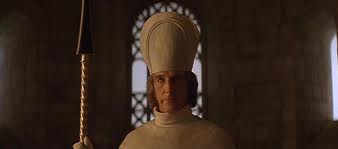 Ladyhawke also has its fair share of good action. Considering Donner's bad feelings towards Richard Lester (who can blame him?), it is ironic that his action sequences, in this film at least, take after Lester's finest work in The Three and Four Musketeers. The fight scenes have some pretty inventive slapstick and Broderick doing all manner of acrobatics, while Hauer gets to swashbuckle and head-butt to his heart's content. The highlight comes in the climactic fight in the church, ending with Hauer throwing his huge sword over several yards right into the heart of John Wood's scenery-chewing Bishop.
 Ladyhawke may not have aged as well as Flesh & Blood or Legend, but it remains a definite guilty pleasure and a bona fide cult film. Its flaws are all in plain sight - the soundtrack, the silly plot, the special effects - and yet none of them can completely eclipse the sheer enjoyment that it brings. If anything these flaws serve to make it more endearing, and more fun than mainstream fare like Robin Hood: Prince of Thieves. Donner would make more consistent features after this, but for pure and simple fun it takes some beating.
Rating: 
Verdict: Silly but sublimely entertaining
Sarah's Key (France, 2011)
Directed by Gilles Paquet-Brenner
Starring Kristin Scott Thomas, Melusine Mayance, Niels Arestrup, Frederic Pierrot
It's well-nigh impossible to make a film about the Holocaust without either lecturing the audience or slipping into inappropriate sentimentality. The best examples of this genre (if such a term is appropriate) are character-driven pieces like The Pianist and Life is Beautiful. These films focus on the utterly human reactions of individuals caught up in Europe's darkest hour, and steadfastly refuse to sugar-coat the brutality for the sake of holding an audience.
 To give credit where it's due, Sarah's Key succeeds in the most important area, namely in its rendering or recreation of the Holocaust. The film explores an aspect of the Final Solution which has not been previously addressed on film, and it approaches the subject with courage and determination. The scenes at the Velodrome d'Hiver, where thousands of French Jews were rounded up and housed without food or sanitation, are suitably unpleasant and very tough to watch, particularly the shots of human excrement or a woman falling from the ceiling.
 Gilles Paquet-Brenner's camerawork is well-judged in these scenes and is surprisingly accomplished for a first-time director. During the scenes in the Vel d'Hiv, he uses long aerial shots to show the isolation of Sarah's family before they are sent to the camps, showing the squallor and hideous conditions without hammering the point home. In the camps his hand-held work is more frenetic: when the mothers are separated from their children, his camera darts all over the place to capture the sense of panic on both sides. This approach makes us feel as confused as the characters would be, and these scenes lack some of the staged quality that hampered Schindler's List.
 The film also benefits from a fantastic performance by the young actress playing Sarah. Melusine Mayance is a bewitching screen presence, and she conveys the innocence of the character without looking like she has been directed to do so. Like her counterpart Saoirse Ronan, she has wisdom beyond her years but is not an adult in a child's body, forced to act like a child. If she continues to deliver on the strength of this performance, she will be breaking audience's hearts for decades to come.
 Among its war film counterparts, Sarah's Key is on one level closest to The Pianist. Apart from Kristin Scott Thomas' links to Roman Polanski (they worked together on Bitter Moon), both films are primarily about survival. Both Sarah Starzynski and Wladyslaw Szpilman are not heroic in the traditional or conventional sense. They endure the Holocaust by neither fighting the authorities head-on nor rolling over and praying for death to come. In the truck on the way to the camp, an old man shows Sarah a ring full of poison, and says: "No-one can choose when I die."
 Both of the protagonists in Sarah's Key - Sarah and the journalist investigating her - experience large amounts of guilt over what happened. While Sarah's guilt is intensely personal (a literal skeleton in the closet), Julia's is part of a national or continental guilt that such awful events were allowed to happen. One man she meets works hard to put names to all the photographs of the Vel d'Hiv victims, commenting that it is painful but the right thing to do. Because this guilt is conveyed through naturalistic conversation, with the camera as observer rather than interrogator, we don't feel like we are being constantly made to hang our collective heads in shame.
 One particular aspect of the events at Vel d'Hiv reinforces the film's message of those closest to the horror turning a blind eye, or even encouraging what was going on. When the Jews are rounded up in 1942, we see a number of native French observers cheering and jeering from the rooftops. The Jews are depicted as inferior not just to the Aryan race, but to native Frenchmen, with even those who have lived in France for decades being degraded and derided. It's a fitting means to distinguish between race and nationality, concepts which became ideologically fused under Nazism.
 On the other hand, the constant switching between the stories does start to become jarring as Julia's situation changes. Sarah's story is consistently more engaging and involving than the events in the present day, and while it never feels like we are watching two different films, we find ourselves longing for Julia's sections of the story to be hurried along. Some of the editing choices are borderline crass - for instance, Julia appears on the site of Vel d'Hiv just after Sarah is taken away.
 This becomes a greater problem in the present-day sections. After it emerges that Sarah is no longer alive, the loose ends flail and fray as the film searches for some kind of cathartic ending. Arguably having her still alive, to be discovered by Julia in the final scene, would have been more predictable and less rewarding. But the ending as it is feels inconclusive in a non-rewarding way, and the coda with the voice-over feels tacked-on.
 Sarah's Key is a flawed but admirable attempt to explore a difficult subject matter from an original angle. Kristin Scott Thomas turns in another fine performances, with a flawless American accent and unique subtlety in her facial expressions. The film is ultimately compromised by its later sections, which do undermine or cheapen a lot of what has gone before. But it is still a solid debut effort which suggests future promise for both its young performers and its director.
Spetters (Netherlands, 1980)
Directed by Paul Verhoeven
Starring Hans von Tongeren, Toon Agterberg, Maarten Spanjer, Renee Soutendijk
Long before he unleashed his particular brand of filmmaking on an unsuspecting Hollywood, Paul Verhoeven was kicking up a fuss in his native Netherlands with a series of playfully provocative films. Having won acclaim for period dramas Katie Tippel and Soldier of Orange, Spetters was the film which set the tone for his later career: lambasted in the press but loved by audiences, and with Verhoeven always having the last laugh. Spetters is a coming of age film set in and around Rotterdam, which follows the stories of three young men aiming to become motocross racing champions. In the manner of all Verhoeven films, it marries full-on sex, violence and strong language with subtle and often intelligent insights into the human condition. The title epitomises this, being both slang for pretty young men and a word meaning 'splatters' - the sound the chip pan fat makes when the female lead tips it down the naked chest of a leather-clad thug.
 Spetters is what you would get if you put The Wild One, Rebel Without A Cause and Saturday Night Fever in a blender, and then inhaled the contents in the middle of a drunken rave. The latter is most evident in the cocky attitude of the male characters, along with a scene early on of the mechanic Eef showing off in the disco, only to be outclassed by an unnamed rival. The costumes take on elements from all these films, with Eef's penchant for leather nodding towards Marlon Brando and Rutger Hauer's perfect silver hair rivalling anything that John Travolta could produce.
 As you would expect from a coming of age film, much of Spetters is concerned with our male protagonists trying to score with women and coming away with a little more than bruised egos. And coming in the middle of the gross-out wave of Animal House, Porky's and Lemon Popsicle, it's only natural to anticipate that such scenes would leave a sour, guilty taste in the mouth. But such scenes are also a showcase for Verhoeven at his best: setting up a given situation, allowing things to turn a little seedy, and then defying our expectations with a cracking punch-line.
 Two examples in Spetters illustrate this ability. The first comes in the disco when one of the men starts chatting up a black woman. He buys her a beer and starts to stroke her leg, flirting with her in a typically unsubtle way. Despite her protestations, he puts his hand under her dress - and brings it out with a strange yellow gunk on his fingers. We grimace in disgust, only to burst into raucous laughter when the woman lifts up her dress to reveal a jar of mustard between her legs. Talk about taking precautions.
 The second such instance comes soon after, when two of the bikers and their respective girlfriends have snuck onto a building site to have sex. Having chosen their spots, one of the girls reveals that she is on her period - which the boyfriend grossly demonstrates by bringing up two bloody fingers. Hearing his friend moaning and panting next door, he asks the girl to fake having sex with him, and together they try to out-moan their friend. Having assumed that the other couple are having great sex, Verhoeven then cuts to a wide shot which shows said couple doing exactly the same!
But the wild antics of these men are not confined to the bedroom. The racing sequences in Spetters are shot with real energy and panache: Verhoeven gets his camera in close and uses long takes, so that when the spectacular crashes happen, we think that people are genuinely getting hurt. The sense of youthful vigour present in these scenes prevents them from becoming gratuitous: Verhoeven clearly identifies with the drives and urges of these young men, and has sought to communicate this in the most natural way he knows. Having taken its time in setting up the three main characters, Spetters really gets into gear when the main love interest arrives in the shape of Fientje, played with feisty abandon by Renée Soutendijk. She arrives inauspiciously with her brother in tow to run a fast food van in the centre of town, but over the course of the film she seduces all three men, ruining the life of Rien and Eef and changing Hans' destiny forever.
 The film sets up Fientje as a dangerous outsider whom the community does not accept. The only reason the police allow her and her brother to stay is because she gives the officer a 'cup of coffee' (in other words, a sexual favour). Eef's father, who is a devout Calvinist, goes so far as to brand her a "whore of Babylon". But as with Verhoeven's subsequent works, particularly The Fourth Man and Basic Instinct, the role of 'evil women' is not quite as clear cut as would first seem.
 Spetters, like all Verhoeven's best work, calls characters' identities into question and leaves us confused as to whom we are really rooting for. The device of seduction is employed to show just how much there is to becoming a man - in other words, there is more to finding out who you are than losing your virginity, or scoring with the best woman in town. Fientje's own motivations are up for debate: she starts as a serial maneater, a femme fatale who wants Rien's riches for a new fur coat. But in the end she is confused as the others, unsure of herself and of her fate.
 There is some kind of moral point in the fate of the three men. Rien is seduced by the money Fientje gets him through sponsorship, but he ends up losing the only woman he really loved. When he finally gets the chance to express it, he is unable to do so: the accident has claimed not only his ability to perform sexually, but all his accompanying confidence and self-esteem.
 Eef desperately wants to seduce Fientje, but the more time he spends with her, the more he becomes convinced that he is deceiving himself - a conviction which culminates in him coming out as gay and hooking up with her brother. It's an odd way to find yourself, but the end point, the realisation of identity, is the same. Meanwhile Hans, the best-endowed of the group, should be first in line to claim Fientje as his own. But being too shy and inept to pull her, he ends up making something of himself and wins her heart by seeing her as something more than a possible conquest.
 Naturally, all this seduction results in a lot of nudity. Sometimes the flesh-bearing is funny, such as an early sequence of Rien, Eef and Hans in the garage measuring their manhoods with a spanner. But others are deeply uncomfortable, like the very tough sequence of Eef being gang-raped in the subway after stealing from a gigolo. Even for long-term Verhoeven fans, who are used to this kind of thing, you will start to lose patience as the film tips further into lazy soft-core territory.
 Alongside its rampant nudity, Spetters pulls no punches when it has to get violent. Outside of the dangerous racing early in the film, there is one particularly wince-inducing moment where Rien suffers an accident that will leave him crippled. Having been hit in the face by a bag of orange peel, Rien goes flying from his bike, rolls down the verge and (in tight close up) catches his leg on a stone pillar. Having made us squirm and then laugh before, Verhoeven turns that approach on its head to effectively show the demise of this character. The end comes with Rien trundling his electric wheelchair back to the motorway to kill himself - a scene made all the more harrowing by the fact that actor Hans von Tongeren took his own life two years later.
 Spetters is a visceral and often hilarious comedy-drama which offers plenty in the way of thrills and spills. Like a lot of coming of age stories, its plot is far too thin, and it resorts to a few too many gross-out moments to keep us interested. But in the sections when it works, it finds Verhoeven firing on all cylinders, delivering substance in the midst of violent sleaze. It's not up there with The Fourth Man or his early work in Hollywood, but it remains good, guilty-pleasure fun.
Rating:
Verdict: Raucous and relentless
Ghosts of Mars (USA, 2001)
Directed by John Carpenter
Starring Natasha Henstridge, Ice Cube, Jason Statham, Pam Grier
The 1990s were a bad time for John Carpenter. Having returned to form with They Live, the man who was once the king of low-budget horror served up a series of disappointments, from the Near Dark rip-off Vampires to the witless Escape from L.A.. But none of these misfires incite such fury and frustration as Ghosts of Mars, one of the lousiest, stupidest and worst thought-out movies outside Michael Bay's back catalogue. For starters, Ghosts of Mars looks really, really cheap. At a budget of $28m, it was among Carpenter's more expensive efforts, and yet it looks for all the world like it was made for less than a tenth of that. The film was shot in a gypsum mine in New Mexico, with all the rocks being painted red to make it vaguely resemble a Martian settlement. Every scene bar one is shot at night, in a move designed to disguise this low-tech approach but which only serves to emphasise it. The film's aesthetic is worryingly similar to Vampirella, a little-known 1990s turkey starring Roger Daltrey as a renegade vampire who lays low on Earth by posing as a rock star.
 The story of Ghosts of Mars finds Carpenter shamelessly ripping off his back catalogue. The idea of prisoners and cops constantly changing sides and teaming up to fight a greater foe is taken from Assault from Precinct 13, but with all the intelligence and social commentary taken out. The idea of ancient ghosts being bent on revenge is from The Fog, and the manner in which people become possessed by these ghosts is like a cross between The Thing and Prince of Darkness.
Ghosts of Mars also rips off at least a dozen other films, borrowing their respective styles at the expense of their collected substance. Being an action movie set on Mars with horror overtones and lots of violence, there is a natural comparison with Total Recall. But whereas Paul Verhoeven was able to use flesh-ripping violence to draw an audience into the story, Carpenter borrows the full-on gore and doesn't use it for anything other than shock value. The designs of the Martian base are not original either. With the angular sandy buildings and metal doors with circles in the middle, they look exactly like Tatooine at night. It's almost as though George Lucas met Carpenter for lunch, agreed to lend him the sets and had them shipped to New Mexico. There are other Star Wars knock-offs too: the sequence of the soldiers breaking into the power station is unforgivably close to Return of the Jedi, where the rebels break into the shield generator on Endor. Add in some grimy interiors from the Alien series and possessed miners who are somewhere between Braveheart and Mad Max, and you have one desperately derivative movie.
 The problem is not simply that Ghosts of Mars is made of seriously well-worn parts. There are dozens of films made each year which use familiar genre tropes and make for passable if forgettable viewing. The problem with Ghosts of Mars is that it is completely stone-faced about its place in the genre. It doesn't show contempt for science fiction or action-adventure, but it takes itself deadly seriously when what it should be doing is having fun. It is to Total Recall what Xanadu was to Flash Gordon: po-faced, naff, and completely misjudged.
 The story of Ghosts of Mars is almost non-existent. There is the thinnest of plots involving the transport of a dangerous convict from A to B, which is complicated by the fact that evil ghosts which used to live on Mars have been released from a mine. But the film ignores or dismisses every possible chance to spice things up, trotting through the backstory of how the ghosts got there and throwing away a potentially interesting idea about Mars being run by a matriarchal society. Such nuggets are treated like the dust on the planet's surface: characters ignore it as best they can and see it as a nuisance when it gets in the way.
 In the absence of any real story, the plot plays out like a video game. Every five minutes there has to be a big action sequence where faceless miners get killed, beaten or blown. And because killing the miners will just unleash the ghosts to possess someone new, there is an endless supply of cannon fodder on which the protagonists can empty their magazines in ever-more pointless shootouts. We keep going round and round in circles until the train arrives, and as soon as our heroes are on the train, one of them insists on going back to try and blow them up!
 The stupidity of Ghosts of Mars can be seen in its numerous plot holes. If the ghosts are indeed ghosts, how come they cannot pass through walls and doors: what is it about them which make them need to possess humans? And if they need human hosts to survive, what was keeping them 'alive' before the seal on the mine was broken? Were there other creatures on Mars before humans arrived that the ghosts preyed on? What caused them to be ghosts in the first place? Why are they here?!
 Then there are various technical questions about Mars itself. Martian gravity appears to be the same as it is on Earth, but there is no attempt to explain this via some kind of 'gravity field generator' or other such device. The planet has only been partially terra-formed, and yet the film expects us to believe that characters can tolerate this by wearing the kind of safety specs worn by A-Level chemists. None of the weapons seem to have been customised or built specifically for Mars, and despite there being less oxygen in the air, the fireballs are every bit as big as they would be on Earth.
 When Carpenter made Assault on Precinct 13, he was very careful to focus on the ethics of law enforcers trusting criminals with their guns. He kept the number of times that guns changed hands to a minimum, so that the claustrophobic tension would not be compromised. Ghosts of Mars is almost a parody of film shootouts in its complete disregard for common sense. There's barely a scene involving Ice Cube where the tables aren't turned or people pull out guns they never had before. This idiocy culminates in a scene where the criminals have their weapons confiscated, only to be armed with new ones seconds later.
 The acting in Ghosts of Mars is universally bad. Ice Cube plays a caricature of himself, attempting to exude attitude via scenery chewing but ending up as little more than obnoxious. Natasha Henstridge, who was cast at the last minute, seems to have only one facial expression and has no chemistry with her co-stars. Because the whole film is narrated by her in flashback, we already know that she will survive: there is no tension or reason to care, and because she is the only one found on the train, all the other characters are expendable.
 The supporting cast fare no better. Jason Statham tries his best but is nowhere near as enjoyable as The Transporter series, or even his brief appearance in Mean Machine. Pam Grier turns up to give the film some kind of genre credibility, but before long the script deems her unnecessary and she literally loses her head. Worst of all is Joanna Cassidy, most famous for playing Zhora in Blade Runner. She spends half her time bouncing off the walls pretending to be mad and half the time staring blankly into space, wondering what happened to her career.
 To say Ghosts of Mars is an abject failure would be doing a disservice to abject failures. It is easily the worst film of Carpenter's career, containing none of the wit, substance, polish or ambition of his heyday. The characters are paper-thin and dull, the acting is terrible, the script is weaker than dishwater and the direction is almost non-existent. It ranks alongside Captivity as an example of a once-great director hitting rock bottom, and is nothing short of dull, dumb and deeply depressing.
Rating: 
Verdict: Mind-numbingly terrible


