
Reflections
-
It is weird to read my correspondences from the late August/early September
period, being the time of transition between my old function in life to my
new ...
14 years ago
Batman Returns (USA, 1992)
Directed by Tim Burton
Starring Michael Keaton, Danny DeVito, Michelle Pfeiffer, Christopher Walken
The huge box office success of Batman allowed Tim Burton to pursue a more personal project in the shape of Edward Scissorhands. Mixing gothic fairy tale with social satire and nods to classic horror movies, it was Burton's first truly great work and began his artistic relationship with Johnny Depp. With both critical and commercial success behind him, Burton was free to make Batman Returns much more of the film he wanted. As before, not everything works, but in certain key areas it is a marked improvement on the original. Whereas Batman felt like a film where Burton was one of many influences fighting for control, Batman Returns is a Tim Burton film first and a comic book adaptation second. Some of the overtly expressionist touches from the first film remain: apart from the continuity of Gotham's architecture, there is the contrast of black and white prams in the credits and the long pan up to the skyline in the final shot. But this film is much more of a gothic fairy tale, as though Scissorhands' close relatives had broken into the Bat-cave.
 This shift is most clearly present in the pre-title sequence. Burton's title sequences have always been elaborate, using evocative imagery to pull an audience into the world he is creating so that any initial preamble can be minimised. But the influence of Edward Scissorhands is clear from the outset, with falling snow and the child that nobody wanted - the only difference being that the Penguin is banished from the castle rather than being kept in it. This sequence has a poetic, bittersweet quality which slowly mutates into something creepier; the longer the camera follows the floating pram, the more we start thinking about Rosemary's Baby.
 Batman Returns sees Burton putting his stamp on Gotham and the characters in a far more distinctive way. He reworks the theme of outsiders from the first film and plays it out in the visuals to a far greater extent, rather than relying on the characters simply talking about it. The costumes emphasise the fractured nature of the characters, from the stitching on Catwoman's hand-made suit to the Penguin's rubber gloves which stand at odds to his waistcoat and walking stick.
 Whereas the first film saw Batman as the hero and ended on a triumphant note, Batman Returns is more nuanced and shows the characters at a more mature and established point in their history. The film expands on the "duel of the freaks" and taps into a central thread of the comics, namely that Batman is no better than the villains he is fighting. Batman, the Penguin and Catwoman are all vigilantes who do what they do because the law has in some way failed them; whatever individual acts of good they may perform, they are all potential enemies of the law, whose level of allegiance to the authorities changes several times over the course of the film.
 With this relativistic set-up, it becomes a question of whether the characters use their status, as outsiders and vigilantes, as a force for good or evil. Batman chooses the light, directing his moral compass on the people of Gotham, funded through his/ Bruce Wayne's immense wealth. The Penguin keeps changing his mind but eventually opts for darkness, choosing violence and revenge and over any possible form of redemption. Most interesting of all is Catwoman, who is trapped somewhere between the two extremes. At the end of the film she is still trying to pin down her raison d'etre, trying to reconcile both her personalities to Gotham, her past life and her costumed rivals.
 One of the complaints made about this film, and subsequently about The Dark Knight, is that Batman becomes marginalised in favour of the villains. While it is undoubtedly true that Burton finds the villains more intriguing, it makes sense both narratively and thematically for Batman to be on the back foot. Because he has no natural powers - he is not, as the Penguin puts it, "a genuine freak" - it takes time for him to respond to new threats and to defeat his enemies using wits rather than convenient gadgets. There's nothing more boring than seeing a hero brush villains aside with one punch, and the relationships which these three characters build during their various encounters give them a new depth.
 Like all the best comic book movies, Batman Returns is centrally focussed on the people trapped within the circumstances of their special powers. With Batman it is doubly interesting because there is no freak accident or supernatural force involved, so that it becomes a moral examination as much as a psychological one. But Catwoman and the Penguin also wrestle with their new identities, and the film is suitably ambiguous as to how far these people have come to terms with who they are.
 The best scenes in Batman Returns are those between Michael Keaton and Michelle Pfeiffer, in either of their incarnations, trying to decide how much of themselves they should reveal, second-guessing whether one knows who the other is, and weighing up whether to be lovers or enemies. In one scene they are kissing on the couch, trying to give in to their passions, but also trying to hide the injuries they sustained from fighting under their respective masks.
In a later scene, Pfeiffer is dancing with Keaton at Shreck's ball, having come her to kill the latter at Catwoman. As Keaton puts two and two together, Pfeiffer remarks "does this mean we have to start fighting now?", a line which perfectly conveys the conflict their characters are facing. Pfeiffer's face shifts dramatically in this scene, taking in panic, fear, angst and sadness as she desperately runs through all those questions in her mind. Does she really want to kill Shreck? Can she live with Bruce Wayne knowing that he is Batman? Can she in any circumstance live with herself? For those of us who are less interested in the psychology of the characters, there is still plenty in Batman Returns by way of popcorn entertainment. Burton may not be the most adept action director, but the set-pieces in Batman Returns are packed full of pyrotechnics and impressive stunts to keep younger viewers entertained. Some of the individual movements feel contrived, such as a gadget which rotates the Batmobile through 180 degrees just so a clown can be set on fire. But in the sheer variety and frequency of the set-pieces, there is something for pretty much anyone.
 The flaws with Batman Returns come less from Burton's vision than from the demands of a blockbuster sequel. The film is rather too long, and in complete contrast to its predecessor has too much plot rather than too little. Christopher Walken is underused for most of the running time, with his evil plots being quickly reduced to an expository sideshow. The film does fall into the Spiderman 3 trap of having too many villains, albeit not so catastrophically as Sam Raimi's effort.
 There are also elements of Batman Returns which seem out of a place for a 12 certificate films. Danny DeVito gets a number of unsavoury lines surrounding "filling the void" and "unlimited poon-tang", which come across as more disgusting than funny, even considering the grotesque nature of his character. And the Penguin's encounters with Catwoman tip over so often into sex talk that you begin to wonder whether this film was misjudged or simply given the wrong rating.
 Despite its flaws, Batman Returns is an improvement on the original and the best of the Burton-Schumacher canon. Its exploration of the characters is more complex and consistent than before, and Burton's evocation of Gotham is darkly distinctive. In hindsight it was probably for the best that Burton moved on to other projects, since he had taken the characters as far as his talent and interest would allow. One only wishes that Joel Schumacher had taken more care once Burton had handed over the keys.
Rating: 
Verdict: A flawed but marked improvement
Angel Heart (USA, 1987)
Directed by Alan Parker
Starring Mickey Rourke, Robert De Niro, Lisa Bonet, Charlotte Rampling
Alan Parker is that most contradictory of characters, the journeyman auteur. In a career spanning four decades he has made a film in almost every conceivable genre, from musicals (Bugsy Malone) to prison dramas (Midnight Express), and from war films (Birdy) to offbeat comedies (The Road to Wellville). While the results have not always been cohesive or agreeable, when he is on form he achieves that rare balance of distinctive directorial vision and respectful treatment of a given story. After working with Peter Gabriel on Birdy, the film which launched the career of Matthew Modine, Parker turned his hand to film noir in the form of Angel Heart. Based loosely on the novel Falling Angel by William Hjortsberg, it combines the hardboiled pulp fiction of Raymond Chandler with the supernatural threat of The Wicker Man, held together by Parker's sumptuous visuals and a powerful central performance by Mickey Rourke. While not a complete masterpiece, it remains a highly compelling work of 1980s cinema which is more than worthy of its cult status.
 On a basic level, Angel Heart is a throwback to the classic noirs of the 1930s and 1940s, with a plot straight out of a classic gumshoe detective story. In the film a private detective meets a mysterious client, who offers him a large sum of money to find a man who owes him some form of debt. As the detective snoops around, he finds himself pulled further and further into a dark new world, and eventually comes to realise that he is more closely connected to the client than he previously thought...
 When written out like this, Angel Heart can seem incredibly hackneyed, the sort of script which had been hanging around studios for years being constantly re-written. But the film is fully aware of its place in the genre, tipping its hat to other recent attempts to reinvigorate or redefine film noir. There is, for instance, a direct nod to Chinatown in the scene on the beach: Harry Angel is given a nose shield which he clips to his sunglasses, mirroring the image of J. J. Gittes with his bandaged nose.
 Both Chinatown and Angel Heart use the conventions of pulp and film noir to provide a firm grounding for their audience, giving some form of reassurance as they indulge in ideas or flights of fantasy which are uncommon for their genre. In the end Angel Heart is the weaker film, since its relationship to such conventions is so close that, on a narrative level at least, it never manages to rise above it. But there is still much pleasure to be had from watching all the pieces fit together, and much terror to be found in Parker's various stylish indulgences.
 Judged purely on its visuals, Angel Heart is as memorably full-on and sumptuous as Pink Floyd - The Wall five years earlier. As with that film, there is a contrast between the pale and faded colours of the 'normal' world (in this case New York City) and the richer, fuller tones which gradually emerge as both film and character tip over into madness. Parker's long-time cinematographer, Michael Seresin, floods these sequences with reds and blacks which wouldn't look out of place in the work of Dario Argento, and his capturing of shadows rivals anything on The Third Man.
 These visuals hint at one of the great successes of Angel Heart as a thriller, namely the level of atmosphere it creates. The three or four scenes involving Robert De Niro are uncharacteristically quiet; they occur in churches, offices and deserted cafés, places in which Parker can play on the pauses and grant De Niro's every word the emphasis it deserves. This, coupled with his threatening characterisation, creates the sense of some great evil hovering over everything that occurs between his meetings with Mickey Rourke. Like the dark shadows on a Francis Bacon painting, we feel threatened by this intangible, amorphous sense of doom, which feeds the paranoia of the audience until we are begging for relief.
 The plot of Angel Heart is rooted in the age-old story of Faustus, which involves a man selling his soul to the devil in return for success - he gains the world at the cost of the one thing that is truly and inalienably his. The character of Johnny Favourite, who never appears on screen, stands in for Faust as a man determined to have fame and fortune at any price. But where Faust seeks no harm to others in his quest for hedonistic fulfilment, Favourite is "as close to true evil as anyone wanted to come" and is driven to desperation in his bid to renege on the deal.
 The film is full of religious imagery relating to both Christianity and voodoo. Some of the Christian imagery is obvious: you don't call characters Harry Angel and Louis Cyphre without good reason. In one of their conversations, Cyphre describes how an egg can represent the human soul; he then proceeds to devour an egg he had peeled with his long fingernails, like the devil wearing down a victim and going in for the kill. Other images are more subtle and inventive, like the recurring shot of fans and elevators - ordinary, everyday objects which carry connotations of death and descent into darkness.
As with the paganism depicted in The Wicker Man, the voodoo elements in Angel Heart are not intended necessarily to be taken as chapter and verse. The intention is less to describe exactly what voodoo entails and how it is practised, and more about conveying a clash of cultures, in this case between atheism and the supernatural in general. Angel's contact with voodoo in New Orleans is the first time he entertains the idea that Johnny Favourite was anything more than an elaborate hoax. In a subversion of Christianity, it is faith in a life after death that leads him not to God but to the Devil. Being both a hardboiled thriller and a supernatural horror movie, Angel Heart contains a certain amount of graphic violence. Such scenes include a live chicken being cut open and its blood being poured over Lisa Bonet, Angel being beaten up by anonymous mobsters, and the numerous murders which occur. Though not an out-and-out shocker in the mould of Hellraiser, there is more than enough in Angel Heart to make you wince and shiver.
 Fortunately, precious little of this violence is salacious or gratuitous. The most terrifying moments in Angel Heart are those which use such imagery in an artier, more abstract way to unnerve the viewer psychologically. As the film goes on, Angel begins to suffer vivid nightmares involving an apartment window, red light and a man screaming - a simple image which becomes steadily more unsettling. There is a further link with Pink Floyd - The Wall in the scene where Angel and Epiphany make love in the leaky apartment. The image of water slowly turning to blood is a close cousin of 'The Thin Ice' sequence with Bob Geldof drowning in the swimming pool.
 The performances in Angel Heart are every bit as memorable as the imagery surrounding them. Although De Niro hovers menacingly over everything, it is Mickey Rourke who defines the film in what remains his finest performance. Harry Angel may be a dishevelled flatfoot, but Rourke brings so much more to the party, from his snarky facial expressions to a deep world-weariness: whether down-to-earth or downright hysterical, Angel feels so much more than just an archetype. The supporting performances by Lisa Bonet and Charlotte Rampling are also pretty convincing, especially from the former in a full-on big-screen debut.
 Angel Heart does for the pulp thriller what Black Swan did for the giallos of Dario Argento. It takes a number of familiar elements from a given genre and affectionately cranks them up to a point of near-hysteria, resulting in a film which is intensely atmospheric and deeply unnerving. Like Black Swan, there are moments which are ridiculous, and it's hardly the most consistent film ever made. But when it works, it works beautifully, resulting in a breath-taking balance of art, faith and fear.
Rating:
Verdict: Sumptuous, stylish, strange and scary
Memento (USA, 2000)
Directed by Christopher Nolan
Starring Guy Pearce, Carrie-Anne Moss, Joe Pantoliano, Stephen Tobolowsky
Long before his reinvention of the superhero genre with Batman Begins; long before he conjured The Prestige onto our screens; long before Inception even existed in a dream, Christopher Nolan was proving his worth as a director. Having garnered critical attention for his debut feature Following, Nolan sets its sights on his brother Jonathan's short story, Memento Mori. Eleven years on, it remains one of the most audacious thrillers in recent memory. Nolan's films have often been criticised for being cold or clinical, being too focussed on ideas or concepts to be interested in the characters. While this has been emphatically disproven with regard to his subsequent films, the opening 20 minutes of Memento are a little too mechanical. Some critics complained about the film's reverse chronology being little more than a gimmick, and certainly if all the colour sections had played literally in reverse, the film would have quickly become annoying. While such accusations are misplaced, this section of the film does seem more concerned with establishing a structure than with introducing a story.
But once we are in the zone and understand how the film is going to work, Memento is never short of fascinating. Like many films associated with time travel or disparate memories, the big reveal happens in the middle (or so we think). But the film's deceptive chronology keeps pulling us in, forcing us to think if we want to keep up and rewarding our detective work. As in The Prestige, Nolan allows us to revisit scenes and places which we thought had run their course, and shows us that little bit more that makes all the difference. Telling the story of Memento in reverse is not simply a gimmick, designed to cover a deceptively simple story of revenge. Instead it challenges one of the deepest foundations of the thriller, namely the linear progression of suspense. In one sequence, when his wife is in bed re-reading a book, Leonard says: "I thought the real pleasure was in wanting to know what happens next." Memento completely inverts this idea, making us want to find out what happened before and allowing us to share in Leonard's disorientated state.
 On top of this emotional inversion, Memento twists the age-old principle of Chekhov's Gun. Chekhov's Gun states that no prop or device shall be introduced unless it is going to be used at some point: if there is a gun on stage in a play, it must be fired at some point, otherwise there is no point in it being there. In Memento, however, the question is not so much what each prop is for as to how it got on stage in the first place. If there is a Polaroid of someone or a name scribbled out, we want to find out how, when and why it got there. We (mostly) know what these props are for, but how they came about could make all the difference.
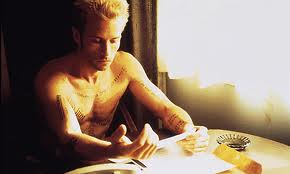 Memento is often cited by film theorists as a demonstration of the difference between plot and story. The distinction, put simply, is that the plot is a logical progression of events from A to B, while the story is what these events are ultimately about. In this case, the plot involves Leonard waking up in a motel, meeting various characters, and shooting Teddy. But it is the story of Memento, namely its exploration of memory and revenge, which is the thing which keeps us glued to the screen.
In approaching the subject of memory, Memento begins by making a distinction between factual and emotional memory. Leonard talks about learning by routine, relying on facts to determine his actions and tattooing them onto his body. Emotional memory, the memory of how an event or moment felt, takes a back seat to cold rationality. But as the film moves on it becomes clear that this distinction is at best ill-defined and at worst completely redundant. Leonard talks about memory being essentially impressionistic - the memory we have of an object or event is not an actual picture of it, but something we have created, changing anything from the colour of a car to the whole time and place when it happened. Even the photos on which Leonard relies are subject to manipulation and can be burned should his desires lead him to believe they are unessential. This, combined with the climactic twist and his recurring mention of 'instinct', raises the question of whether we really know or experience anything real.
 In terms of its character content, Memento could be called the acorn from which the mighty oak of Inception grew. Apart from their aesthetic similarities (both being expertly shot by Wally Pfister), both films have a central character whose actions are driven or dominated by the memories of his dead wife. Although Leonard's wife is a much gentler creature than Mal and has much less screen time, there is the same idea of creating new worlds from memories as a way of dealing with or attempting to escape reality (whatever that is). While Inception is more successful and adventurous in conveying this concept, all the groundwork for Cobb's dreamscapes is to be found in Leonard's decision-making.
 Memento is also further proof of the hardiness of film noir, showing just well how its techniques and archetypes have persisted and retained their relevance. Where previous neo-noir efforts like Blade Runner borrowed most from the genre's visual poetry, Nolan takes the convention of the unreliable narrator to its most extreme conclusion. Just as Deckard is increasingly unsure who may or may not be a replicant (or indeed, whether that really matters), so we find ourselves unravelling with the story until, in Teddy's words, "you can only remember the things you want to be true".
 This brings us on to the final scene in which the timelines merge and we are left utterly baffled by what we have seen. Teddy's line is the pivotal phrase in the film, capturing as it does both the film's message about memory and the motivations of the various characters. In Teddy's case, it is an indication of corruption, a desire to solve cases and create something certain even if the outcome isn't true: as he says, "there's plenty of 'John G's for us to find."
For Leonard, however, the line reveals something darker. Having believed all along that Leonard was in the right, we are faced with the possibility that our tragic hero may in fact be a monster. Either his version of events is true, in which case his wife was murdered and Teddy gets what he deserves - or Leonard killed her, and is now wandering the earth killing people to fit with his twisted version of events. Most chillingly, Nolan leaves it to us to choose, handling his material with more subtly than American Psycho and leaving us genuinely unnerved. Memento is a truly great film with a twist and subtle touch which makes The Usual Suspects look like total child's play. Its intense examination of memory, morality and revenge is counterpointed by slick visuals and great performances, including a career-best turn from the eternally underrated Guy Pearce. It isn't quite a masterpiece, being neither as multi-stranded as Inception nor as mesmerising as Mulholland Drive. But whichever version of events you choose to believe, its greatness cannot be disputed.
Rating: 
Verdict: Memorably marvellous


