
Reflections
-
It is weird to read my correspondences from the late August/early September
period, being the time of transition between my old function in life to my
new ...
14 years ago
Ladyhawke (USA, 1985)
Directed by Richard Donner
Starring Matthew Broderick, Rutger Hauer, Michelle Pfeiffer, Leo McKern
When it comes to 1980s fantasy, there are three broad categories into which films can fall. There are those like Flesh & Blood, which get the balance between substance and silliness spot on, marrying Machiavellian mercenaries to grin-inducing battle scenes. There are those like Excalibur, which take themselves so seriously that they're fatally dull. And there are those that are totally, utterly, and enjoyably silly - and into that category goes Ladyhawke. Ladyhawke is of historical interest due to its place in Richard Donner's career. The fiasco surrounding Superman II, on which he was replaced mid-shoot by Richard Lester, had thrown Donner's career off-course: he had to watch Superman II and III take huge amounts of money while he delivered flops like Inside Movies and The Toy. But either side of this film, he found himself very much in mainstream favour again, first with The Goonies and later with Lethal Weapon. It is interesting that a director whose place in history has been defined by blockbusters (including, of course, The Omen) should be capable of making something so delightfully odd in the midst of two more rounded and confident efforts.
 Like many 1980s fantasies, there are aspects of Ladyhawke to which time has not been kind. The most obvious of these is Andrew Powell's soundtrack, which was nominated for a Saturn award in 1985 but has since become regarded in some quarters as one of the worst ever composed. After Toto's contributions to Dune, it became more common for pop groups or composers to score films, due to the selling potential of the groups and the relatively cheap cost of synthesised music. But Powell's efforts go just too far even to be enjoyed ironically, with its overproduction and bouncy pop timbre frequently jarring with the quieter moments.
 The score is one aspect of Ladyhawke which confirms its inherent silliness, even before we get to the meat of the story. Another such aspect is its visuals, which manage to look lavish and professional while still feeling ropey and cheap. The film is shot by Vittorio Storaro, who famously shot Apocalypse Now - something which is evident in the multitude of blood-red, beautiful sunsets which are central to the plot. But in amongst the terrific scenes of frozen lakes, dark forests and crisp skylines, there are numerous scenes which look like they were filmed in a hurry, treading unintentionally close to Monty Python and the Holy Grail.
 This feeling of cutting corners is reinforced by the paucity of special effects. For a film in which people metamorphose into animals on a daily basis, the special effects of Ladyhawke are coy to say the least. Apart from a few shots where Michelle Pfeiffer's eyes change shape in close-up, all the big transitions happen off-screen; on several occasions Matthew Broderick leaves the room just beforehand, as though the actors had to go off-stage to change costumes. While Donner wouldn't have had access to the CG wizardry we take for granted, there was plenty of scope in the physical effects of the time to achieve something a little more palpable. Only four years earlier Rick Baker produced the definitive werewolf transformation for John Landis, in a film with half of Ladyhawke's total budget.
 Added to this shortcoming we have a number of plot holes which either confuse or produce unwanted tittering. First there is the problem of clothes: Rutger Hauer and Michelle Pfeiffer keep the same outfits throughout, but there's not much effort to keep the clothes together when one of the pair is in animal form. Then there is the question of memory. The film borrows the horror device of the person having no memory of what they did as a beast - so how come the hawk remembers to stay with her master, or the wolf not to eat his mistress? Finally, there are several blatant continuity errors. We are told that Pfeiffer appears as an eagle whenever it is daylight, and yet there are at least two scenes where it's daylight and yet she is still there. At least when Shrek half-inched the plot, it was consistent throughout.
 But in spite of these problems, Ladyhawke is a consistently entertaining little romp. Like Logan's Run nine years earlier, it's only when you stop trying to take it seriously that its ideas and emotional impact bubble to the surface. And like Logan's Run, this transition is cemented via a dominant performance by a great actor - not Peter Ustinov, but Leo McKern.
 Most famous for playing Horace Rumpole in the long-running TV series Rumpole of the Bailey, McKern had courted cult status at various points in his career: as veteran reporter Bill McGuire in The Day The Earth Caught Fire, as a recurring Number 2 in The Prisoner, and in his previous outing with Donner as a mad archaeologist in The Omen. But whereas that last appearance was a silly cameo in an otherwise seriously creepy film, here McKern brings weight and gumption to an otherwise facile concoction. Like Ustinov before him, he puts a brake on excessive silliness, if only for a moment, in order to steer the viewer towards the emotional heart of the film.
 Not only is McKern's delivery well-suited to disguising exposition, but he illuminates some cracking lines in the script. Most of the wisecracks go to Broderick, who is on very fine form; his soliloquys with God about telling the truth and resisting temptation are guaranteed to raise a smile. But McKern's timing is note-perfect, as he waits for a knight to fall right through the drawbridge before quipping: "Always walk on the left side!". Best of all comes when Broderick brings him the hawk after it has been wounded by an arrow. Having been told that he can't eat it, McKern bellows: "What? Is it Lent again already?!"
 While McKern's performance is the icing on the cake, the other major players are also firing on all cylinders. Rutger Hauer seems naturally suited to the historical romp, whether as a heroic figure here or as an antihero in Flesh & Blood. His typically brilliant screen presence, being equally charming and threatening, suits the personality of Navarre as a knight tormented by the woman he loves but cannot have. And while Michelle Pfeiffer's hair may be straight out of a pop video, she too fits her character very nicely. Her beauty conveys both the innate sense of mystery about Isabeau and the vulnerability of her predicament. She's so convincing, in fact, that you keep recognising her facial features in those of the hawk.
 Having these two charismatic performances goes some way in making the romance at the heart of the film feel believable. Somehow the grandiosity of the setting gives the relationship more weight, making it feel like there is more at stake than with similarly inseparable lovers in more mainstream rom-coms. The story is an interesting variation on the age-old tale of two people destined to be together but cursed to be apart, and for all the ridiculous elements within the central conceit it does end up pulling you in.
 This emotional pull is most evident in two scenes towards the end. The first occurs when Philippe finds Navarre lying next to Isabeau as a wolf. The sun begins to rise, Isabeau begins to change, and for a split second both see each other with human eyes. Navarre reaches out to touch Isabeau, only for her to change and fly away, leaving him beating the earth in frustrated rage. The other comes during the solar eclipse where the two are reunited and the curse is broken. The slow pacing and distance between them prior to their first real contact reinforces the strength of the bond between them.
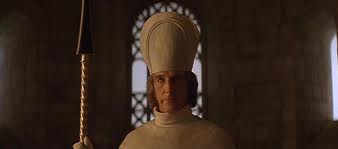 Ladyhawke also has its fair share of good action. Considering Donner's bad feelings towards Richard Lester (who can blame him?), it is ironic that his action sequences, in this film at least, take after Lester's finest work in The Three and Four Musketeers. The fight scenes have some pretty inventive slapstick and Broderick doing all manner of acrobatics, while Hauer gets to swashbuckle and head-butt to his heart's content. The highlight comes in the climactic fight in the church, ending with Hauer throwing his huge sword over several yards right into the heart of John Wood's scenery-chewing Bishop.
 Ladyhawke may not have aged as well as Flesh & Blood or Legend, but it remains a definite guilty pleasure and a bona fide cult film. Its flaws are all in plain sight - the soundtrack, the silly plot, the special effects - and yet none of them can completely eclipse the sheer enjoyment that it brings. If anything these flaws serve to make it more endearing, and more fun than mainstream fare like Robin Hood: Prince of Thieves. Donner would make more consistent features after this, but for pure and simple fun it takes some beating.
Rating: 
Verdict: Silly but sublimely entertaining
The Guard (Ireland, 2011)
Directed by John Michael McDonagh
Starring Brendan Gleeson, Don Cheadle, Liam Cunningham, Mark Strong
Film reviewers like me frequently get accused of being unable to appreciate films designed purely to entertain. But while we may spend a lot of our time directing people towards films in which entertainment may not be top priority, we are as capable as the next punter of having a good time. The Guard is the latest film to prove this, being the most purely entertaining film since Scott Pilgrim vs. the World. From a cineaste's point of view, The Guard contains a great number of familiar genre elements. It has described as a cross between Lethal Weapon and Father Ted, and there are strong hints of both throughout. The pairing of Brendan Gleeson and Don Cheadle is in the buddy cop style, with one being by-the-book to the point of being inept, and the other being a loose cannon who is unprofessional but gets the job done. The shots of the landscape in and around Connemara resemble the opening credits of Father Ted, and there are occasions when Gleeson's facial expressions copy those of Father Dougal.
 The film is also deeply rooted in the conventions of westerns. Gleeson's performance has been specifically compared to Gary Cooper's in High Noon (high praise indeed), but more generally the film corresponds to the stock western plot of the irascible, antiheroic sheriff defending his town from simple-minded crooks. From a more European perspective, one could compare The Guard to the 1930s comedies of Will Hay: there are hints of Ask a Policeman in the role of smugglers, and Oh Mr. Porter! in the Connemara settling and the seeming simple-mindedness of the characters.
 The Guard is the debut film from writer-director John Michael McDonagh, whose brother Martin McDonagh previously worked with Gleeson on In Bruges. As with his brother's debut, the stock plots and familiar conventions of The Guard are a springboard to create interesting characters and carve out a distinctive niche through strong language and violence. But The Guard emerges as the superior film, for two clear reasons.
 Firstly, the film benefits from a low-budget aesthetic. Because In Bruges looked relatively glossy and was flashily directed, it led you to expect something very polished and balanced, so that whenever the more constrictive elements of the plot encroached, you felt somewhat underwhelmed. The Guard doesn't have the luxury of looking like an expensive film, with understated camerawork and a more washed-out colour palette. But this has the side effect of allowing the script to breathe, so that we are less conscious of the clichés when they do come to the surface.
 Secondly, The Guard benefits from a relative lack of archness in its characters. Both filming are incredibly knowing in their construction of dialogue, from the police officers discussing Fellini's 8 1/2 to the lad with the camera commenting that the events that transpired would make a really great book one day. But where In Bruges occasionally felt like it was showing off, being arch for its own sake, The Guard puts the brakes on all that very quickly. The characters feel more genuine and more immediately likeable, even in their most questionable or archetypal moments.
 One of the best examples of this latter trend comes in the performance of Mark Strong. He plays a British gangster hired by the Irish mob to oversee the cocaine smuggling operation, and is as much a fish out of water as Don Cheadle's character. In one of the best scenes in the film, he delivers a bribe to two corrupt police officers, who offer up clichéd lines like "It's all there?". Strong's response is sarcastic but smart, pointing out not only the inherent stupidity of their question within the confines of the film, but also the silliness of a particular generic convention. His character embodies the part of our brain that says "well that wouldn't happen", and seeing that urge physicalized is a real delight.
 There is a similar intelligence with regard to the distinctly un-PC humour of Sergeant Gerry Boyle. The script for The Guard is fantastically bad taste and walks the tightrope between laughter and pain with perfect balance. You'll quickly lose count of the number of times you'll laugh yourself stupid, squirm in your seat, or do both at once whenever Boyle opens his mouth. One particularly funny faux pas occurs when Boyle and Everett are having breakfast, and the conversation moves on to skiing. Boyle remarks: "I thought black guys couldn't ski?". Awkward pause. "Or is that swimming?".
 Such scenes recall the Father Ted episode 'Are You Right There, Father Ted?', in which Ted is accused of being a racist and attempts unsuccessfully to put things right. Both are attacking racists and racism by showing how utterly absurd and pitiful such statements or attitudes are. Boyle has the same misplaced innocence as Father Dougal and does not understand that what he is saying is wrong or insensitive: when berated for his remarks at the FBI briefing, he remarks that racism is part of his culture. We may find Boyle likeable as a character, but the film doesn't use ignorance as an excuse to condone any of his vices, whether racism, drinking, or using two hookers on his day off. We laugh at the statements and the characters, rather than with them.
 But in the midst of this knowing use of racial epithets and black humour, there is a more melancholy side to the film. Boyle may be unconventional, but he is not entirely a happy-go-lucky buffoon who has everything he needs and couldn't care less. There are several scenes where he visits his dying mother, scenes which make us laugh by showing where he got his spirit from. But these moments, and those featuring the young children, are reminiscent of Being There, contrasting the well-meaning, almost clownish central character with the dark world around him.
 In Being There, the gag was that whenever Chance spoke his mind, people read into his words and behaviour as if he were a guru, rather than just the sheltered child whose only life experience was in tending gardens. Boyle may not be sheltered, but there is a through-line in the characters' growing acceptance of his value as a member of the force and an ultimately upstanding human being. As Everett remarks early on, "I can't tell if you're really motherfucking dumb, or really motherfucking smart", though by the end he has clearly made up his mind.
 The Guard hangs on the brilliant central performance of Brendan Gleeson. He is clearly enjoying himself, taking McDonagh's script and breathing life into the character though naturalistic mannerisms and great comic timing. He improves on his performance in In Bruges and is as commanding a screen presence as he has ever been. Don Cheadle compliments him perfectly, proving his comedic worth by playing everything poker straight. The montage of him attempting to interview the locals, including a horse, is a particular highlight.
 Taken as a piece of pure, undiluted entertainment, The Guard is one of the best films of the year. It is deeply generic and occasionally its low-budget aesthetic works against it, with the sound design rendering some of the thicker accents inaudible. But those are little niggles which fail to tarnish a hilarious and beautifully constructed black comedy. Brendan Gleeson has given interviews suggesting that the McDonagh brothers have a friendly rivalry. On the basis of this, it's one-nil to John.
Rating: 
Verdict: This year's Scott Pilgrim
Batman (USA, 1989)
Directed by Tim Burton
Starring Michael Keaton, Jack Nicholson, Kim Basinger, Michael Gough
At a time when the default way of putting comics on screen is to 'go dark', it's easy to forget how radical Tim Burton's Batman would have seemed to 1980s audiences. The only previous attempt at a 'serious' superhero movie had been Richard Donner's Superman, which in itself was compromised by its heavy-handed producers. More than 20 years on, Batman remains an ambitious and entertaining attempt to bring Bob Kane's vision to the big screen, and while not all of it works, there is much to enjoy and appreciate. Both at the time and in light of his subsequent output, Burton was an interesting choice to direct . He admitted to having little interest in the comics before he was offered the project - a revelation that led to a clash with Kevin Smith in the late-1990s when both were developing a Superman project. On the other hand, Burton's background in animation gave him an understanding of characters' physicality, and of the way in which their surroundings could be employed to reflect or express their emotions in a fantastical away.
 Burton's vision for Gotham City stems from the expressionist traditions of German cinema. The architecture, with its dizzying skyscrapers and bustling streets, tips its hat lovingly to Metropolis and thereafter to Blade Runner. The latter is particularly evident in the rooftop scenes, where Burton contrasts light and shadow very effectively to show the fractured nature of both heroes and villains. This and the recurring image of smoke rising from the streets give things a film noir feel which plays into the hands of the source material.
 Whereas Christopher Nolan's 'Gotham trilogy' is set in an alternative version of the present, Burton's vision finds the 1940s and the 1980s living side by side, like a lighter version of Blade Runner's retrofitted future. This hybrid reflects the comics' desire to stay with the times while keeping the characters timeless, and can be seen in every aspect of the art direction. Robert Wuhl's reporter is a 1940s flatfoot with a contemporary tape recorder, and at every press conference there is a mixture of old and new microphones. All the men wear classic suits while Jerry Hall and Kim Basinger flaunt the height of 1980s fashion. Even the Batmobile is part of this admixture, mixing fastback and hot-rod styling under a Chevrolet soundtrack.
 But although the film captures the marriage of old and new reflected in the comics, there is a conflict between Burton's imagination and the extent to which this can be conveyed through the special effects. Even if we make allowances for model shots and moving backdrops (like the dated sequence of Batman and Vicki Vale falling off the cathedral), some of the action sequences look as though they were constrained, not for budgetary but for creative reasons. In his later films Burton would bring more of his vision to the screen thanks to carefully controlled digital effects, but no matter how many effects there are on the Batmobile, only a small amount ends up in plain sight.
 Burton's interest in the characters lies less in what the comics lay out as to the split personalities and motivations of Batman and the Joker. Batman examines the psychology of individuals who choose to live separate lives and hold separate identities, whether out of moral conviction or because of some hideous accident. In the climactic "duel of the freaks" in the cathedral belfry, Batman and the Joker emerge as being formed from both aspects, with their worldviews being shaped by their attitudes to the accidents. The murder of Bruce Wayne's parents leads him to strive for justice, while Jack Napier's cruel accident drives him to revenge through creating chaos.
 Confrontations like this exist outside Batman's relationship with the Joker, and tie in with Burton's running theme of outsiders. Michael Keaton plays Bruce Wayne as the awkward billionaire who has everything he wants but yearns to be accepted rather than just admired. He is torn between his desire for a normal life, embodied by his relationship with Vicki Vale, and his urge to fight injustice by becoming a monster. As in the sequel, some of the best moments in Batman find Keaton struggling over whether or not he should reveal his true identity to the woman he loves.
 Because of the balance between Batman and the Joker in terms of character study, the Joker is naturally on screen for a large amount of time. But Jack Nicholson, who is clearly having fun, almost walks off with the whole film, leaving just the awkward silences between the two lovers and the bluster of Robert Wuhl to fill in the time. Ever since The Shining, Nicholson had been playing the over-the-top card to his advantage, and had been rewarded in this field with an Oscar for Terms of Endearment.
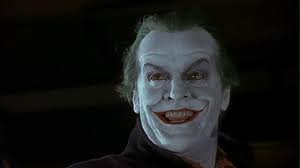 There have been many comparisons made between Nicholson's Joker and Heath Ledger's, with fanboys seething long into the night over which version is best. Suffice to say, they're two completely different styles, for completely different stories, in completely different universes. But if one were to draw a comparison, we could say there has been a steady progression from light to dark, beginning with Cesar Romero, moving through Nicholson and Mark Hamill and finishing with Ledger.
 Much of Nicholson's performance finds him clowning around, with most of the Joker's stuff being more funny than scary. This is not entirely a bad thing; the Joker wouldn't be the Joker without a sense of humour, however dark. In certain sections the balance of humour and horror is well-judged, like the Joker electrocuting a rival gangster while dancing around, saying he's "got a live one here". But after a while Nicholson's shtick begins to get tiresome and you yearn for the straight-ahead sliminess that he exhibited as Jack Napier.
 Character development is one of the big problems with Batman, with Sam Hamm's script making a number of odd detours and U-turns which jar with its opening act. Vicki Vale begins as a resourceful photojournalist straight out of the present day - but somehow, about halfway through, she turns into a damsel in distress, frequently screaming and having to be rescued. Jerry Hall exists only to swoon and pose on cue - although considering her background in modelling, this is arguably perfect casting. The peripheral characters come and go with little new to stimulate them, with Billy Dee Williams being very underused as Harvey Dent.
 The story of Batman itself is much of a muchness. It takes a good 15 minutes to separately introduce us to all the different groups, before we get to Axis Chemicals and the origins of the Joker. When you get down to it, the plot is just about enough to fill an episode of the TV series - the Joker taints make-up products, Batman stops him, and they have a big showdown. Burton was still developing his craft as a storyteller and would not reach a good balance until Edward Scissorhands a year later.
 There are also a number of incongruent elements which keep tripping the film up. The Prince songs in the soundtrack don't work; in fact the whole art gallery scene brings the film to a grinding halt, so Jack can show off and the studio can flog records. An earlier sequence, of the Joker cutting up photos in his lair, is never incorporated meaningfully into the plot. And then there are the usual contrivances surrounding gadgets - not only does Batman always have the gizmo he needs, but he can blow up an entire factory without leaving so much as a scratch on his car.
 Batman is a flawed but thoroughly entertaining attempt to put the comic books on the big screen. Burton was still finding his feet as a director, and his work on Edward Scissorhands would ensure that the sequel was more focussed and substantial. Whole sections of Batman feel out of place, or ill-disciplined, or just plain odd. But in the end the whole just about works, and as a piece of entertainment it still holds up.
Rating:
Verdict: Produces a smile but never quite soars
The Omen (UK/ USA, 1976)
Directed by Richard Donner
Starring Gregory Peck, Lee Remick, David Warner, Patrick Troughton
The Omen follows in a long line of films from the 1960s and 1970s which focus on the fear of children with a basis in the supernatural. The extent and role of the supernatural varies, as does our knowledge of its influence. For instance, in Rosemary’s Baby the Devil is clearly involved from an early stage, while in Don’t Look Now, we do not know how much the spirit world is in control. Much like Village of the Damned, Rosemary’s Baby and The Exorcist, The Omen is upfront in its treatment of the Devil and it makes no bones about the level of dramatic irony involved on the part of the audience. But no amount of unveiling or explanation can prevent it from being one of the creepiest and scariest films of the 1970s. Its simple but effective premise is explored in chilling detail thanks to a series of convincing performances, a brilliant score and solid direction.
When lecturing about suspense, Alfred Hitchcock would often cite Sabotage as an example of how such a device can be misused. Sabotage features a sequence of a small boy carrying a parcel which turns out to be a bomb; after building it up and up, the bomb blows up on a bus, killing the boy and many others. Hitchcock subsequently realised that he had put his audience through the mill and not rewarded them, and that if suspense of that kind is to work, there has to be some form of resolution to prevent an audience from being alienated. It is ironic that in the year that Hitchcock made his last film that a work should come along which completely breaks one of his golden rules. When it comes down to it, The Omen is just that: a evil portent or harbinger of a greater evil to come. Unlike in End of Days, there is no big special-effects ending in which the apocalypse arrives (or in the case of Omen III, Christ returns). The film builds up tension and fear to an unbearable level and then bravely refuses to mitigate it with any kind of reassurance.
Because of this, The Omen raises deep questions about predeterminism. The unstoppable nature of Damien, and the ruthlessness with which the forces of good are dispatched, seems to paint us mortals as nothing but pawns in a spiritual war between God and Satan. We have no real influence or control over the events which transpire, and faith becomes little more than a crutch of fear, a desperate hope that we are not destined to be cannon fodder in a war for human souls. The photographs which foretell the gruesome deaths cannot be changed; the camera doesn’t lie, and the future is fixed. In line with this fatalistic message, the characters in The Omen have clear, pre-ordained motivations. Both of Damien’s nannies turn out to be Satan worshippers – we don’t get an upfront revelation like in Rosemary’s Baby, but their creepy characterisation and Jerry Goldsmith’s nerve-shredding score have essentially the same effect. Though it may appear that Robert Thorn’s decision to kill his son is one of free will, it could equally be another element of Damien’s plan; there is no point being born into a wealthy, powerful family if you have no means of inheriting said wealth or power. Thorn is like a modern-day Thomas, believing in the truth only when he has seen the devastation Damien has wrought.
The Omen raises a troubling supplementary question: if everything about this war is predetermined, what is the role of the church? Are the priests genuinely working for good, or are they somehow complicit? On the one hand, it is a priest who first suggests that Robert Thorn adopt; on the other hand, we have Father Brennan, who is desperately seeking forgiveness for his part in Damien’s conspiracy. Brennan is a classic Cassandra character, whose incoherent babblings from the book of Revelation contain clear and accurate warnings of what will come. But of course, his warnings are not heeded and thing play out as the Devil intends. But it is not theology which makes The Omen so scary. This lies in the full-on nature of the deaths achieved by brilliant camerawork and special effects. By having the omens appear only as black lines on photographs, the film pulls a clever trick: we know who will die, but we are never exactly sure how. Hence when the nanny hangs herself or the priest gets impaled with a flagpole, it’s a real shock.
The death of David Warner’s character is a perfect example of this. We first realise that he is destined to die when we see a photograph of him with a black line through his neck. We then follow his every movement closely, looking out for any object that could possibly achieve that effect. After Leo McKern fills us with some form of hope, we stop worrying about him and start to relax. But jut at that moment, Warner’s head is cut clean off by a sheet of glass. We sit there open-mouthed, wondering how they did it and recovering from the fright of our life. The Omen has a brilliantly creepy atmosphere, making you feel constantly surrounded by the very essence of evil. Richard Donner draws on the rich traditions of Gothic horror and the more serious end of Hammer (like Village of the Damned), using architecture and pace to create deep-seated unease. The Thorns’ home in England is full of high staircases, dark passageways and open rooms with large windows. The churches are forbidding fortresses, and the weather is wild and unpredictable.
 The Omen is also a demonstration of how effective horror can be achieved through a simple choice of editing and camera angles, something which has often been neglected at the gorier end of the spectrum. Take the use of close-ups at the hospital, as the camera cuts back and forth between Kathy Thorn and Mrs. Baylock. It’s a simple device which easily creates tension and prevents the score from descending into melodrama. Brennan’s death is another example of effective editing: the camera cuts back and forth between the falling pole and his scream, before cutting to the wide shot of the pole passing straight through him.
The one weak spot in The Omen comes in the lengthy exposition as David Warner and an on-form Gregory Peck attempt to decode the warnings in Revelation and apply them to the present day. Their initial encounter in Brennan’s house is well-played, but when they start talking about the ‘eternal sea’ and the common market, it starts to get a bit silly. It’s nowhere near as po-faced or ridiculous as the ‘1999’ twist in End of Days, but it treads so uncomfortably close to this that the whole project threatens to be derailed._4.jpg) Despite this niggle, The Omen remains a classic horror film, every bit as terrifying after nearly thirty-five years. Neither the inferior sequels nor the pointless shot-for-shot remake have taken the edge off either its premise or its place in horror history. For Peck fans, it’s a rewarding autumnal performance which is more satisfying than his role in The Boys from Brazil. For Donner fans, it’s a compelling calling card and evidence of his strengths as a director. And for everyone else, it’s a well-constructed, deeply creepy chiller, which still has the power and the potency to scare one half to death.
Despite this niggle, The Omen remains a classic horror film, every bit as terrifying after nearly thirty-five years. Neither the inferior sequels nor the pointless shot-for-shot remake have taken the edge off either its premise or its place in horror history. For Peck fans, it’s a rewarding autumnal performance which is more satisfying than his role in The Boys from Brazil. For Donner fans, it’s a compelling calling card and evidence of his strengths as a director. And for everyone else, it’s a well-constructed, deeply creepy chiller, which still has the power and the potency to scare one half to death.
Rating: 4.5/5
Verdict: A chilling horror classic


