
Reflections
-
It is weird to read my correspondences from the late August/early September
period, being the time of transition between my old function in life to my
new ...
14 years ago
Ladyhawke (USA, 1985)
Directed by Richard Donner
Starring Matthew Broderick, Rutger Hauer, Michelle Pfeiffer, Leo McKern
When it comes to 1980s fantasy, there are three broad categories into which films can fall. There are those like Flesh & Blood, which get the balance between substance and silliness spot on, marrying Machiavellian mercenaries to grin-inducing battle scenes. There are those like Excalibur, which take themselves so seriously that they're fatally dull. And there are those that are totally, utterly, and enjoyably silly - and into that category goes Ladyhawke. Ladyhawke is of historical interest due to its place in Richard Donner's career. The fiasco surrounding Superman II, on which he was replaced mid-shoot by Richard Lester, had thrown Donner's career off-course: he had to watch Superman II and III take huge amounts of money while he delivered flops like Inside Movies and The Toy. But either side of this film, he found himself very much in mainstream favour again, first with The Goonies and later with Lethal Weapon. It is interesting that a director whose place in history has been defined by blockbusters (including, of course, The Omen) should be capable of making something so delightfully odd in the midst of two more rounded and confident efforts.
 Like many 1980s fantasies, there are aspects of Ladyhawke to which time has not been kind. The most obvious of these is Andrew Powell's soundtrack, which was nominated for a Saturn award in 1985 but has since become regarded in some quarters as one of the worst ever composed. After Toto's contributions to Dune, it became more common for pop groups or composers to score films, due to the selling potential of the groups and the relatively cheap cost of synthesised music. But Powell's efforts go just too far even to be enjoyed ironically, with its overproduction and bouncy pop timbre frequently jarring with the quieter moments.
 The score is one aspect of Ladyhawke which confirms its inherent silliness, even before we get to the meat of the story. Another such aspect is its visuals, which manage to look lavish and professional while still feeling ropey and cheap. The film is shot by Vittorio Storaro, who famously shot Apocalypse Now - something which is evident in the multitude of blood-red, beautiful sunsets which are central to the plot. But in amongst the terrific scenes of frozen lakes, dark forests and crisp skylines, there are numerous scenes which look like they were filmed in a hurry, treading unintentionally close to Monty Python and the Holy Grail.
 This feeling of cutting corners is reinforced by the paucity of special effects. For a film in which people metamorphose into animals on a daily basis, the special effects of Ladyhawke are coy to say the least. Apart from a few shots where Michelle Pfeiffer's eyes change shape in close-up, all the big transitions happen off-screen; on several occasions Matthew Broderick leaves the room just beforehand, as though the actors had to go off-stage to change costumes. While Donner wouldn't have had access to the CG wizardry we take for granted, there was plenty of scope in the physical effects of the time to achieve something a little more palpable. Only four years earlier Rick Baker produced the definitive werewolf transformation for John Landis, in a film with half of Ladyhawke's total budget.
 Added to this shortcoming we have a number of plot holes which either confuse or produce unwanted tittering. First there is the problem of clothes: Rutger Hauer and Michelle Pfeiffer keep the same outfits throughout, but there's not much effort to keep the clothes together when one of the pair is in animal form. Then there is the question of memory. The film borrows the horror device of the person having no memory of what they did as a beast - so how come the hawk remembers to stay with her master, or the wolf not to eat his mistress? Finally, there are several blatant continuity errors. We are told that Pfeiffer appears as an eagle whenever it is daylight, and yet there are at least two scenes where it's daylight and yet she is still there. At least when Shrek half-inched the plot, it was consistent throughout.
 But in spite of these problems, Ladyhawke is a consistently entertaining little romp. Like Logan's Run nine years earlier, it's only when you stop trying to take it seriously that its ideas and emotional impact bubble to the surface. And like Logan's Run, this transition is cemented via a dominant performance by a great actor - not Peter Ustinov, but Leo McKern.
 Most famous for playing Horace Rumpole in the long-running TV series Rumpole of the Bailey, McKern had courted cult status at various points in his career: as veteran reporter Bill McGuire in The Day The Earth Caught Fire, as a recurring Number 2 in The Prisoner, and in his previous outing with Donner as a mad archaeologist in The Omen. But whereas that last appearance was a silly cameo in an otherwise seriously creepy film, here McKern brings weight and gumption to an otherwise facile concoction. Like Ustinov before him, he puts a brake on excessive silliness, if only for a moment, in order to steer the viewer towards the emotional heart of the film.
 Not only is McKern's delivery well-suited to disguising exposition, but he illuminates some cracking lines in the script. Most of the wisecracks go to Broderick, who is on very fine form; his soliloquys with God about telling the truth and resisting temptation are guaranteed to raise a smile. But McKern's timing is note-perfect, as he waits for a knight to fall right through the drawbridge before quipping: "Always walk on the left side!". Best of all comes when Broderick brings him the hawk after it has been wounded by an arrow. Having been told that he can't eat it, McKern bellows: "What? Is it Lent again already?!"
 While McKern's performance is the icing on the cake, the other major players are also firing on all cylinders. Rutger Hauer seems naturally suited to the historical romp, whether as a heroic figure here or as an antihero in Flesh & Blood. His typically brilliant screen presence, being equally charming and threatening, suits the personality of Navarre as a knight tormented by the woman he loves but cannot have. And while Michelle Pfeiffer's hair may be straight out of a pop video, she too fits her character very nicely. Her beauty conveys both the innate sense of mystery about Isabeau and the vulnerability of her predicament. She's so convincing, in fact, that you keep recognising her facial features in those of the hawk.
 Having these two charismatic performances goes some way in making the romance at the heart of the film feel believable. Somehow the grandiosity of the setting gives the relationship more weight, making it feel like there is more at stake than with similarly inseparable lovers in more mainstream rom-coms. The story is an interesting variation on the age-old tale of two people destined to be together but cursed to be apart, and for all the ridiculous elements within the central conceit it does end up pulling you in.
 This emotional pull is most evident in two scenes towards the end. The first occurs when Philippe finds Navarre lying next to Isabeau as a wolf. The sun begins to rise, Isabeau begins to change, and for a split second both see each other with human eyes. Navarre reaches out to touch Isabeau, only for her to change and fly away, leaving him beating the earth in frustrated rage. The other comes during the solar eclipse where the two are reunited and the curse is broken. The slow pacing and distance between them prior to their first real contact reinforces the strength of the bond between them.
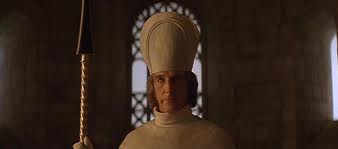 Ladyhawke also has its fair share of good action. Considering Donner's bad feelings towards Richard Lester (who can blame him?), it is ironic that his action sequences, in this film at least, take after Lester's finest work in The Three and Four Musketeers. The fight scenes have some pretty inventive slapstick and Broderick doing all manner of acrobatics, while Hauer gets to swashbuckle and head-butt to his heart's content. The highlight comes in the climactic fight in the church, ending with Hauer throwing his huge sword over several yards right into the heart of John Wood's scenery-chewing Bishop.
 Ladyhawke may not have aged as well as Flesh & Blood or Legend, but it remains a definite guilty pleasure and a bona fide cult film. Its flaws are all in plain sight - the soundtrack, the silly plot, the special effects - and yet none of them can completely eclipse the sheer enjoyment that it brings. If anything these flaws serve to make it more endearing, and more fun than mainstream fare like Robin Hood: Prince of Thieves. Donner would make more consistent features after this, but for pure and simple fun it takes some beating.
Rating: 
Verdict: Silly but sublimely entertaining
Kind Hearts and Coronets (UK, 1949)
Directed by Robert Hamer
Starring Dennis Price, Alec Guinness, Valerie Hobson, Joan Greenwood
Since the brand was revived several years ago, Ealing Studios have developed a reputation for quaintness. With the exception of John Landis' underrated Burke and Hare, the majority of the new Ealing's output has been frothy, often retrograde films designed solely for the export market. How easily we forget that the self-same studio once produced some of the darkest, edgiest and blackest comedies the world had ever seen. And there is no better example of this than Kind Hearts and Coronets, which takes pride of place with The Red Shoes as one of the finest British films of the 1940s. Describing any old film as 'edgy' comes with problems. Changes in social attitudes since the 1940s means that, on one level, filmmakers are now able to show a wider range of subjects to a greater extent than ever before. Under this line of argument, what was once considered edgy, radical or insightful now looks timid and tame. But even if we accept this as a general rule, Kind Hearts and Coronets still stands as a proud and intriguing exception. Like Peeping Tom eleven years later, it has retained its emotional impact even after its aesthetic achievements have been surpassed.
 Kind Hearts and Coronets is a comedy about a serial killer, at a time when the vast majority of films involving murder sought to completely demonise the assailant in question. More than that, it is about a serial killer who vengefully targets the aristocracy, who while waning in power still held a great deal of influence in government and high society. The film is a vitriolic attack on the British class system, thinly disguised as an erudite comedy of manners. To paraphrase Macbeth, it may look like the innocent flower, but it is most definitely the serpent under it, and its venom is ruthless and bitter.
 In a further comparison to Peeping Tom, the film had a rocky ride with the censors when first released. Sir Michael Balcon, then-head of Ealing, sought to distance himself from the film, believing that the public could not handle its ironic treatment of the subject matter. In line with the restrictive Hays Code, the American distributors requested that Robert Hamer added a ten-second epilogue, to show Louis Mazzini getting his comeuppance in a way while the original ending only implied. While Alec Guinness went on to win an Oscar for The Bridge on the River Kwai, neither Dennis Price nor Robert Hamer would ever reach this level of success again. Film critic David Thompson described the latter's fortunes as "the most serious miscarriage of talent in post-war British cinema".
 Many of the classic Ealing comedies used present events to satirise the past and vice versa. Passport to Pimlico satirised both the Berlin airlift and the exile of the Dutch monarchy to Canada, while some commentators have argued that The Ladykillers is a send-up of the post-war Labour government. Kind Hearts and Coronets was made in the year of the Second Parliament Act, which further curbed the power of the House of Lords and with it the aristocracy. The real-life political attack on landed wealth is contrasted with the lethal attacks of Louis Mazzini, with the aristocracy being 'killed off' in both cases.
 Kind Hearts and Coronets has a very poisonous view of the British class system, and in particular of the aristocracy's attempts to justify its position. While marrying out of love may have brought Mazzini's mother poverty, marrying for wealth and "good breeding stock" brings nothing but misery. Whatever diversions the D'Ascoynes may pursue (the navy, photography, the church, hunting) there are a universally inward-looking bunch, with little time for anyone whose interests or backgrounds are not identical to their own.
 Although Mazzini is of noble blood, his training as a draper, shop assistant and bank clerk gives him a middle-class status, something which simultaneously repulses and pleases him because it serves as the perfect cover for his crimes. The closer he comes to his goal of becoming Duke of Chalfont, the more he takes on the characteristics of a D'Ascoyne, shunning his childhood sweetheart Sibella (Joan Greenwood) and refusing to help Lionel in his hour of need. The film brutally depicts the entrenched arrogance of the British elites, something which has persisted longer after the D'Ascoynes of this world have withered away.
 Dennis Price, who had previously found fame in Powell and Pressburger's A Canterbury Tale, is absolutely extraordinary in the lead role. Having been aptly described as "sourly handsome", he presents Louis Mazzini as a man of immense class and sophistication, but who is also capable of being cold, dismissive, callous and sociopathic. Price was always self-deprecating about his acting abilities, describing himself as "second-rate" and "lacking the essential spark." But whatever else happened in his career, this performance is enough to dismiss all such deprecation.
 What makes his performance so interesting is that, for a lot of the time, Price doesn't speak. The prolific use of voiceover gives his performance a silent movie quality - not because his movements are exaggerated, but because his facial expressions and posture play a bigger part in his characterisation. Normally this amount of voiceover could quickly become tedious, but here it works brilliantly, taking us behind Mazzini's mask of dignity. It makes his deadpan expression all the more funny, as the most unspeakable things are uttered without the merest twitch of his lips. It is as though we were inside the mind of a killer, hearing his darkest deeds completely uncensored and without any license on the part of the screenwriter.
 Kind Hearts and Coronets' themes of love and class are also expressed in Mazzini's relationships with women. For most of the film he is taken with Sibella, who marries Lionel but confides in Louis due to their friendship as children, and increasingly out of desperation as just how boring her husband is. Louis strings Sibella along, playing with her heart strings and being glad to kiss her while knowing he can never bring himself to be with her. This is a further example of Louis' corruption as he grows closer to his goal, becoming as cold and as haughty as the people who caused him to swear revenge.
 If Sibella is the proud plaything who is ultimately beneath his stature, Edith (Valerie Hobson) provides the security of wealth and the moral backbone Louis needs. Their initial meeting, while her husband is still alive, indicates that such a marriage would not be any fun: her strong religious conviction forbids drinking, leading her husband to keep gin and whisky in his dark room. Much of the film plays out like a bedroom farce as Louis tries to keep the two women from ever meeting. In the final scene, he has to choose between dull security and loving disgrace, quoting from The Beggar's Opera as he struggles to make up his mind.
 The humour in Kind Hearts and Coronets is as black as can be, with multiple jokes about hanging and all the murders having a comedic quality. These range from the general being blown up as he opens the caviar, to the admiral mistaking port for starboard and sinking his ship, and finally Mazzini's employer dying of shock after inheriting the title. There are dozens of laugh-out-loud moments, such as Mazzini's comments after shooting down Lady Agatha D'Ascoyne: "I shot an arrow through the air; she fell to earth in Berkeley Square." But a lot of the time the film is so edgy and so forthright that you're almost afraid to laugh: the barb is so strong that to laugh is almost too easy a response.
 The film is most popularly remembered for Alec Guinness, who plays all eight members of the D'Ascoyne family. He was originally only offered four roles, but pressed Hamer to cast him in all eight after reading the script. Suffice to say, he's magnificent, with each family member having clearly developed character traits and quirks, and each looking hilariously pompous in all that make-up. The split-screen shooting used to put all eight characters on screen is utterly seamless, and Hamer's direction is totally first-rate.
 Kind Hearts and Coronets is a perfect black comedy, which is as funny as Monty Python and the Holy Grail and as artistically accomplished as the best work of Powell and Pressburger. The performances are all superb, particularly from Guinness and Price, and Robert Hamer's direction gives the film a note-perfect pace so that all the jokes hit the spot. Over 60 years since it took the world by storm, it remains the darkest, edgiest and funniest of the classic Ealing comedies, and will be reducing generations to fits of laughter for years to come.
Rating:
Verdict: A perfect black comedy
Spetters (Netherlands, 1980)
Directed by Paul Verhoeven
Starring Hans von Tongeren, Toon Agterberg, Maarten Spanjer, Renee Soutendijk
Long before he unleashed his particular brand of filmmaking on an unsuspecting Hollywood, Paul Verhoeven was kicking up a fuss in his native Netherlands with a series of playfully provocative films. Having won acclaim for period dramas Katie Tippel and Soldier of Orange, Spetters was the film which set the tone for his later career: lambasted in the press but loved by audiences, and with Verhoeven always having the last laugh. Spetters is a coming of age film set in and around Rotterdam, which follows the stories of three young men aiming to become motocross racing champions. In the manner of all Verhoeven films, it marries full-on sex, violence and strong language with subtle and often intelligent insights into the human condition. The title epitomises this, being both slang for pretty young men and a word meaning 'splatters' - the sound the chip pan fat makes when the female lead tips it down the naked chest of a leather-clad thug.
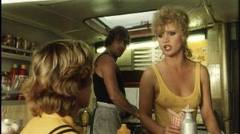 Spetters is what you would get if you put The Wild One, Rebel Without A Cause and Saturday Night Fever in a blender, and then inhaled the contents in the middle of a drunken rave. The latter is most evident in the cocky attitude of the male characters, along with a scene early on of the mechanic Eef showing off in the disco, only to be outclassed by an unnamed rival. The costumes take on elements from all these films, with Eef's penchant for leather nodding towards Marlon Brando and Rutger Hauer's perfect silver hair rivalling anything that John Travolta could produce.
 As you would expect from a coming of age film, much of Spetters is concerned with our male protagonists trying to score with women and coming away with a little more than bruised egos. And coming in the middle of the gross-out wave of Animal House, Porky's and Lemon Popsicle, it's only natural to anticipate that such scenes would leave a sour, guilty taste in the mouth. But such scenes are also a showcase for Verhoeven at his best: setting up a given situation, allowing things to turn a little seedy, and then defying our expectations with a cracking punch-line.
 Two examples in Spetters illustrate this ability. The first comes in the disco when one of the men starts chatting up a black woman. He buys her a beer and starts to stroke her leg, flirting with her in a typically unsubtle way. Despite her protestations, he puts his hand under her dress - and brings it out with a strange yellow gunk on his fingers. We grimace in disgust, only to burst into raucous laughter when the woman lifts up her dress to reveal a jar of mustard between her legs. Talk about taking precautions.
 The second such instance comes soon after, when two of the bikers and their respective girlfriends have snuck onto a building site to have sex. Having chosen their spots, one of the girls reveals that she is on her period - which the boyfriend grossly demonstrates by bringing up two bloody fingers. Hearing his friend moaning and panting next door, he asks the girl to fake having sex with him, and together they try to out-moan their friend. Having assumed that the other couple are having great sex, Verhoeven then cuts to a wide shot which shows said couple doing exactly the same!
But the wild antics of these men are not confined to the bedroom. The racing sequences in Spetters are shot with real energy and panache: Verhoeven gets his camera in close and uses long takes, so that when the spectacular crashes happen, we think that people are genuinely getting hurt. The sense of youthful vigour present in these scenes prevents them from becoming gratuitous: Verhoeven clearly identifies with the drives and urges of these young men, and has sought to communicate this in the most natural way he knows. Having taken its time in setting up the three main characters, Spetters really gets into gear when the main love interest arrives in the shape of Fientje, played with feisty abandon by Renée Soutendijk. She arrives inauspiciously with her brother in tow to run a fast food van in the centre of town, but over the course of the film she seduces all three men, ruining the life of Rien and Eef and changing Hans' destiny forever.
 The film sets up Fientje as a dangerous outsider whom the community does not accept. The only reason the police allow her and her brother to stay is because she gives the officer a 'cup of coffee' (in other words, a sexual favour). Eef's father, who is a devout Calvinist, goes so far as to brand her a "whore of Babylon". But as with Verhoeven's subsequent works, particularly The Fourth Man and Basic Instinct, the role of 'evil women' is not quite as clear cut as would first seem.
 Spetters, like all Verhoeven's best work, calls characters' identities into question and leaves us confused as to whom we are really rooting for. The device of seduction is employed to show just how much there is to becoming a man - in other words, there is more to finding out who you are than losing your virginity, or scoring with the best woman in town. Fientje's own motivations are up for debate: she starts as a serial maneater, a femme fatale who wants Rien's riches for a new fur coat. But in the end she is confused as the others, unsure of herself and of her fate.
 There is some kind of moral point in the fate of the three men. Rien is seduced by the money Fientje gets him through sponsorship, but he ends up losing the only woman he really loved. When he finally gets the chance to express it, he is unable to do so: the accident has claimed not only his ability to perform sexually, but all his accompanying confidence and self-esteem.
 Eef desperately wants to seduce Fientje, but the more time he spends with her, the more he becomes convinced that he is deceiving himself - a conviction which culminates in him coming out as gay and hooking up with her brother. It's an odd way to find yourself, but the end point, the realisation of identity, is the same. Meanwhile Hans, the best-endowed of the group, should be first in line to claim Fientje as his own. But being too shy and inept to pull her, he ends up making something of himself and wins her heart by seeing her as something more than a possible conquest.
 Naturally, all this seduction results in a lot of nudity. Sometimes the flesh-bearing is funny, such as an early sequence of Rien, Eef and Hans in the garage measuring their manhoods with a spanner. But others are deeply uncomfortable, like the very tough sequence of Eef being gang-raped in the subway after stealing from a gigolo. Even for long-term Verhoeven fans, who are used to this kind of thing, you will start to lose patience as the film tips further into lazy soft-core territory.
 Alongside its rampant nudity, Spetters pulls no punches when it has to get violent. Outside of the dangerous racing early in the film, there is one particularly wince-inducing moment where Rien suffers an accident that will leave him crippled. Having been hit in the face by a bag of orange peel, Rien goes flying from his bike, rolls down the verge and (in tight close up) catches his leg on a stone pillar. Having made us squirm and then laugh before, Verhoeven turns that approach on its head to effectively show the demise of this character. The end comes with Rien trundling his electric wheelchair back to the motorway to kill himself - a scene made all the more harrowing by the fact that actor Hans von Tongeren took his own life two years later.
 Spetters is a visceral and often hilarious comedy-drama which offers plenty in the way of thrills and spills. Like a lot of coming of age stories, its plot is far too thin, and it resorts to a few too many gross-out moments to keep us interested. But in the sections when it works, it finds Verhoeven firing on all cylinders, delivering substance in the midst of violent sleaze. It's not up there with The Fourth Man or his early work in Hollywood, but it remains good, guilty-pleasure fun.
Rating:
Verdict: Raucous and relentless
Cronos (Mexico, 1993)
Directed by Guillermo del Toro
Starring Federico Luppi, Ron Perlman, Claudio Brook, Tamara Shanath
Well before the 'abstinence porn' of Twilight began to hit our screens, a whole wave of vampire films in the 1990s returned to the deep well of sex which had become the lifeblood of vampire fiction. We had Anne Rice's AIDS allegory Interview with a Vampire, John Landis' uneven crime drama Innocent Blood, and of course Francis Ford Coppola's bonkers version of Dracula.
But in the midst of these hypersexual offerings, a small Mexican film from a first-time director was helping to radically reshape the genre. Cronos, the debut by Guillermo Del Toro, demonstrated that vampire fiction could explore themes far more varied than sex, such as the fear of death, the loneliness of old age and the relationship between Mexico and the USA. A hugely influential work of horror cinema, it is every bit as striking and significant as Let The Right One In. When I reviewed The Usual Suspects, I remarked that one test of a good filmmaker is being able to take a hackneyed series of conventions, and create something which is both memorable and mindful of its genre origins. On this level alone Cronos is a triumph, since it is able to fulfil all the requirements of being a bona fide vampire film which approaching all the key plot points and characters arcs from distinctively unusual angles.
 Cronos may have a backstory about the origins of the vampire, followed by the introduction of our protagonists to said bloodsucker which results in quite a lot of gore. But Del Toro manages to achieve this while removing from the story all connotations of sex or lust. In place of Hammer's heaving bosoms and phallic fangs, he gives us skin peeling like wallpaper and the intricate clockwork of the Cronos device. The closest the film comes to anything sexual is a scene of Federico Luppi licking a nosebleed off a bathroom floor, which is shot with such clinical precision that there can be no room for erotic thoughts.
By refocusing the story around ageing and the fear of death, Cronos hits on the central dilemma in vampire fiction: would you rather live forever but lose your soul, or stay pure and human but live in constant fear of death? Both the elderly characters in the film choose the former, albeit for different motives and by entirely different means. Dieter, the dying businessman, makes a conscious decision to pursue the device: he owns the manual needed to operate it and believes it is the only thing that can keep him and his empire alive (and out of his nephew's hands). Jesus, on the other hand, is 'bitten' accidentally, and only comes to use the device frequently through observing its physical benefits. His desire, in the form of addiction to blood, is every bit as strong as Dieter's desire to possess the device himself, but it is not motivated by selfishness or a desire for power. Like Dracula, Jesus becomes weary of eternal life: he is worn down not by an army of brides, but by the constant torment of those who are jealous of his powers. In the end his remaining sense of self triumphs over the vampire he has become, and he sacrifices himself to protect his beloved granddaughter.
The theme of ageing is also conveyed in the visuals of Cronos. Guillermo Navarro's cinematography is very washed-out, with dark woods and fading reds to indicate how everything around the characters is very slowly dying or decaying. Even the brightest scenes in the film, like the New Year's party, are filled with pale colours and make use of shadows wherever possible. Beyond its direct connections with the vampire genre, Cronos is connected to other key figures in horror. The design of the Cronos device itself, with its peculiar blend of biology and mechanics, resembles the work of Clive Barker: its design as is intricate as the puzzle box in Hellraiser and there is the same suggestion of great evil being contained in or brought forth from something of great beauty.
 There are also connections with John Carpenter in the film's elaborate and highly convincing make-up. Del Toro's training under make-up artist Dick Smith shines through in his pursuit of organic, physical terror, and the work of his make-up artist M. Carrajal rivals anything which Rob Bottin achieved on The Thing. There is a further connection with Carpenter contained in a line where the device is dismissed as "just a toy". Like Carpenter in Hallowe'en, Del Toro is taking an aspect of horror which had become institutionalised and accepted, and proving that it could still scare you to death.
 Cronos is a deeply religious film, in its use of iconography and its exploration of the meanings to both life and death. Again, this is drawing on a classic trait in vampire fiction, namely that the act of being or becoming a vampire is a rebellion against the laws of nature (including death), which it was believed were set in stone by God. Though there is no scene of Jesus declaring war on heaven, as happens in the Coppola version, his faith is counterpointed by his growing dependence on the device, as demonstrated by him reciting the Lord's Prayer while allowing it to stab him a second time.
 There are other indications of these religious themes as well. The Cronos device was created by an alchemist, someone who brought the material and spiritual worlds together, using what became the scientific method to find the divine substance which could cure all disease and prolong life. The images of cockroaches bursting out of angels, or the device being hidden in said statues, hints at the threat which such a device poses to Christianity. By removing the certainty of death, it undermines the corresponding fear of death and damnation, and therefore makes it less necessary either to repent or to live a moral life.
 To add to its theological wrangling, Cronos also has political connotations. The film is a rich allegory for US-Mexican relations, in which America is the bloodsucker which takes without asking and refuses to yield. Dieter, the American, is determined not to let the Mexicans (in the shape of Jesus) get one over on them - the second they come up with something useful, the Americans want it for themselves and won't take no for an answer. There is a contrast between Federico Luppi's sympathetic, caring grandfather and Ron Perlman's aggressive and ambitious nephew. Perlman may slip in and out of Luppi's language, but he is only interested in himself - it is not communication, only giving orders in a language he thinks they can understand.
 The performances in Cronos are mostly of a high quality. Luppi is a great screen presence, seeming frail and vulnerable while coming across as a strong and determined character. Perlman, in his first of several collaborations with Del Toro, is a very fine match for him. His versatility with language is matched only by his desire to throw himself physically into the role. The only weak link is the young girl, played by Tamara Shanath. It isn't so much her performance as the limited extent of her character's development; we don't feel as strongly connected to her as we do with her counterparts in The Devil's Backbone or Pan's Labyrinth.
 Cronos is a great debut feature from one of horror's greatest directors. While not as perfectly formed as Pan's Labyrinth, it contains all the hallmarks of Del Toro's genius, from its powerfully unique visuals to its constant invention and intelligence even in the most trivial of moments. It's a top-notch chiller and a welcome shot in the arm for vampire fiction, proving that the genre is still able to stimulate as well as scare. It's not Let The Right One In, but it should be welcomed into anyone's collection.
Rating: 
Verdict: Creepy, chilling and very clever


