
Reflections
-
It is weird to read my correspondences from the late August/early September
period, being the time of transition between my old function in life to my
new ...
14 years ago
Ladyhawke (USA, 1985)
Directed by Richard Donner
Starring Matthew Broderick, Rutger Hauer, Michelle Pfeiffer, Leo McKern
When it comes to 1980s fantasy, there are three broad categories into which films can fall. There are those like Flesh & Blood, which get the balance between substance and silliness spot on, marrying Machiavellian mercenaries to grin-inducing battle scenes. There are those like Excalibur, which take themselves so seriously that they're fatally dull. And there are those that are totally, utterly, and enjoyably silly - and into that category goes Ladyhawke. Ladyhawke is of historical interest due to its place in Richard Donner's career. The fiasco surrounding Superman II, on which he was replaced mid-shoot by Richard Lester, had thrown Donner's career off-course: he had to watch Superman II and III take huge amounts of money while he delivered flops like Inside Movies and The Toy. But either side of this film, he found himself very much in mainstream favour again, first with The Goonies and later with Lethal Weapon. It is interesting that a director whose place in history has been defined by blockbusters (including, of course, The Omen) should be capable of making something so delightfully odd in the midst of two more rounded and confident efforts.
 Like many 1980s fantasies, there are aspects of Ladyhawke to which time has not been kind. The most obvious of these is Andrew Powell's soundtrack, which was nominated for a Saturn award in 1985 but has since become regarded in some quarters as one of the worst ever composed. After Toto's contributions to Dune, it became more common for pop groups or composers to score films, due to the selling potential of the groups and the relatively cheap cost of synthesised music. But Powell's efforts go just too far even to be enjoyed ironically, with its overproduction and bouncy pop timbre frequently jarring with the quieter moments.
 The score is one aspect of Ladyhawke which confirms its inherent silliness, even before we get to the meat of the story. Another such aspect is its visuals, which manage to look lavish and professional while still feeling ropey and cheap. The film is shot by Vittorio Storaro, who famously shot Apocalypse Now - something which is evident in the multitude of blood-red, beautiful sunsets which are central to the plot. But in amongst the terrific scenes of frozen lakes, dark forests and crisp skylines, there are numerous scenes which look like they were filmed in a hurry, treading unintentionally close to Monty Python and the Holy Grail.
 This feeling of cutting corners is reinforced by the paucity of special effects. For a film in which people metamorphose into animals on a daily basis, the special effects of Ladyhawke are coy to say the least. Apart from a few shots where Michelle Pfeiffer's eyes change shape in close-up, all the big transitions happen off-screen; on several occasions Matthew Broderick leaves the room just beforehand, as though the actors had to go off-stage to change costumes. While Donner wouldn't have had access to the CG wizardry we take for granted, there was plenty of scope in the physical effects of the time to achieve something a little more palpable. Only four years earlier Rick Baker produced the definitive werewolf transformation for John Landis, in a film with half of Ladyhawke's total budget.
 Added to this shortcoming we have a number of plot holes which either confuse or produce unwanted tittering. First there is the problem of clothes: Rutger Hauer and Michelle Pfeiffer keep the same outfits throughout, but there's not much effort to keep the clothes together when one of the pair is in animal form. Then there is the question of memory. The film borrows the horror device of the person having no memory of what they did as a beast - so how come the hawk remembers to stay with her master, or the wolf not to eat his mistress? Finally, there are several blatant continuity errors. We are told that Pfeiffer appears as an eagle whenever it is daylight, and yet there are at least two scenes where it's daylight and yet she is still there. At least when Shrek half-inched the plot, it was consistent throughout.
 But in spite of these problems, Ladyhawke is a consistently entertaining little romp. Like Logan's Run nine years earlier, it's only when you stop trying to take it seriously that its ideas and emotional impact bubble to the surface. And like Logan's Run, this transition is cemented via a dominant performance by a great actor - not Peter Ustinov, but Leo McKern.
 Most famous for playing Horace Rumpole in the long-running TV series Rumpole of the Bailey, McKern had courted cult status at various points in his career: as veteran reporter Bill McGuire in The Day The Earth Caught Fire, as a recurring Number 2 in The Prisoner, and in his previous outing with Donner as a mad archaeologist in The Omen. But whereas that last appearance was a silly cameo in an otherwise seriously creepy film, here McKern brings weight and gumption to an otherwise facile concoction. Like Ustinov before him, he puts a brake on excessive silliness, if only for a moment, in order to steer the viewer towards the emotional heart of the film.
 Not only is McKern's delivery well-suited to disguising exposition, but he illuminates some cracking lines in the script. Most of the wisecracks go to Broderick, who is on very fine form; his soliloquys with God about telling the truth and resisting temptation are guaranteed to raise a smile. But McKern's timing is note-perfect, as he waits for a knight to fall right through the drawbridge before quipping: "Always walk on the left side!". Best of all comes when Broderick brings him the hawk after it has been wounded by an arrow. Having been told that he can't eat it, McKern bellows: "What? Is it Lent again already?!"
 While McKern's performance is the icing on the cake, the other major players are also firing on all cylinders. Rutger Hauer seems naturally suited to the historical romp, whether as a heroic figure here or as an antihero in Flesh & Blood. His typically brilliant screen presence, being equally charming and threatening, suits the personality of Navarre as a knight tormented by the woman he loves but cannot have. And while Michelle Pfeiffer's hair may be straight out of a pop video, she too fits her character very nicely. Her beauty conveys both the innate sense of mystery about Isabeau and the vulnerability of her predicament. She's so convincing, in fact, that you keep recognising her facial features in those of the hawk.
 Having these two charismatic performances goes some way in making the romance at the heart of the film feel believable. Somehow the grandiosity of the setting gives the relationship more weight, making it feel like there is more at stake than with similarly inseparable lovers in more mainstream rom-coms. The story is an interesting variation on the age-old tale of two people destined to be together but cursed to be apart, and for all the ridiculous elements within the central conceit it does end up pulling you in.
 This emotional pull is most evident in two scenes towards the end. The first occurs when Philippe finds Navarre lying next to Isabeau as a wolf. The sun begins to rise, Isabeau begins to change, and for a split second both see each other with human eyes. Navarre reaches out to touch Isabeau, only for her to change and fly away, leaving him beating the earth in frustrated rage. The other comes during the solar eclipse where the two are reunited and the curse is broken. The slow pacing and distance between them prior to their first real contact reinforces the strength of the bond between them.
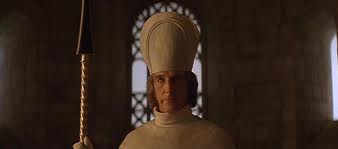 Ladyhawke also has its fair share of good action. Considering Donner's bad feelings towards Richard Lester (who can blame him?), it is ironic that his action sequences, in this film at least, take after Lester's finest work in The Three and Four Musketeers. The fight scenes have some pretty inventive slapstick and Broderick doing all manner of acrobatics, while Hauer gets to swashbuckle and head-butt to his heart's content. The highlight comes in the climactic fight in the church, ending with Hauer throwing his huge sword over several yards right into the heart of John Wood's scenery-chewing Bishop.
 Ladyhawke may not have aged as well as Flesh & Blood or Legend, but it remains a definite guilty pleasure and a bona fide cult film. Its flaws are all in plain sight - the soundtrack, the silly plot, the special effects - and yet none of them can completely eclipse the sheer enjoyment that it brings. If anything these flaws serve to make it more endearing, and more fun than mainstream fare like Robin Hood: Prince of Thieves. Donner would make more consistent features after this, but for pure and simple fun it takes some beating.
Rating: 
Verdict: Silly but sublimely entertaining
The Ninth Gate (France/ Spain/ USA, 1999)
Directed by Roman Polanski
Starring Johnny Depp, Lena Olin , Frank Langella, Emmanuelle Seigner
With the notable exception of Se7en, numerical horror-thrillers are utter rubbish. With their ridiculous twists, over-the-top acting and an overreliance on special effects, they epitomise all that is banal and disappointing about these two genres. You would think that Roman Polanski, the man who gave us Repulsion and Rosemary's Baby, would be able to handle such well-worn material in at least a workable manner. But instead we end up with a ripe old stinker every bit as disappointing as Prince of Darkness. Polanski has always been a fan of absurdist, quirky comedy, being greatly influenced by France's crown prince of absurdity, Eugene Ionesco. While absurdity in and of itself is no bad thing, Polanski has always been at his best when this aspect of his sensibility has been minimised, or at least properly accommodated. You have to admire him for being able to switch between bleak, serious works like Tess and The Pianist, and something more fun and frothy like Frantic. But his out-and-out exercises in comedy have dated very badly, with What? being the worst example.
 Further doubts are raised by Polanski's attitude towards the source material. When interviewed in 1999 he said that he didn't believe in the supernatural - something you would never have guessed from Rosemary's Baby. He was drawn to the novel El Club Dumas by Arturo Pérez-Reverte because it was an opportunity to play with the clichés of a genre that he enjoyed. The consequence is that we aren't sure how seriously Polanski is taking things, and therefore how seriously we should be taking him.
 The Ninth Gate starts off quite atmospherically, with good pacing, dusty books and nice gothic colours. Film noir touches are evident throughout, from the archetype of the downbeat detective (or "book detective" in this case) to the enigmatic women in his life. Like so many noirs or Hitchcock films, the blond is enigmatic but for the most part on the hero's side, while the brunette is seductive and passionate to the point of being pure evil.
 Having set things up quite nicely in the first ten minutes, The Ninth Gate starts to crumble as more and more ridiculous elements encroach. We might swallow the story about the three copies of The Nine Gates, if only because Frank Langella sounds authoritative as he wades through exposition. But subsequent developments are so clouded or convoluted that we quickly give up trying to figure it all out, insofar as there is anything to figure out. It feels like the sort of thing that Polanski could have done in his sleep - and for much of the film, he might as well have done.
 All the big plot points in The Ninth Gate can be anticipated because they borrow all too heavily from better genre efforts. Having Dean Corso commissioned to search for The Nine Gates is exactly the same set-up as Angel Heart, but with a book instead of a jazz musician. His infiltration of a secret ceremony is lifted from The Wicker Man, and the mansion scenes strongly resemble Eyes Wide Shut, although this may be coincidental. There are also very standard references to The Omen in the use of 666, for instance, The NINE Gates being published in 1666. There is even a nod to An American Werewolf in London, as Corso arrives at the castle in a truck full of sheep.
 Having given up on taking The Ninth Gate seriously, the next logical step is to try and enjoy it as a comedy, perhaps as an unintentional one. But the comedic elements are so completely at odds with Polanski's execution of the twists that they feel like they have escaped from a different film. The twin brothers, who are played by the same actor via split screen, bumble their way through their lines like a cross between Thomson and Thompson from Tintin and Alf Garnett in Till Death Us Do Part.
 The silliness of the supporting characters increases as the film moves on. Baroness Kessler, played by Barbara Jefford, is introduced as a formidable character of real threat to Dean Corso - who then slips almost immediately into pantomime villain mode when we discover that she only has one hand. Corso later finds her slumped in her motorised wheelchair having been strangled: he turns the wheelchair around, only for her to go careering through the double doors, like Mason Verger's death in Hannibal two years later.
 Like many numerical thrillers, The Ninth Gate suffers from dodgy special effects. It's hardly a dull car crash like End of Days, in which Gabriel Byrne demonstrates his demonic power by blowing everything up, and Arnold Schwarzenegger try to stop him with a grenade launcher. But alongside bad continuity and an unconvincingly burnt book, there are at least two examples of dodgy wire work, in which Emmanuelle Seigner floats down into a scene, without any prior clue that she could fly.
 The Ninth Gate is littered with irritating plot holes which leaving us scratching our heads even in the moments when generic convention could fill in the gaps. There is no explanation of the serpent tattoo on the brunette's back, nor of Boris Balkan's ability to know exactly where Corso is at any one time - which is, conveniently, always within reach of a phone. But more annoying than either of these is Polanski's contempt for the subject matter. It's hard to believe that either Corso or Balkan know or care so much about rare tomes when they treat them so carelessly. They don't bother to handle them with gloves, flip through ancient pages like they were airport paperbacks and carry them around in scruffy bags which get flung everywhere.
 This care-free attitude spills over into the performances. Johnny Depp had wanted to work with Polanski for some time, but Polanski didn't tell him that he wasn't giving the performance that he wanted - in other words, he was almost completely undirected in the role. To be fair to Depp, he gets the physical stuff right, modelling himself on Raymond Chandler and being more convincing than he is in Secret Window. But otherwise it's pretty phoned-in, with Polanski being unable or unwilling to tease out the greatness that Tim Burton or Terry Gilliam had managed.
 Frank Langella is no stranger to trashy villains, having played Skeletor in the awful He-Man movie, Masters of the Universe. He does the best with a surprisingly underwritten role, looking a little bit like Michael Redgrave in The Dambusters. Lena Orin has far too little to do beyond flashing her stocking tops in the first half-hour and then dressing up like the actress from Scottish Widows for the satanic ceremony. As for Seigner, she does a good demon stare, but otherwise she's too airy-fairy, wafting through the scenery as if she doesn't really care who she's playing or what she's doing. In any case, it's essentially the same character she plays in Frantic - the quirky outsider who helps the male protagonist, only this time she's the devil as well.
 The final nail in The Ninth Gate's coffin comes with its ending, which is hopelessly dragged out and completely incoherent. We get to see Langella self-immolate and fail to pass through the Ninth Gate - but that's not the end. Seigner makes love to Depp against the flames with her demon eyes, the camera zooms in on Depp as if he realises who she is all along, and he seems about to scream - but that's not the end. After the two drive back, and Seigner remarks "is that it?" (to which the answer is "no"), Depp goes back to the bookshop and finds the missing page - but that's not the end. Depp then goes back to the castle and the screen fades to white, in one of the most shambolic and unsatisfying endings in 1990s cinema.
 The Ninth Gate is an example of what happens when a great director indulges themself to the extent that they no longer feel the need to try. As an exercise in supernatural horror it is every bit as rubbish as Prince of Darkness: Polanski's film looks better, but Carpenter's was shorter. In attempting to put his stamp on overly familiar elements, Polanski fails to deliver chills, thrills or knowing laughs. Thank God that he redeemed himself beyond all recognition just three short years later.
Rating: 
Verdict: One of Polanski's few bad films
The Boys from Brazil (USA, 1978)
Directed by Franklin J. Schaffner
Starring Gregory Peck, Laurence Olivier, James Mason, Jeremy Black
From the sadistic Amon Goeth in Schindler's List to the pantomime Gestapo in Raiders of the Lost Ark, Nazis have consistently proven themselves to be Hollywood's most reliable villains. The costumes, accents and mannerisms are so easy to recognise and replicate that a wide range of characters can be created. Nazis on film can be cold, ruthless and heartless, or scenery-chewing cannon fodder - the enemies of democracy, or something more playful and harmless. Coming three years before Raiders, The Boys from Brazil attempts to have the best of both worlds. It attempts to explore serious ideas about history repeating itself and the dangers of scientific progress, within the confines of a pulpy plot and a great deal of hammy acting. In the end it does veer sharply towards the silly end of things, but even if it can't compete with Steven Spielberg, there is still much to cherish and enjoy.
 Considering the context in which it was made, it's fair to assume that The Boys from Brazil carried a great deal more weight than would appear immediately obvious. Coming only 16 years after the capture of Adolf Eichmann, it was still faintly credible to believe that there were dozens of ex-Nazis hiding out in South America, harbouring bitterness and plotting to 'put things right'. Likewise this was nearly 20 years before Dolly the Sheep was created; cloning was still the stuff of science fiction, and the lack of palpable examples in nature made the prospect of a Fourth Reich all the more terrifying.
 This feeling of weight is compounded by the talent on both sides of the camera. The film is based on a novel by Ira Levin, whose previous works, Rosemary's Baby and The Stepford Wives, had captivated the public both in print and on the big screen. Franklin J. Schaffner had demonstrated his ability to combine politics and populist entertainment in both the original version of Planet of the Apes and the Oscar-winning Patton. And then we have the two male leads, one a beloved Hollywood veteran, the other hailed as the greatest actor ever to grace the English stage.
 With the bar set so high, you could be forgiven for reacting badly to the finished film. There is a conflict between the serious talent involved and the essentially pulpy, trashy nature of the story, which means the film has neither has the grace or poise to be a truly 'serious' work, nor the knowingness needed to take it into Flash Gordon territory. Some of the sillier moments of the film may produce the same belly-laughs and face-splitting grins that Mike Hodges achieved, but for the most part it is sadly unintentional.
 Part of this silliness, as has been mentioned, comes from innate contrivances in the plot. While there is great potential in the idea of old Nazis cloning Hitler to bring back their great empire and enslave the world all over again, the idea falters when the actual technology is examined. We are asked to believe that the cloning technology we see on screen is both cutting-edge - according to Bruno Ganz - and would have been available some 25 years ago, so that Gregory Peck's Dr. Mengele could have come up with such a scheme in the first place.
 If you manage to get beyond this initial trifle, there are various other contrivances and plot holes surrounding the mystery element of the film. Even if Ezra Lieberman were the most highly-skilled Nazi hunter in the world, it seems unfeasible that he could pick up the trail so quickly simply by sorting through newspaper clippings of civil servants. Furthermore, if Mengele's plan is to condition the young Hitler clones, why does said conditioning start with the fathers being murdered? Surely to be properly effective, the boys would have to be encouraged to be artistic rather than just assuming that they would be genetically? Finally, there is the small matter of the money - for all the stories about Nazi gold hidden in Swiss bank accounts, it's hard to imagine James Mason and his associates living quite so lavishly without detection.
 Then there are the performances to consider. Peck had recently returned to public prominence through his role in The Omen, which avoided becoming preposterous by the gravity and subtly of his performance. In this, however, he is hamming it for all his worth, scowling at the camera, chewing the scenery and spitting out his lines in a German accent which, to be kind, comes and goes. Laurence Olivier is equally ripe, although his accent is more ridiculous and wanders more obviously. The fact that he was Oscar-nominated for his performance is proof that the film, and perhaps the Academy, had gotten sillier with age.
In a way, though, the performances hold the key to enjoying or understanding the film. Once you accept the hammy tone both Peck and Olivier are going for, your opinion slowly adjusts from one of mild disappointment to embracing the film as a piece of trashy fun. From this point of view the two leads are enjoying themselves, and in their final confrontation much of that enjoyment rubs off on us. Considering that both actors were well over 60 (and Olivier was recovering from kidney surgery), it's a thrill that they could actually do the fight scene, let alone do it so well. If the fight scene is a case of 'spot the stunt double', then the supporting cast is one of 'spot the famous face'. One of the murdered fathers is played by Michael Gough (Batman's butler), and his wife is Prunella Scales, best known for playing Sybil in Fawlty Towers. Walter Gotell, famous for his role as a Soviet agent in the Bond films, makes an appearance as one of Mengele's oldest allies. He gets one of the funniest lines in the film early on, when he remarks: "And by killing this old mailman I will be fulfilling the destiny of the Aryan race?".
Bruno Ganz, who would ironically play Hitler in Downfall years later, shows up later on as a professor specialising in cloning. He makes the most of what is essentially the Basil Exposition role: his job is to explain how cloning works so we and Olivier can join the dots and unleash the twist. There is also a very good performance by Jeremy Black, who goes through a multitude of accents and one very bad haircut to convincingly play all the different clones of Hitler. The film also has its fair share of B-movie special effects which somehow make it more endearing. Aside from fairly standard acts, like a dummy being thrown off a dam and Bobby's dad falling strangely after being shot, we have the sequence of Peck being mauled to death by several Alsatians. Here we get false arms dangling off Peck's body, obvious make-up (with scars that are raised up off his forehead) and bucketloads of giallo-red blood.
 Within these final scenes The Boys from Brazil attempts - and partially succeeds - to touch on the serious issue at the heart of its story. It explores the danger of fascism or other tyranny returning if people forget about it; Mengele's experiment is possible because even those charged with bringing Nazis to justice have lost faith in their cause. There is also an argument about pre-emptive justice, i.e. should the clones be killed for what they may become, or should they be left to develop and choose their own destinies. The film does well in showing both sides of the argument; Lieberman destroys the list of the 94 boys, but then in a classic Levin twist, we see Bobby Wheelock in his dark room, staring with a morbid fascination at Mengele being ripped to shreds...
 The Boys from Brazil is an interesting and enjoyable if completely silly film, which brings several interesting issues to the fore while providing ample in the way of entertainment. It's not as successful as Rosemary's Baby or The Stepford Wives, either as an adaptation of Levin's work or as a deeply disconcerting piece of filmmaking. But once we have embraced its hammy exterior, and forgiven its more obvious shortcomings, it emerges as something with bombast, brio, and just a little bite.
Rating:
Verdict: Suspenseful but silly
Indiana Jones and the Kingdom of the Crystal Skull (USA, 2008)
Directed by Steven Spielberg
Starring Harrison Ford, Karen Allen, Shia LeBoeuf, Cate Blanchett
Nostalgia is a very dangerous thing. Having great memories of a certain point in one's life is fantastic, but any attempt to recapture that moment when everything around you has changed is bound to end in failure. All that remains once the forced smiles have disappeared is a sad sense of disappointment and an increased awareness of the rapid passage of time.
It is with a similarly heavy heart that we approach the fourth, but perhaps not final, Indiana Jones film, which comes 19 years after the original trilogy bowed out on a high with Indiana Jones and the Last Crusade. It's been a long time coming, having gone through various scripts and directors since The Young Indiana Jones Chronicles wrapped in the mid-1990s. Steven Spielberg, who felt he had matured as a filmmaker since the originals, only agreed to make a fourth film if he could guarantee the fans something new and entertaining. And in all fairness, he has partially succeeded. The problem, as Spielberg readily admits, is that so much has changed since the original trilogy. On the one hand, there have been many films, if not entire franchises, which have unashamedly ripped off Indiana Jones. Romancing the Stone, Tomb Raider, National Treasure, even The Da Vinci Code, all try to do their own version of the films with varying degrees of success. On the other hand, the action genre has changed beyond recognition, through the work of John McTiernan, the Wachowskis, Paul Greengrass and (unfortunately) Michael Bay. Just as James Bond looks out of place next to Jason Bourne, so Indiana Jones feels at best like affectionate old hat.
What this all means is that 'Indy 4' has the dual burden of having to update the series to give it a relevance or purpose, while also retaining the nostalgic, B-movie aesthetic and pantomime content which made the originals so much fun. To everyone's surprise, and some disappointment, what we end up with is just more of the same. It's delivered every bit as efficiently and light-heartedly as the originals, but with an even more deliberate nostalgia and not much of an attempt to argue its case for existing. Proof of this is easily found in the plot, which borrows heavily from the first three films. The central strand, about recovering an ancient religious artefact which may have magical powers, is a straight lift from Last Crusade, only with Mayan mythology rather than Christian icons. The involvement of foreign armies (the Russians on this occasion) sits very closely to Raiders of the Lost Ark, with Cate Blanchett's character filling in for both the poncy archaeologist and the Gestapo officer. And the scenes of underground tribal warriors clearly resemble the mine scenes in Temple of Doom, with vague, heavily watered-down hints of Apocalypto.
All that has been said so far makes the film seem like a simple case of George Lucas betraying the fans that made him rich and famous, ruthlessly milking a cash cow while flogging a dead horse. One of the big criticisms centres on the involvement of aliens in the story, which brings with it a lot of special effects and the kind of preposterous mythological dialogue which was already quite silly when The Omen was being made. But, at the risk of a massive backlash, this idea is more or less in keeping with the spirit of the series even if its execution is not. The work of Erich von Däniken, about the possibility of extra-terrestrial influence on prehistoric societies, is every bit as preposterous as the legend of the Holy Grail - it doesn't in itself make the story any less compelling or entertaining.
Just like its predecessors, Indiana Jones and the Kingdom of the Crystal Skull is at heart an upmarket B-movie, which pays tribute to the matinee idols and boys' own adventures of Lucas' and Spielberg's youth. The new material (well, I say new) is handled in the same pulpy way as the other plots: it matters in relation to keeping up with the story, but you don't have to go away and think about it afterwards. And the film does a fairly decent job of showing how certain aspects have moved on; there's a sad moment of Indy looking at photos of Henry Jones Sr. and Marcus Brody on his desk, but we don't linger on the details long enough for it to get mawkish. Spielberg has always been as his best directing light-hearted, crowd-pleasing popcorn fodder; even when the films are familiar in terms of story and themes, they are better assembled and more engaging than his 'serious' works. And in this film there is a lot of fun to be had. There's nothing quite as witty as the sword vs. gun fight in Raiders of the Lost Ark, or all the banter between father and son in Last Crusade. But the scene where a fight breaks out between the rockers and the jocks to the sound of 'Shake Rattle & Roll' is guaranteed to put a smile on your face.
 Like the originals, there is an element of silliness involved. If you find yourself losing it when Indy survives a nuclear blast by hiding in a lead-lined fridge, then you're not going to get through it. But for those of us who are left, the film manages to keep up the entertainment just enough for us not to notice. Let's be honest, if you handle a guy who manages to survive such amazing stunts, even at this ripe old age, then a prospect of crystal aliens or a sand-based obelisk with a lake underneath isn't going to faze you.
 The stunts and set-pieces in Crystal Skull are also generally well-played. Most of them refer directly back to the previous films - the truck chase through the jungle begins almost exactly like the truck chase in the first film. Others are more generic, such as the cars racing along a cliff or driving a motorcycle through a building. As before, these scenes are unremarkable but efficiently delivered, and they deserve credit for mostly avoiding CGI, with Harrison Ford still doing most of his own stunts.
 Elsewhere we have John Hurt and Cate Blanchett having a good time chewing the scenery, and Ray Winstone turning even the silliest line into something vaguely threatening. The one weak link is Shia LeBoeuf, who isn't convincing either as Indy's son or as a rebel-without-a-cause. When he first romps on screen, looking like a kid dressing up as Marlon Brando, you sort of forgive him and expect improvement. But he simply isn't charismatic enough to carry the film, let alone any future instalments.
 Indiana Jones and the Kingdom of the Crystal Skull is not a terrible film by any means. It recaptures the tone of the originals very well, something which is both its biggest strength and its greatest weakness. It is staggeringly unremarkable in its plot and execution, but at under 2 hours long it is much less bloated and baggy than either the Star Wars prequels or the Pirates of the Caribbean series. In the end, it's probably as good, if not slightly better than we had any right to expect. But if a fifth instalment should come along soon, it might not be so easily embraced.
Prince of Darkness (USA, 1987)
Directed by John Carpenter
Starring Donald Pleasance, Jameson Parker, Victor Wong, Lisa Blount
With any kind of film surrounding the supernatural there is a very fine line between profound and preposterous, between the sublime and the ridiculous. Prince of Darkness desperately wants to be taken seriously, but it ends up every bit as laughable and stupid as Exorcist II: The Heretic. While not John Carpenter's worst film (that honour is reserved for Ghosts of Mars), it remains one of his most obvious and embarrassing failures. Prince of Darkness is the middle instalment of Carpenter's 'apocalypse trilogy', three films which share the premise of a deadly force which could destroy humanity if fully unleashed (the others being The Thing and In the Mouth of Madness). For all the pretentions and incoherence of the latter, Prince of Darkness is by far and away the weakest of the trilogy. What should have been an interesting take on an age-old battle between good and evil ended up as a higgledy-piggledy hotchpotch of incongruent ideas, resulting in a rubbish horror movie which neither scares nor thrills.
To be fair, Prince of Darkness is at least trying to explore a number of interesting ideas. Its central thesis is that evil is something physical, something which can be studied scientifically rather than being confined to ethics and theology. Good and evil are characterised as matter and anti-matter, and just as God came to Earth in human form to save Mankind, so evil has to inhabit the physical to unleash its full potential. There is also within the classic fear of the unknown, which Carpenter had previously explored in both Hallowe'en and The Thing. There are some fairly standard discussions about quantum theory, Schrodinger's Cat, and how logic breaks down at a sub-atomic level. But apart from the last five minutes, and scraps of expository dialogue throughout, these themes are barely addressed in a head-on way. The film is a mishmash of horror clichés, assembled and directed in a shambolic manner which you would not normally associate with John Carpenter. The screenplay seems to have enough ideas for three or four very different films. But rather than elaborate on any particular one, Carpenter decides to throw them altogether in the hope that all the pieces would fit.
 The plot of Prince of Darkness starts out relatively straightforward: there is a green canister in an abandoned church which has sentience and intelligence, and may or may not be the Devil. But then we have to believe that this liquid has the ability to move objects through telekinetic power, and that people can become possessed by having the liquid squirted into their mouths. And then, we have the twist involving a world behind mirrors, which probably served as the inspiration for Into the Mirror over 20 years later. And then, there's a whole caboodle about shared dreaming caused by tachyon beams from the future. The film keeps piling one badly executed plot point on top of another until all credibility has evaporated.
This overburdening of the plot also causes a disturbing number of plot holes, some of them amusing, some of them annoying. For instance, if the canister containing the green liquid is supposed to be impregnable, how come is it leaking out and collecting on the ceiling? Come to think of it, why is it defying gravity by leaking upward? And why, oh why, do the people just stand there, open-mouthed, so the liquid can be sprayed straight at them? Then there are all sorts of questions raised by the concept of shared dreams. The dreams are supposedly a message from the future, warning against the return of Satan. But if Satan did return, bringing the 'anti-God' with him, surely the universe would have been destroyed and there would be no way to send the message? Alternatively, if our heroes succeed in stopping him, surely the messages wouldn't exist in the first place, and therefore the dreams would stop at the end of the film? And why do the dreams change after Danforth has gone through the mirror?
 The film is also sub-standard on a visual level. There are several half-decent locations, like the abandoned church and the university campus which resembles the quiet suburbia of Hallowe'en. And some of the special effects are okay, like the swirling canister or the decaying flesh make-up on the 'chosen one'. Beyond that, it's just another haunted house, populated by characters who deliver cheesy lines about the church being abandoned and how "this place gives me the creeps". Carpenter is a great low-budget filmmaker, but he simply doesn't do anything interesting with the location, using very conventional architecture as the main sort of threat.
 Much of Prince of Darkness is completely ridiculous, being hugely derivative of other, better horrors. The motley bunch of devil worshippers outside the church, including rock legend Alice Cooper, are a straight lift from both Rosemary's Baby and George Romero's zombie films, due to their silence and unified motion. There have been dozens of films about demonic possession, but the use of water as diabolical ectoplasm is a total rip-off of The Exorcist. The regenerating flesh of the 'chosen one' is second-rate H. P. Lovecraft, and Donald Pleasance's seemingly mad priest is pinched from Patrick Troughton's character in The Omen.
But the biggest debt owed by Prince of Darkness is to the Quatermass series. Carpenter was a big fan of Nigel Kneale to the extent that he credited his screenplay to 'Martin Quatermass'. Ironically, Kneale was irritated by this association, due to his bad experience as the original screenwriter of Hallowe'en III: Season of the Witch. The idea of an ancient evil being something physical (or at least quantifiable) was handled superbly in The Quatermass Experiment, which took a ghostly story about possessed astronauts and turned this into a physical threat every bit as terrifying as the Thing. Prince of Darkness is like a poorly scripted, badly made version of that story, with all the true terror taken out. We then come to the small matter of characters. Even when Carpenter was soft-peddling, he could always be relied upon for interesting, offbeat characters who would rise to the challenge. In Prince of Darkness, the acting is wooden, the characters are bland, and the character development is almost non-existent. Brian and Danforth go straight from meeting for coffee to sleeping together, and even though there is only one kiss between them for the rest of the film, we have to believe that they are passionately in love.
For all its great ambitions, the film is effectively a slasher by proxy. There are so many characters running around that we don't have enough time to form proper emotional bonds. Hence when people start getting picked off, we just don't care - even the sight of Alice Cooper stabbing someone with a bicycle is dull. We aren't all that sorry for Danforth when she gets dragged into the other world, before the mirror is smashed by a conveniently-placed axe, trapping her forever. If a film about pure evil can't make us connect with the good guys, then something has gone terribly wrong. As if that wasn't enough, we also have to put up with some out-of-place comedy. One character, played by Dennis Dun, makes all kinds of stupid verbal faux pas which are badly written and out of context. While being hunted down by the possessed women, he makes jokes about a Jewish woman marrying a African doctor, and remarks that "he's not used to being dominated by women". Such comments are every bit as stupid as the jokes in Big Trouble in Little China and add nothing at all to the story.
 Prince of Darkness is ripe, silly, cheesy trash and one of the low points of Carpenter's career. It's not as depressing a failure as Ghosts of Mars, but it fails on just about every level, both as a horror film and as pure entertainment. The experience is made all the more frustrating by Carpenter's record and the great potential hidden in its ideas. It should have been good, it could have been great - but instead it's a total stinker.
Rating: 1/5
Verdict: Ripe, ridiculous and utter rubbish


